
 By Layla Zulfa
For decades, frontend engineers have grappled with a frustrating limitation in CSS: the inability to natively access the structural position of an element within the Document Object Model (DOM). Whether orchestrating a staggered fade-in animation for a grid of cards, dynamically sizing a horizontal navigation bar, or distributing color swatches evenly across a spectrum, developers have routinely had to rely on brittle workarounds.
The introduction of sibling-index() and sibling-count()—part of the CSS Values and Units Module Level 5 specification—radically shifts this paradigm. These native functions allow developers to query the browser’s internal tree structure directly within CSS declarations, eliminating the need for rigid preprocessor loops or external JavaScript logic.
Main Facts
The core mechanics of the new specification center around two primary functions that resolve to raw integers (<integer>):
sibling-index(): Returns the 1-based index position of an element relative to its element siblings.sibling-count(): Returns the total number of element siblings sharing the same parent container.
Unlike the legacy counter() function, which produces strings restricted to pseudo-element content properties, these new utilities output actual numeric values. This distinction enables them to integrate directly into mathematical functions like calc(), min(), max(), round(), mod(), and modern trigonometric functions such as sin() and cos().
Crucially, these functions require no arguments, event listeners, mutation observers, or expensive JavaScript re-renders. A single line of CSS can now scale effortlessly from five items to five thousand:
li
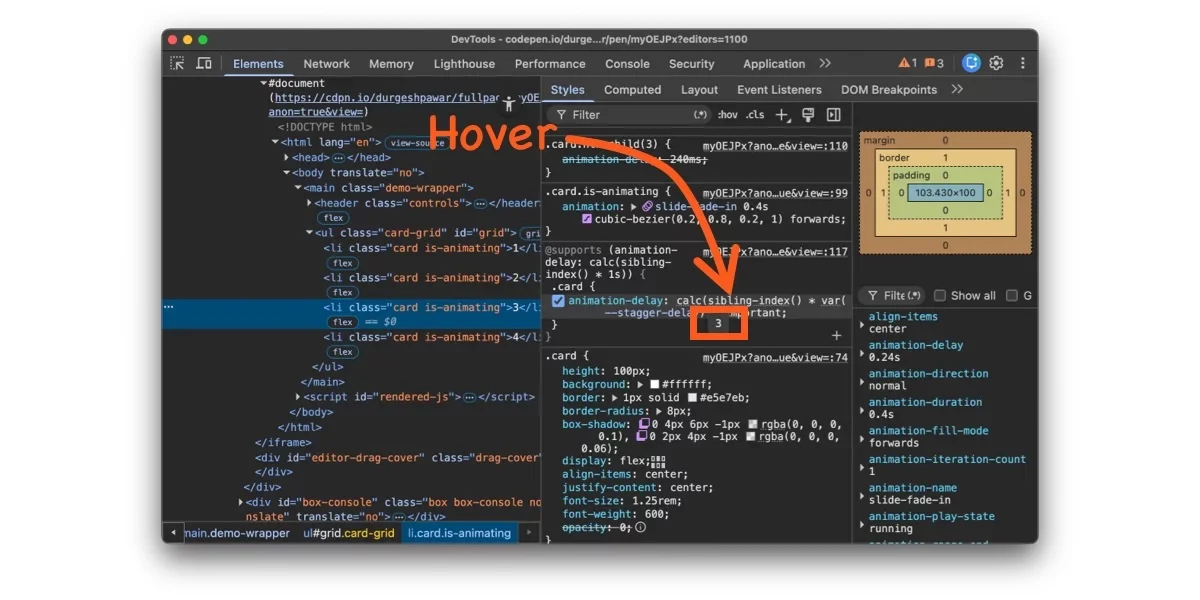
  animation-delay: calc(sibling-index() * 100ms);
Chronology and Specification Development
The path to native tree-counting in CSS spans several years of technical discourse within the World Wide Web Consortium (W3C):
- December 2019 (W3C CSSWG Issue #4559): The foundational proposal for tree-counting functions was formally introduced to the CSS Working Group, sparking extensive debate regarding browser rendering performance, scoping rules, and DOM interactions.
- Specification Evolution: The proposal was codified into the CSS Values and Units Module Level 5 working draft (specifically Section 9: Tree-Counting Functions), with engineers like Roman Komarov pioneering early, complex $O(sqrtN)$ selector strategies as interim solutions.
- June 2025 (Browser Engine Implementations): Stability arrived as Chrome and Edge (v138) officially shipped support in production releases, quickly followed by WebKit implementation in Safari 26.2.
- Current Status: As of late 2025, Firefox has logged a positive standards position with active implementation tracking under Bugzilla issue #1953973, bringing the feature closer to a universal Baseline status.
Supporting Data and Practical Patterns
Once recognized as pure integers, sibling-index() and sibling-count() unlock a wide array of advanced layout patterns that previously demanded complex preprocessor loops or DOM manipulation.
1. Reverse Staggered Animations
To make the final item in a list animate instantly while earlier items follow a reverse cascade, developers can use algebraic subtraction:
.card
  animation: fade-in 0.4s ease both;
  animation-delay: calc((sibling-count() - sibling-index()) * 80ms);
Here, the last child evaluates to (N - N) * 80ms = 0ms, firing immediately, while the first child initiates after an offset of (N - 1) * 80ms.
2. Automatic Equal Widths
Hardcoding percentage widths for dynamic tab components or button groups is no longer necessary:
.tab
  width: calc(100% / sibling-count());
If a navigation bar scales from four tabs to five, or drops down to three, the layout updates instantly without media queries or resize observers.
3. Algorithmic Color Distribution and Radial Layouts
Design systems can leverage tree-counting to distribute color swatches harmoniously across the hue spectrum:
.swatch
  background-color: hsl(
    calc((360deg / sibling-count()) * sibling-index()) 70% 50%
  );
Combined with native CSS trigonometric functions (sin() and cos()), these functions also eliminate the need for JavaScript coordinate calculations when rendering circular or radial menus:
.radial-item
  --angle: calc((360deg / sibling-count()) * sibling-index());
  --radius: 120px;

  position: absolute;
  left: calc(50% + var(--radius) * cos(var(--angle)));
  top: calc(50% + var(--radius) * sin(var(--angle)));
  transform: rotate(calc(var(--angle) * -1));
Official Responses and Edge Cases
While developer reception has been overwhelmingly enthusiastic, standards bodies and browser vendors have established strict boundaries to maintain security and rendering integrity.
Shadow DOM Scoping and Security
Web Components introduce complex scoping boundaries. sibling-index() evaluates strictly against the local DOM tree rather than the flattened visual tree. Inside a Shadow DOM, an internal helper element will count its direct shadow peers, ignoring any projected light DOM children via <slot>. Furthermore, if an external stylesheet attempts to probe component internals via ::part(), the browser deliberately returns 0 to prevent third-party scripts from inspecting encapsulated component structures.
The display: none Pitfall
A critical nuance involves hidden elements. Because tree-counting functions read the DOM tree rather than the visual layout tree, elements styled with display: none are still counted:

<ul>
  <li>Apple</li>                 <!-- sibling-index() = 1 -->
  <li style="display:none">Banana</li> <!-- sibling-index() = 2 (Hidden) -->
  <li>Cherry</li>              <!-- sibling-index() = 3 (NOT 2) -->
</ul>
For dynamic search filters that toggle visibility via display: none, developers must remove non-matching nodes from the DOM entirely to prevent unintended visual gaps in staggered animations or radial layouts.
Implications for Modern Web Architecture
The advent of native tree-counting carries profound implications for performance, progressive enhancement, and accessibility:
Performance at Scale
By shifting index calculations from JavaScript runtime loops to the browser’s native cascade phase, CPU overhead is significantly reduced. However, developers must exercise caution: inserting an element at the beginning of a massive container with 10,000 children forces the rendering engine to recalculate indices for all subsequent siblings. For high-frequency data feeds or infinite-scroll grids, virtualized JavaScript windowing remains necessary.
Progressive Enhancement
Because Firefox adoption is still pending, production environments require robust fallback strategies utilizing @supports:
/* Baseline fallback for unsupported browsers */
.item
  width: 25%;
  animation-delay: 0ms;


/* Progressive enhancement for modern engines */
@supports (z-index: sibling-index())
  .item
    width: calc(100% / sibling-count());
    animation-delay: calc(sibling-index() * 80ms);
Accessibility Considerations
A vital warning for accessibility engineers: these functions are purely visual. Utilizing sibling-index() mathematics to visually reorder elements via CSS grid or order properties creates a dangerous disconnect between visual layout and semantic source order. Screen readers and keyboard navigation follow the DOM tree, meaning asynchronous visual reordering without corresponding updates to ARIA attributes (aria-posinset and aria-setsize) results in a fractured experience for assistive technology users.
Future Horizons
Looking ahead, the CSS Working Group has already documented potential extensions, such as the of <selector> argument (e.g., sibling-index(of .active)), which would allow developers to count only siblings matching specific criteria. Proposals for children-count() and descendant-count() are also under discussion, promising an era where the structural relationship between parent, child, and sibling elements is entirely manageable through pure, declarative CSS.
 Iffa Jayyana
 Azzam Bilal Chamdy
 Nila Kartika Wati
