
 By Nana Wu
By Smashing Editorial
Executive Summary & Main Facts
For the past several years, corporate leadership across nearly every sector has operated under a monolithic assumption: that humanity is collectively pining for more artificial intelligence in daily life. From boardrooms in Silicon Valley to traditional financial institutions in London, executives have presumed that consumers and employees are desperate for new AI features, AI-native workflows, and revolutionary AI products designed to replace legacy systems.
However, a massive discrepancy has emerged between executive ambition and ground-level reality. Data from user experience research, productivity tracking, and industry adoption metrics reveal a striking truth: people do not want more AI. At least, they do not want it packaged the way tech visionaries envision.
Instead of generating excitement, uninvited AI integrations frequently result in low adoption rates, high delivery costs, reputational damage, and profound worker anxiety. Rather than lightening workloads, modern AI implementations often amplify internal organizational flaws, create tedious error-checking loops, and industrialize workplace burnout.
Chronology of the AI Push: From Hype to Workplace Friction
Phase 1: The "AI-First" Mandate (2022–2024)
Following the explosive public debut of generative AI models, companies rushed to rebrand. Every software suite, customer relationship management tool, and mobile app hastily introduced chat boxes, predictive writing assistants, and generative features. "Powered by AI" became the default value proposition across global tech markets. During this period, speed-to-market trumped usability, and executive strategies treated AI as an automatic solution for operational stagnation.
Phase 2: The Integration Backlash and Productivity Paradox (2025–Present)
As these features settled into daily workflows, empirical studies began to challenge the utopian productivity narrative. Rather than streamlining operations, studies tracking workplace habits revealed unexpected trends: email volumes surged, reliance on internal messaging platforms skyrocketed, and weekend work hours increased as employees scrambled to clean up, verify, and correct AI-generated content.
Organizations realized that introducing standalone AI tools without fixing fundamental data quality or technical debt only created a chaotic new layer of administrative overhead.
Supporting Data & Empirical Insights
Recent productivity studies paint a stark picture of how AI is actually altering modern labor. Far from eliminating work, AI often intensifies it.

Key metrics highlighting the hidden toll of mandatory AI adoption include:
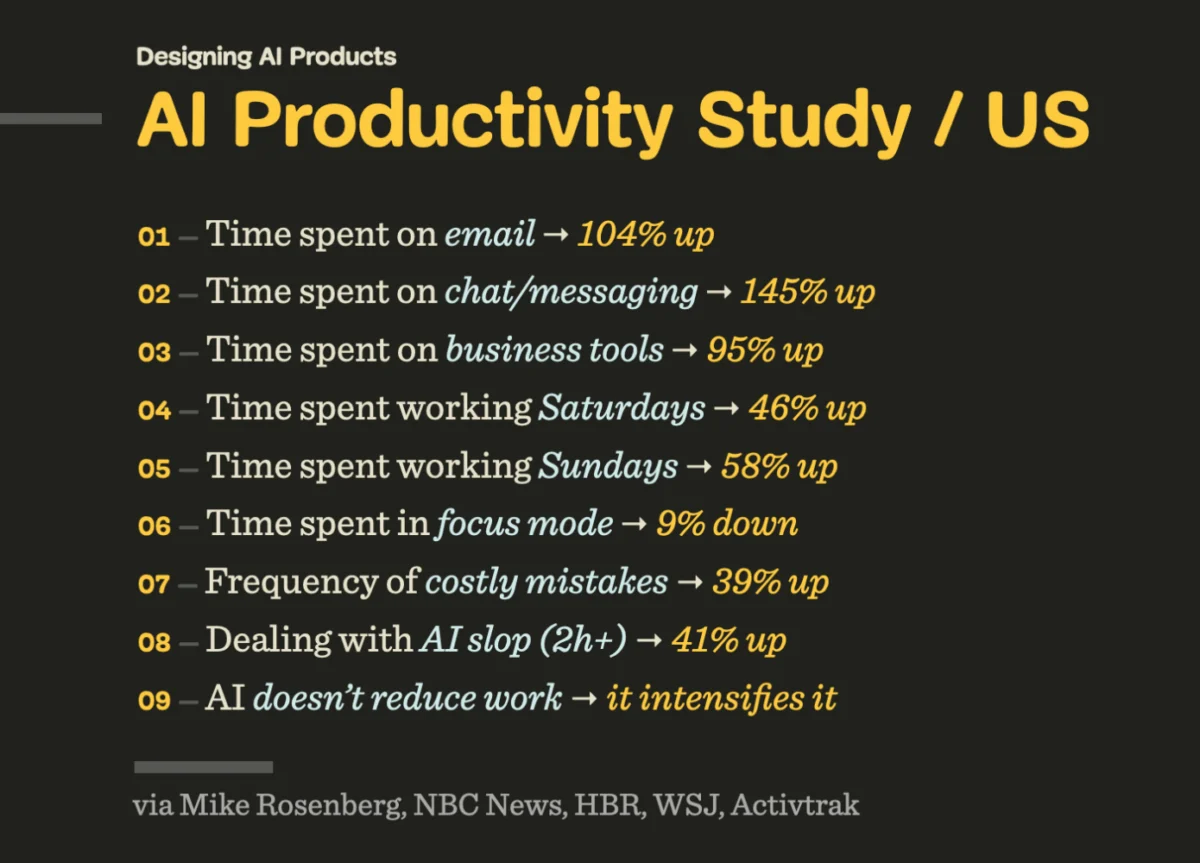
- Surge in Digital Communication: Email handling time rose by 104%, while chat and messaging tool usage jumped by 145%.
- Expanded Work Weeks: Weekend labor saw a dramatic increase, with Saturday working hours up 46% and Sunday hours up 58%.
- Erosion of Focus: Deep-focus mode metrics dropped by 9%, reflecting an increasingly fragmented workday.
- The Cost of "AI Slop": Dealing with poorly filtered AI outputs and correcting costly mistakes rose by 39% to 41%.
Furthermore, data from organizational studies emphasize that AI is fundamentally a tool rather than a value proposition. As UX experts frequently note, users do not evaluate software by comparing it to the fallibility of human beings; they compare software features directly against other software features. If a traditional, deterministic feature works reliably every single time, while an AI-powered alternative introduces hallucinations and unpredictability, users will consistently reject the AI option.
Official Responses and Industry Perspectives
The backlash against forced AI integration is prompting pushback from prominent industry thinkers, designers, and organizational leaders.
Bo Young Lee captured the collective sentiment regarding the boundaries of AI deployment with a viral statement:

"I don’t want to read books written by AI. I don’t want to gaze upon paintings by AI. I don’t want AI to teach my children. I don’t want to have an AI therapist. I don’t want AI making my medical decisions. I want AI to do all the physical and mental labor that taxes me so I can read books written by humans and go to art galleries to engage with art made by humans. I want AI that makes my life easier rather than forces me to change myself."
This perspective highlights a fundamental design philosophy failure: forcing users to adapt their cognitive models to accommodate unpredictable algorithms, rather than building technology that respects human workflows.
UX design veterans, including Vitaly Friedman (creator of Design Patterns For AI Interfaces), argue that corporations must fundamentally rethink interface design. Instead of building disruptive, high-profile "AI-first" ecosystems that demand constant human supervision, developers should strive for "AI-second" interfaces—subtle, humble, calm, and ambient systems that operate quietly in the background.
Implications for the Future of Work and UX Design
1. AI Belongs in Key Activities, Not Value Propositions
As business model strategists point out, AI belongs under "Key Activities" and "Key Resources," not on the customer-facing "Value Proposition" line. Customers do not pay for the underlying technology; they pay for outcomes—speed, reliability, accessibility, and ease of use.

2. The Danger of Exposing Organizational Debt
AI acts as an amplifier of corporate shortcomings. If an organization suffers from fragmented data, unclear communication, or broken internal politics, introducing an AI layer will not fix those structural flaws. Instead, it will ingest the dysfunction, scale it up, and hand the resulting mess directly to the end user.
3. Redefining Automation: The "AI-Second" Paradigm
The future of successful software design relies on understanding what humans actually want. People do not dream of managing swarms of autonomous AI agents in their bank accounts, nor do they want conversational chat boxes injected into every corner of their digital existence.
Instead, users want automation that:
- Eliminates Drudgery: Takes over tedious, repetitive, mentally exhausting tasks that bring zero professional fulfillment.
- Respects Mental Models: Aligns seamlessly with intuitive workflows developed over years of professional practice.
- Guarantees Reliability: Provides consistent, predictable performance without the hidden tax of constant hallucination checking.
Wrapping Up: Designing for Humans
Ultimately, the friction surrounding artificial intelligence is not rooted in a generalized technophobia. It is driven by exhaustion. People like human stories, human emotions, and human connections.

The mandate for product designers and corporate leaders moving forward is clear: stop treating AI as a magical buzzword designed to inflate valuation metrics. Instead, use technology responsibly to strip away the boring, repetitive noise of daily labor, leaving individuals with the time, headspace, and energy to focus on what truly matters—working, creating, and living alongside other humans.
Meet "Design Patterns For AI Interfaces"
To help product teams navigate this transition, UX expert Vitaly Friedman has released Design Patterns For AI Interfaces, a comprehensive video course featuring practical design patterns extracted from real-life software products. To explore practical guidelines on building calm, user-centered AI applications, check out the course resources or join upcoming live UX training sessions.
 Iffa Jayyana
 Azzam Bilal Chamdy
 Nila Kartika Wati
