
 By Pevita Pearce
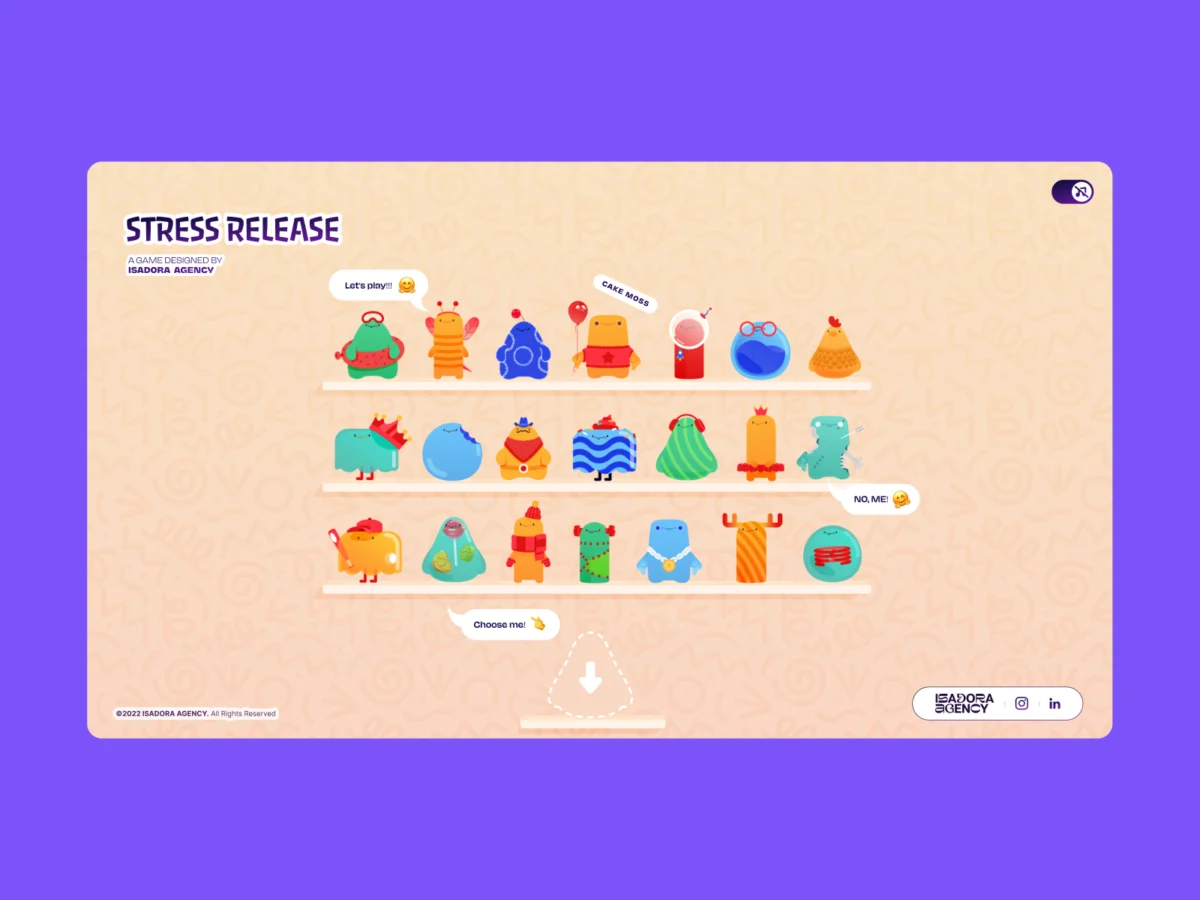
In the modern landscape of front-end web development, creating a tactile, bouncy, or destructive digital interface usually triggers an automatic industry reflex: reach for a physics engine. Frameworks like Matter.js, Cannon.js, or bespoke WebGL solutions have long held the crown as the gold standard for immersive, gamified web experiences. They offer ready-made simulations of gravity, friction, and elastic collisions, making it easy to drop objects onto a canvas and let algorithms handle the chaos.
However, when the creative engineering team at Isadora Agency set out to build Stress Release—a digital stress-relief squeeze toy designed for burnt-out creatives to smash, stretch, and distort animated UI characters—they quickly realized that algorithmic physics were entirely wrong for the job.
Instead of relying on WebGL or heavy physics simulations, the development team engineered a real-time, highly responsive experience relying entirely on programmatic Lottie state controls, standard DOM manipulation, and distance-based mathematics. In doing so, they proved a vital architectural lesson: when building heavily interactive web applications, the underlying technology must serve the art direction, not override it.
Main Facts: Architecture Over Physics
The core challenge behind Stress Release was a conflict between simulated motion and handcrafted art. Physics engines are designed to produce plausible motion—calculating how a generic rubber ball might bounce, deform, or roll across a canvas based on mass and velocity. But Isadora Agency’s animators had produced something entirely different: intentional motion.
The team’s designers had meticulously crafted bespoke .json Lottie files featuring exact, frame-by-frame sequences. For instance, a signature "mega squeeze" reaction required a precise 181-frame build-up followed by a meticulously timed release sequence. Algorithmic approximations generated by a physics engine would have instantly flattened or distorted these carefully tuned keyframes.
To maintain absolute deterministic control, the developers bypassed WebGL entirely. By combining Lottie’s native timeline API with standard DOM elements and simple trigonometric math, they preserved the exact visual intent of their animators while delivering a snappy, tactile user experience.
Chronology: From Physics Experimentation to Pure DOM Control
Phase 1: The Initial Exploration and Realization
When development on Stress Release began, the team naturally gravitated toward conventional physics libraries. The primary design goal was clear: build a highly tactile experience where every user click yielded an immediate, satisfying, and squishy reaction.
As early prototypes took shape, however, a critical flaw emerged. The physics engines were making the characters act like unpredictable rubber balls bouncing uncontrollably across the canvas. The motion felt chaotic rather than expressive. The team realized that they did not want generalized realism; they wanted specific, character-driven reactions. Consequently, the physics engines were scrapped entirely in favor of a hybrid DOM-and-Lottie pipeline.

Phase 2: Mapping Radial Input to the DOM
Because the application was built on standard DOM elements and Lottie runtimes (which render vector animations internally as SVGs), elements could be targeted directly via IDs and CSS classes.
To create the sensation of a physical impact when a user clicked a character, the team implemented radial input mapping. Every click event was translated from page coordinates into the character’s local coordinate space. By measuring the click against the character’s exact center point using the Pythagorean theorem (Math.hypot), the developers calculated a precise straight-line distance from the impact point.
// Character's center point in its own coordinate space
var x_center = parseFloat($("#playChar").width()  / 2);
var y_center = parseFloat($("#playChar").height() / 2);

// Click position relative to the character's top-left corner
var offset = $("#playChar").offset();
var X = parseFloat(e.pageX - offset.left);
var Y = parseFloat(e.pageY - offset.top);

// Vector from center to click point
var a = parseFloat(X - x_center);
var b = parseFloat(Y - y_center);

// Calculate straight-line distance
var distance = Math.hypot(a, b);
This single distance metric drove three critical game variables simultaneously: the point reward (functioning like a dartboard with concentric scoring rings), the feedback intensity, and the exact placement of an explosion/distortion Lottie animation. By dynamically updating the margin coordinates of the explosion asset to match the click vector (a and b), the application created an unshakeable illusion of spatial accuracy.
Phase 3: Programmatic State Control and Narrative Handling
With input coordinates resolved, the team turned to interaction handling. Rather than calculating forces, the application relied on pre-defined animation segments mapped to frame ranges:

const play_segments = [
  charId: 0,
  sections:
    idle:     [0,  40],   // looping idle state
    squeeze1: [41, 80],   // light reaction
    squeeze2: [81, 120],  // medium reaction
    squeeze3: [121, 160], // heavy reaction
  ,
  playOrder: ["squeeze1", "squeeze2", "squeeze3"],
  endAnimation: [161, 200]
];
When a user clicked a character, the application halted the current segment immediately, locked out further clicks to prevent state conflicts, and forced Lottie to jump directly to the target frame range. Once the sequence completed, native event callbacks (onComplete) safely unlocked the interaction layer and returned the character to its looping idle state.
Supporting Data: Performance Optimization Under Lottie’s Weight
While avoiding WebGL kept the rendering pipeline clean and deterministic, it introduced a significant engineering hurdle: file size and performance overhead.
Lottie JSON files can be notoriously heavy, especially when dealing with complex vector paths. Stress Release featured 21 unique character animations, alongside multiple explosion variants that needed to load seamlessly. On a mobile device, attempting to render multiple high-fidelity Lottie instances simultaneously would quickly lead to dropped frames and severe battery drain.
To combat this, Isadora Agency implemented aggressive performance optimization strategies:

- Tiered Quality Settings: On the character selection shelf—where 21 distinct animations played simultaneously—the team instantiated Lottie with reduced visual quality and frame rates.
shelf = lottie.loadAnimation( container: document.getElementById("charShelf" + i), renderer: "svg", loop: true, autoplay: true, path: "assets/shelf/" + shelfFolders[i] + "/" + shelfFolders[i] + ".json", ); lottie.setQuality(0.5); // 50% quality - reduces interpolation calculations shelf.setSpeed(0.6); // 60% speed - fewer frame calculations per second - Dedicated Focus Scaling: When a user selected a single character to interact with, the application destroyed or idled background animations and allocated full processing power to the active asset.
playChar = lottie.loadAnimation( container: document.getElementById("playChar"), renderer: "svg", loop: true, autoplay: true, path: chosenChar.url, ); lottie.setQuality(1); // full quality for the active focus object - CSS-Driven Responsiveness: By managing layout sizing via CSS custom properties (
--doc-heightand--doc-width) tied to window resize listeners, the DOM elements scaled fluidly without requiring expensive recalculations of canvas bounding boxes or collision meshes.
Official Perspectives and Technical Rationale
Reflecting on the architecture behind the project, the engineering consensus at Isadora Agency highlights a vital principle for modern web creators: tech stack choices must always be subordinated to creative intent.
Alexey Kopytin, speaking on the structural rationale of the project, emphasized that developers often fall into the trap of using complex tools simply because they are industry standards. "When your interactions require bespoke, highly controlled visual reactions," Kopytin notes, "opting for programmatic state control over emergent simulation empowers animators to dictate the exact feel of the experience."
Instead of forcing designers to compromise their vision to fit the limitations or unpredictable nature of a physics engine, the engineering team built a bridge between math and art. The code’s sole responsibility became listening for user inputs, calculating straightforward geometric distances, and triggering handcrafted sequences with absolute precision.
Broader Implications for Web Animation and Tactile UX
The success of Stress Release offers a compelling blueprint for UI/UX engineers building highly gamified or brand-forward web experiences. As web applications increasingly lean toward playful, tactile interfaces to combat digital fatigue, the tension between performance, interactivity, and design fidelity will only grow.

Key takeaways from Isadora Agency’s architectural approach include:
- Determinism vs. Emergence: Physics engines excel at realism, but storytelling and brand identity often demand absolute predictability. Programmatic frame-range control ensures that a user’s interaction yields the exact emotional and visual response intended by the designer every single time.
- Leveraging the DOM for Scale: Bypassing canvas-heavy solutions in favor of DOM-managed SVG elements simplifies responsive design. Utilizing CSS custom properties allows UI components to adapt effortlessly across desktop and mobile form factors without complex coordinate remapping layers.
- Pragmatic Optimization: Heavy vector animations like Lottie files are viable at scale only if developers actively manage rendering quality, execution speed, and memory cleanup based on what is actively visible to the user.
Ultimately, by mapping Lottie’s native timeline capabilities directly to DOM events and trigonometric positioning, developers can deliver rich, deeply satisfying tactile experiences without bloating their applications with unnecessary WebGL runtimes. As digital experiences become more expressive, respecting the artist’s frame-by-frame intent may well become the ultimate hallmark of elite front-end engineering.
 Azzam Bilal Chamdy
 Nila Kartika Wati
 Evan Lee Salim
