
 By Nana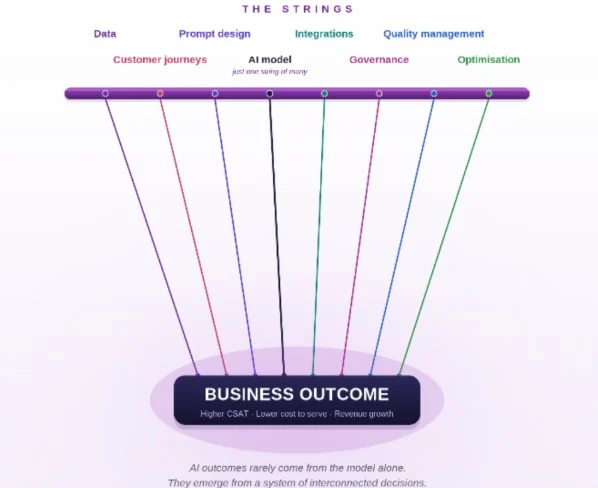
Generative AI has officially transitioned from the sandbox of experimentation into the boardroom of value creation. However, as organizations pivot toward measurable business impact, a critical realization is emerging: the bottleneck to success is rarely the model itself—it is the ecosystem of execution. Claire Butcher, AI Solutions Consultant at Sabio Group, unpacks why shifting from "AI-first" to "outcome-first" is the only path to enterprise-scale ROI.
The Great Divide: Innovation vs. Implementation
The promise of Generative AI (GenAI) is no longer a theoretical exercise. According to Google Cloud’s ROI of AI 2025 report, the gap between early adopters and the rest of the market is widening. Roughly 88% of organizations that have embraced "agentic" AI—systems capable of performing tasks autonomously—report a tangible return on investment (ROI) from at least one use case. In contrast, that figure drops to 74% across the broader market.
Despite these optimistic metrics, a more sobering reality persists. Research from industry titans including Deloitte and McKinsey highlights a persistent "value trap": many organizations are struggling to convert high-performing pilots into enterprise-scale outcomes.
For years, when AI was confined to experimental labs, accountability was largely academic. It was about "learning" and "testing." Today, the conversation has shifted. When executives are asked to justify budgets based on revenue growth, cost reduction, and operational efficiency, accountability becomes strictly commercial. The question is no longer "How does this model work?" but "Why did this specific outcome occur—or fail to occur?"
AI Does Not Deliver Outcomes; Systems Do
The fundamental misunderstanding in the current AI gold rush is the belief that the model is the "brain" that solves all problems. In reality, businesses do not invest in AI for the sake of the technology; they invest because they require a transformation in performance—lower costs to serve, enhanced customer experience (CX), higher containment rates, and rapid issue resolution.

These outcomes are rarely the result of a single Large Language Model (LLM). Instead, they emerge from a complex "web of strings":
- Data Integrity: The quality of the information the AI consumes.
- System Integration: How seamlessly the AI talks to CRM, ERP, and case management tools.
- Workflow Orchestration: The logic that governs the AI’s behavior.
- Continuous Optimization: The iterative feedback loop that turns yesterday’s conversations into tomorrow’s improved service.
If we view these components as strings, an enterprise AI project is a marionette. In many commercial setups, these strings are held by different entities: the customer, the technology vendor, the system integrator, and the managed service provider. The outcome is not determined by the model alone, but by how effectively those strings are pulled in unison. Whoever holds the most strings—and has the most influence over these variables—ultimately dictates the success of the initiative.
Chronology of the Shift: From Experimentation to Execution
To understand where the market is headed, one must look at how the perception of AI has evolved over the last 24 months:
- The "Shiny Object" Phase (2023–2024): Organizations prioritized access to models. The focus was on "GPT versus Gemini" and "open-source versus proprietary." The goal was simply to show progress.
- The Reality Check (Early 2025): CFOs and COOs began demanding clear KPIs. The focus shifted from model capabilities to "Time to Value" and "Total Cost of Ownership."
- The Era of Accountability (Late 2025–Present): The market is now entering a phase where the "Consultancy-Delivery-Management" triad is being re-evaluated. Businesses are moving toward outcome-based models where the service provider shares the risk and the reward.
Supporting Data: Why Influence Equals Accountability
The principle of "accountability following influence" is becoming the gold standard for vendor management. If an advisory partner dictates the strategy, they must stand behind the ROI of that strategy. If a delivery partner implements the tech, they are accountable for its technical efficacy. If a managed service provider runs the operation, they are accountable for the performance metrics.
The data suggests that the highest performing organizations are those that remove the friction between these parties. In a contact center, for example, the AI’s ability to resolve a customer’s query depends on the knowledge base (the data), the API connections (the integration), and the prompt engineering (the tuning).
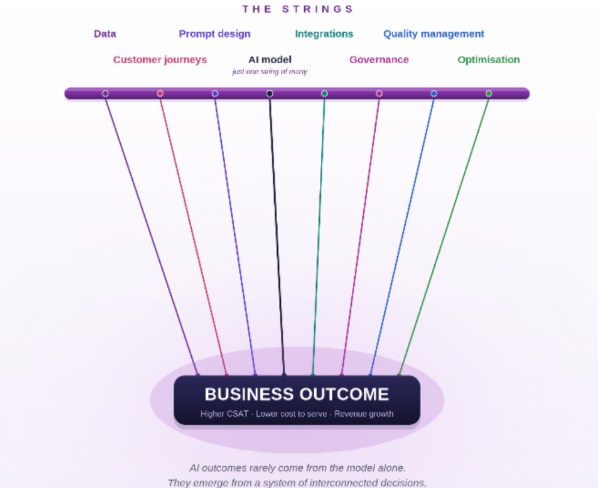
Research indicates that "pulling the string" on prompt optimization or knowledge management often yields a higher, more immediate ROI than swapping one frontier model for another. Organizations that recognize this spend less time obsessing over the "brain" and more time optimizing the "body" of the system.
Official Perspectives: The Freedom to Succeed
"An AI agent is not a ‘set and forget’ tool," explains Claire Butcher. "Its performance is a direct result of constant tuning. It learns from real-world conversations and requires frequent adjustments to journeys. Because of this, the commercial model depends on two variables: the customer’s willingness to grant us the freedom to tune the agent, and their willingness to collaborate at the speed that optimization demands."
This creates a dichotomy in the market:
- The Low-Freedom Model: If a client requires a slow, bureaucratic sign-off process for every minute change, the supplier cannot be held accountable for the outcome. In this scenario, a traditional fee-for-service model is the only honest, viable approach.
- The High-Freedom Model: Where a customer trusts a partner to continuously tune the system and iterate in real-time, the partner can effectively "own" the result. This is where outcome-based, "pay-for-results" models become not just possible, but the most logical way to align incentives.
Implications for Future Strategy
As organizations look to 2026 and beyond, the competitive advantage will go to those who treat AI as an operational, rather than a technical, challenge. The bottleneck is no longer access to frontier models—that is a commodity. The bottleneck is execution.
The Three Pillars of Execution:
- Clearly Defined Problems: Stop asking "What can AI do?" and start asking "What specific customer pain point are we solving?"
- Agreed, Measurable Goals: Ensure both the client and the provider have the same definition of success.
- The Freedom to Act: Grant the teams responsible for the outcomes the autonomy to iterate, optimize, and pivot without unnecessary administrative friction.
Conclusion: Who Holds the Strings?
The shift toward outcome-based AI is a maturity milestone. It signals that an organization has moved past the phase of "magical thinking" and is ready to treat AI as a robust, industrial-strength business asset.
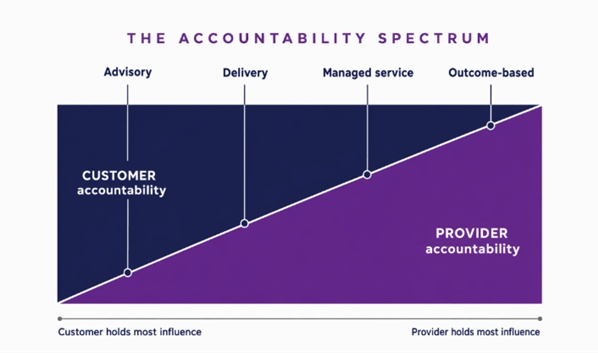
Before committing to the next phase of your AI roadmap, conduct a "string audit." Map out the variables that define your project—the data, the integrations, the journey design, and the governance—and identify exactly who holds each string. If you find that the people responsible for the outcome lack the authority to change the system, you have identified your primary risk.
As the industry converges on these new standards of accountability, Sabio Group remains committed to the principle that if a partner controls the outcome, they should be willing to stand behind it. Whether through advisory, delivery, or full-scale managed services, the focus must remain on the outcome, not just the code.
To explore these concepts in greater detail, join the upcoming AI Business Consultancy Day, hosted by Sabio Group in Manchester on Tuesday, September 15th. This event will provide a forum for leaders to discuss the transition from AI experimentation to sustainable, outcome-based success.
 Dwi Wanna
  Lina Irawan