
 By Raul Delapena Setiawan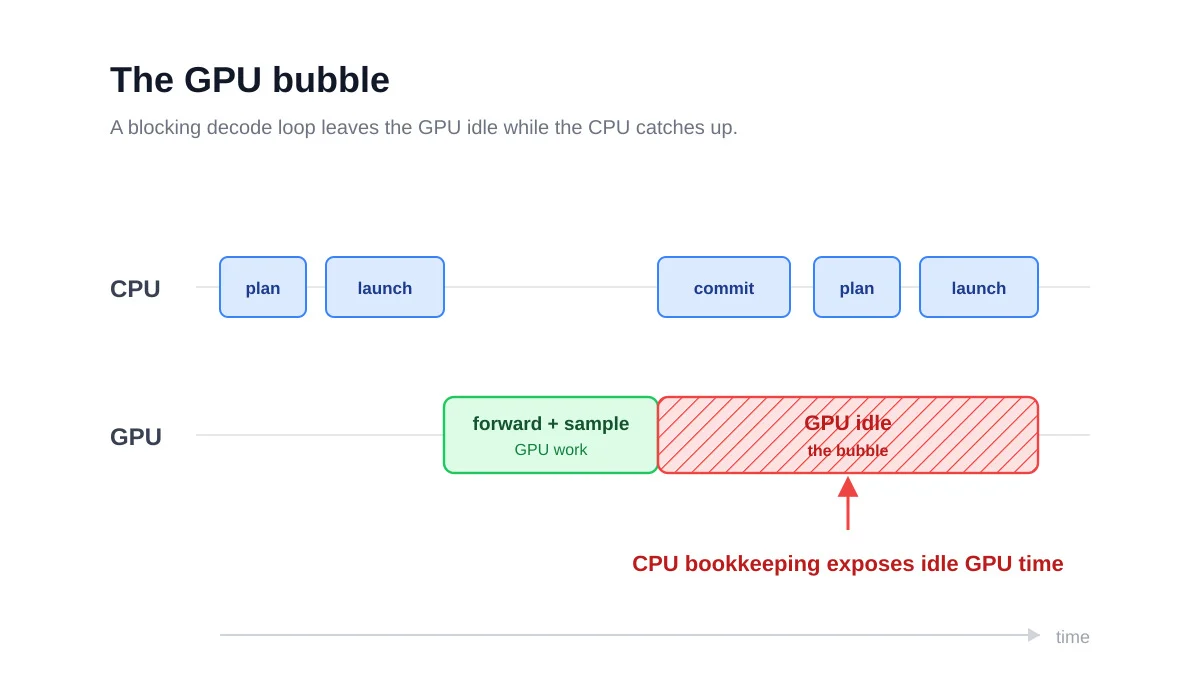
June 4, 2026 — In the high-stakes arena of Vision-Language Model (VLM) deployment, every millisecond is a competitive advantage. Today, Moondream Engineering announced a breakthrough in inference performance with its proprietary engine, "Photon." By re-engineering the fundamental handshake between the Central Processing Unit (CPU) and the Graphics Processing Unit (GPU), Photon has achieved near-realtime inference speeds—clocking in at approximately 33ms on NVIDIA’s flagship B200 hardware. This technical leap, which delivers up to 35% higher decode throughput, marks a significant milestone in AI infrastructure efficiency.
The Main Facts: Defining the "GPU Bubble"
To the uninitiated, running an AI model appears straightforward: the CPU sends instructions, the GPU crunches the math, and the answer is returned. However, Moondream’s engineering team has identified that this linear approach is inherently flawed.
In standard inference environments, the GPU frequently sits idle. This is not due to a lack of computational work, but rather a scheduling lag known as a "GPU bubble." When a model generates text, it does so autoregressively, producing one token at a time. Each subsequent token depends on the previous one, forcing a rigid, sequential "baton pass" between the CPU and GPU.
While the GPU performs billions of arithmetic operations per token, the CPU must perform critical housekeeping: selecting the next request, preparing metadata, picking the output token, and managing the stream. Because the time required for a single token’s worth of GPU work is small, the CPU’s fixed-cost housekeeping tasks become a massive bottleneck. The GPU is forced to wait for the CPU to finish its tasks before it can begin the next calculation, resulting in the "bubble" that limits overall throughput.
Chronology: The Evolution of Pipelined Decoding
The development of Photon was driven by a single, obsessive question: How can we make AI models run as fast as humanly possible?
The Blocking Model
Initially, Moondream utilized a "blocking" architecture. In this setup, every step was a strictly synchronized event. The CPU would plan a forward pass, the GPU would execute it, and the system would then pause to synchronize. Only after the CPU had processed the results and committed them to memory would it launch the next step. This "stop-and-start" methodology wasted precious milliseconds on every single token generated.
The Pipelined Shift
Moondream’s engineers realized that the solution lay in "pipelined decoding." By overlapping work, the team discovered they could launch the next GPU forward pass while the CPU was still finalizing the previous token’s housekeeping.
This required a fundamental shift in memory management. Because the token sampled at step t does not strictly need to leave the GPU immediately for the next step to begin, the team architected a system where the GPU reads the token directly from its own memory for the next calculation. The CPU’s bookkeeping—such as detokenization and streaming—happens in the background, effectively hiding the bubble.
Technical Mechanisms: How Photon Works
To make this pipelining safe and reliable, Moondream implemented three core architectural mechanisms:
1. Ping-Pong Slots
To avoid overwriting results while the CPU is still reading them, Photon utilizes "ping-pong slots." By keeping two distinct working sets of buffers, the system alternates between them. While the GPU writes to one slot, the CPU reads from the other. This ensures that the GPU is never stalled by the CPU’s memory access, and it eliminates the need for expensive, runtime GPU memory allocations that would otherwise disrupt performance.
2. Forward Now, Sample Later
In constrained decoding scenarios—where the model is forced to output specific formats like coordinates or bounding boxes—the sampling mask depends on the previous token. Photon circumvents this by separating the "forward" pass from the "sampling" phase. The next forward pass is launched before the previous sampling commit is finished, ensuring the GPU remains perpetually active.
3. Zombie Management
A unique challenge occurs when a request finishes mid-flight, but its forward pass has already been queued. Photon treats these finished requests as "zombies." Instead of building complex cancellation logic, the system allows the zombie sequence to remain in the pipeline until the next commit. It effectively "rides along" without consuming meaningful resources, then is cleaned up only once all references to it are cleared. This elegant refcounting approach removes the need for high-overhead, real-time batch modification.
Supporting Data and Benchmarks
The efficiency gains of Photon are most pronounced on high-end hardware like the NVIDIA B200. Moondream’s internal benchmarks demonstrate a consistent reduction in GPU idle time, bringing it to under 0.05ms per step.
| Hardware/Stream | Blocking (ms) | Pipelined (ms) | Throughput Gain |
|---|---|---|---|
| 3090 (1 stream) | 5.44 | 5.10 | +6.5% |
| 3090 (32 streams) | 11.74 | 10.52 | +11.6% |
| B200 (1 stream) | 3.11 | 2.63 | +17.6% |
| B200 (32 streams) | 5.55 | 3.98 | +35.4% |
As the data shows, the performance gains are multiplicative. As the hardware becomes faster and the batch sizes larger, the "bubble" becomes a more significant percentage of the total processing time, making Photon’s pipelining increasingly valuable.
Official Perspective: The Moondream Philosophy
In a statement accompanying the release, the Moondream Engineering team emphasized that there is no "silver bullet" for inference speed. "Photon isn’t fast because of this one technique," the team noted in their technical blog. "It is fast because dozens of details compound across the serving stack—from image tiling to kernel optimization and synchronization removal."
The team remains committed to the principle that performance is found in the "corners of the stack." By scrutinizing the interactions between software scheduling and hardware execution, they have demonstrated that even mature hardware like the NVIDIA B200 can be pushed beyond its conventional limits through intelligent software architecture.
Implications for the AI Industry
The implications of the Photon engine are twofold:
- Lower Latency for Real-Time Applications: By shaving off 35% of the overhead in high-concurrency environments, Photon allows for significantly more responsive AI assistants, particularly those requiring complex vision-based tasks like spatial reasoning and object detection.
- Infrastructure Efficiency: For large-scale service providers, a 35% increase in throughput translates to a direct reduction in the total cost of ownership (TCO) for GPU clusters. Being able to serve 35% more requests on the same hardware without sacrificing quality is a game-changer for the economics of AI scaling.
As Moondream looks toward the future, the industry is already anticipating "Photon 2.0." While details remain under wraps, the team has teased that the next iteration will be a significant upgrade. For now, the engineering community is analyzing the current breakthrough as a masterclass in low-level optimization, proving that in the race to AGI, the winners will be those who best manage the silent, invisible gaps in hardware performance.
 rifanmuazin
  Layla Zulfa
  Evan Lee Salim