
 By Nana
Technical search engine optimization (SEO) remains one of the most powerful levers for driving organic visibility, improving crawl efficiency, and ensuring search engines can accurately parse and index website content. However, the technical initiatives that offer the most transformative performance gains also carry the highest potential for catastrophic traffic loss.
When executing major structural changes—such as URL migrations, canonical tag updates, robots.txt modifications, and site-wide internal link restructures—the margin for error is razor-thin. A single misconfigured directive can inadvertently de-index thousands of revenue-generating pages or drain crawl budgets.
To succeed, modern digital marketing and engineering departments must treat technical SEO not as a mere checklist of diagnostic errors, but as a disciplined branch of product management. This requires balancing optimization opportunities against implementation risks, coordinating across multi-disciplinary teams, and establishing rigorous pre- and post-launch testing protocols.
Main Facts: The Structural Tension of Technical SEO
At its core, technical SEO focuses on optimizing a website’s infrastructure so search engine crawlers can efficiently discover, render, and index its pages. While content quality and backlink profiles dictate a site’s authority, technical SEO serves as the foundation. Without it, search engines may remain entirely unaware of a site’s high-quality content.
The fundamental challenge of technical SEO lies in its asymmetric risk-to-reward ratio:
+-----------------------------------------------------------------+
|                    THE TECHNICAL SEO MATRIX                      |
+-----------------------------------------------------------------+
| HIGH IMPACT / HIGH RISK         | LOW IMPACT / LOW RISK         |
| • Site Migrations               | • Meta Description Tuning     |
| • URL Restructuring             | • Title Tag Length Fixes      |
| • Canonical Tag Overhauls       | • Image Alt Text Updates      |
| • Robots.txt Modifications      | • Minor Schema Additions      |
+-----------------------------------------------------------------+
The Fallacy of Automated Auditing
Many organizations rely heavily on automated crawling tools to evaluate their site’s health. While these platforms are indispensable for identifying issues at scale, they lack business context. Automated reports treat all issues with similar mechanical urgency, often flagging minor, low-impact errors while failing to highlight systemic business risks.
For instance, an automated audit may flag hundreds of missing meta descriptions or slightly over-length title tags on non-priority, deep-archived pages. Fixing these might improve an arbitrary "site health score" in an SEO tool, but it yields virtually zero business value. Conversely, a subtle canonical loop on a core product template might escape basic automated filters while quietly eroding the organic revenue of an entire e-commerce enterprise.
The Necessity of Human Triaging
To prevent development teams from becoming overwhelmed by low-value tasks, technical SEOs must manually validate audit findings. Every recommendation must be filtered through a rigorous validation framework that considers:

- Priority Sections: Does the issue affect core, revenue-generating directory paths, or is it isolated to low-value, legacy pages?
- Technical Constraints: Is the flagged issue a deliberate workaround designed to bypass a platform limitation or legacy CMS restriction?
- True Business Impact: Will resolving this issue directly improve crawl budget, indexing accuracy, or organic rankings, or is it merely cosmetic?
Chronology: The Lifecycle of Technical Implementation
Successful technical SEO execution follows a structured, chronological pipeline. This lifecycle ensures that optimizations are thoroughly vetted, safely deployed, and continuously monitored to minimize risk.
+-----------------------------------------------------------------------------------------+
|                               TECHNICAL SEO LIFECYCLE                                   |
+-----------------------------------------------------------------------------------------+
|  1. Discovery &   -->  2. Triaging &   -->  3. Pre-Launch   -->  4. Deployment  -->  5. Ongoing  |
|     Validation         Prioritization       QA (Staging)         & Live QA       Monitoring |
+-----------------------------------------------------------------------------------------+
Phase 1: Discovery and Validation
The process begins with an exhaustive crawl of the live production environment using enterprise-grade crawling software, supplemented by log file analysis and search console diagnostics. The resulting raw data is manually analyzed to filter out false positives and isolate genuine structural issues.
Phase 2: Triaging and Prioritization
Once validated, recommendations are mapped against a priority matrix that weighs expected performance impact against development effort and operational risk. High-effort, high-risk tasks are separated from low-risk "quick wins." This phase culminates in the creation of detailed developer tickets containing clear acceptance criteria, visual examples, and affected URL lists.
Phase 3: Pre-Launch Quality Assurance (QA)
Before any code is deployed to the production environment, updates are pushed to a staging or development environment. SEO teams run simulated crawls of this non-production environment to verify that the implemented changes behave as intended. This is the critical gatekeeper phase where redirect loops, broken links, and accidental indexation blocks are caught before they reach search engine crawlers.
Phase 4: Deployment and Live QA
Upon successful validation in staging, the changes are deployed to the live production server. The SEO and engineering teams must coordinate to run immediate post-launch diagnostic tests. This involves crawling key page templates, validating server response codes, and testing canonical declarations in real-time.
Phase 5: Post-Launch Monitoring
The final phase involves ongoing, long-term monitoring. Using tools like Google Search Console, server log analyzers, and rank tracking software, SEOs monitor indexation status, crawl rates, and organic traffic over the subsequent days and weeks. This ensures that any delayed issues—such as crawl budget drops or indexing volatility—are caught and resolved early.
Supporting Data: Analyzing the Five High-Risk Technical SEO Pillars
Certain technical SEO initiatives carry a disproportionately high risk profile. Understanding the mechanics, potential points of failure, and mitigation strategies for these five core initiatives is essential for maintaining site stability.
1. URL Restructuring and Redirection Architectures
Migrating pages to new folder structures, consolidating content paths, or moving directories to subfolders is often necessary for site architecture optimization. However, because search engines treat every new URL as a completely unique page, changing a URL breaks the established relationship between that page and search engine indexes.

- The Risk: Missing or incorrect redirect mappings can instantly break organic rankings, sever backlink equity, and trigger a wave of 404 "Not Found" errors.
- Mitigation Strategy: Maintain a strict 1-to-1 redirect mapping spreadsheet. Implement permanent (301) redirects, avoid redirect chains (where URL A redirects to B, which redirects to C), and update all internal links to point directly to the final destination URL.
2. Canonical Tag Management
Canonical tags (rel="canonical") act as a directive to search engines, pointing them to the preferred, authoritative version of a page when duplicate or highly similar content exists. They are crucial for e-commerce sites that generate dynamic, parameter-driven URLs for filtering and sorting.
- The Risk: If a canonical tag is dynamically misconfigured on a page template, it can point thousands of unique pages to a single homepage or parent category. This instructs search engines to de-index those unique child pages, leading to a sudden and severe drop in organic visibility.
- Mitigation Strategy: Always use absolute URLs rather than relative paths in canonical tags. Thoroughly audit template-level canonical outputs across all page types, paying close attention to pagination and faceted navigation parameters.
3. Robots.txt File Modifications
The robots.txt file is the first document a search engine crawler requests when visiting a website. It dictates which directories and URL patterns crawlers are allowed to access.
- The Risk: A single typo or misplaced wildcard character (
*) in a robots.txt file can block search engine crawlers from accessing entire sections of a site—or even the entire domain. A common catastrophic error is accidentally deploying a staging robots.txt file (which often contains a universalDisallow: /directive) directly to the live production server. - Mitigation Strategy: Use robots.txt testing tools to validate syntax before deployment. Ensure that staging environments have strict access controls (such as IP whitelisting or basic authentication) rather than relying solely on robots.txt to prevent indexing.
4. Large-Scale Internal Link Restructuring
Internal links distribute PageRank (link equity) throughout a website, helping search engines discover deep pages and understand the contextual relationships between different topics.
- The Risk: Major changes to global navigation menus, footers, or contextual linking blocks can drastically alter how search engines crawl a site. Removing critical internal links can isolate pages, turning them into "orphaned pages" that search engines struggle to find and index.
- Mitigation Strategy: Prior to modifying global navigation, map out the internal link architecture. Ensure that high-priority, revenue-generating pages remain within three clicks of the homepage, and monitor crawl depth metrics during post-launch analysis.
5. Comprehensive Site Migrations
Site migrations—whether changing domains, rebranding, redesigning layouts, or transitioning to a new Content Management System (CMS)—are the most complex initiatives in technical SEO. They combine all four of the previously discussed risks into a single, high-stakes deployment.
- The Risk: With so many variables changing simultaneously, even minor configuration oversights can result in massive, long-term traffic declines that can take months to diagnose and correct.
- Mitigation Strategy: Establish a cross-functional migration task force with a dedicated project manager. Create a comprehensive, step-by-step checklist covering pre-launch, launch-day, and post-launch activities, and avoid launching major migrations during peak business seasons.
| Technical Initiative | Primary SEO Benefit | Implementation Risk Level | Key Metric to Monitor |
|---|---|---|---|
| URL Restructuring | Improved directory logic & user navigation | High | 404 error rates & redirect latency |
| Canonical Updates | Consolidates link equity; resolves duplicate content | Medium-High | Indexation status of target pages |
| Robots.txt Changes | Maximizes crawl budget efficiency | High | Crawl rate fluctuations in Search Console |
| Internal Link Overhaul | Optimizes PageRank distribution & discovery | Medium | Crawl depth & internal link count per page |
| Site Migration | Supports rebranding, CMS upgrades, or redesigns | Critical | Organic impressions & traffic retention |
Official Responses: Aligning Engineering, Product, and SEO
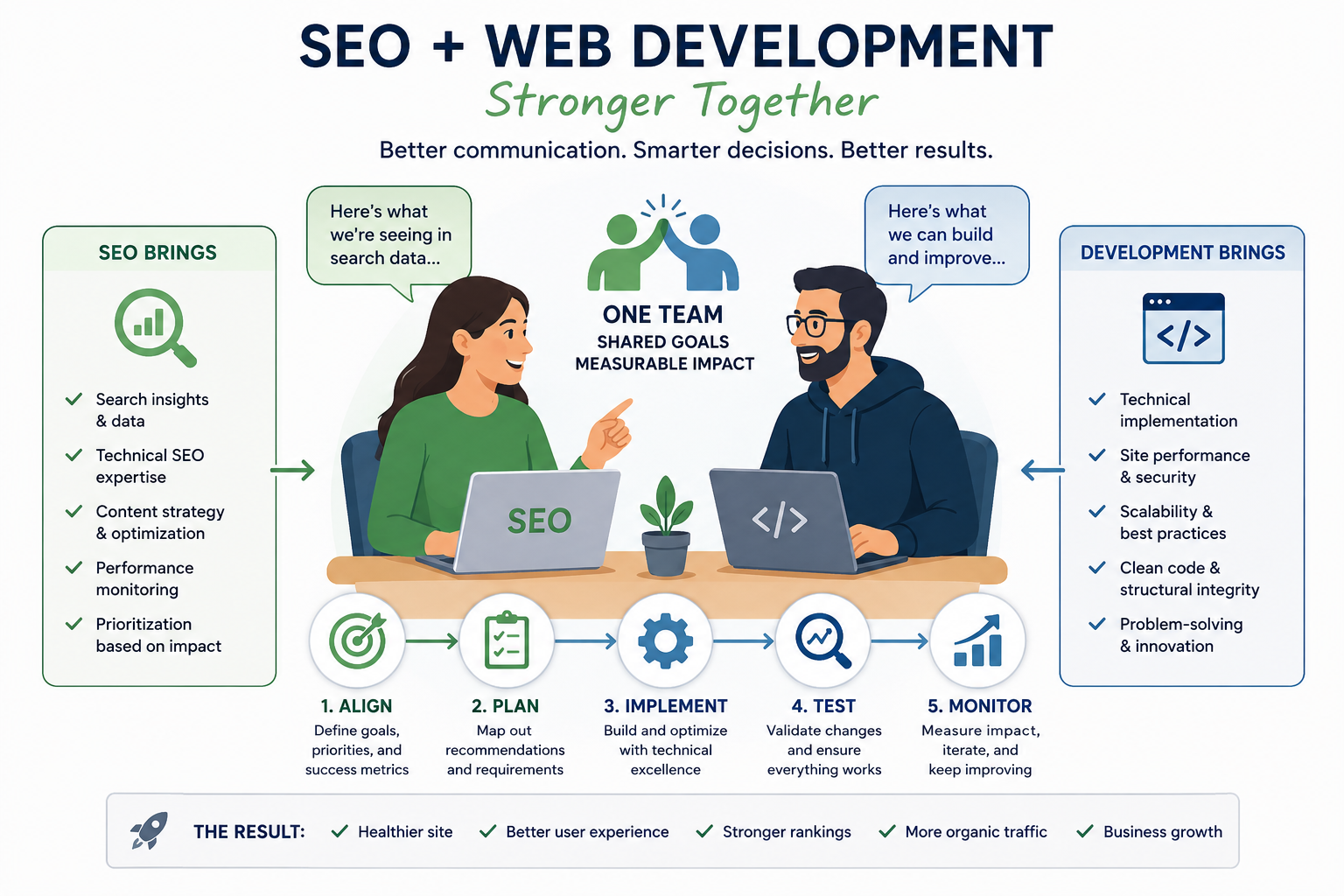
Successful technical SEO execution is fundamentally a collaboration challenge. It requires close coordination between SEO specialists, software developers, product managers, and QA engineers. Historically, friction has existed between these teams due to differing priorities, communication styles, and key performance indicators (KPIs).
+-------------------------------------------------------------------------+
|                      CROSS-FUNCTIONAL ALIGNMENT                         |
+-------------------------------------------------------------------------+
|   SEO TEAM               PRODUCT MANAGERS          ENGINEERING TEAM     |
|   Identifies search      Balances business         Implements stable,   |
|   opportunities &        priorities & manages      scalable, and clean  |
|   mitigates risks.       sprint resources.         technical code.      |
+-------------------------------------------------------------------------+
The Developer’s Perspective
Web developers prioritize code stability, site speed, clean architecture, and meeting product deadlines. When an SEO team delivers a massive list of automated audit errors without clear prioritization or implementation context, developers often view it as low-priority technical debt.
To bridge this gap, SEO recommendations must be translated into standard developer tickets (e.g., in Jira or Azure DevOps) that align with existing engineering workflows. Each ticket should contain:
- Clear Problem Statement: Why is the current setup problematic for search engine crawling or indexation?
- Specific Acceptance Criteria: What must the final code achieve to satisfy the ticket requirements?
- Reproducible Examples: Concrete examples of affected URLs, code snippets, or server responses.
- Validation Steps: Simple instructions for how the developer or QA engineer can verify the fix in a staging environment.
The Product Manager’s Role
Product Managers (PMs) act as gatekeepers for the development queue, balancing feature requests, bug fixes, and technical debt. To secure sprint resources for technical SEO initiatives, SEOs must build a business case that quantifies the value of the optimization or the financial risk of inaction.
For example, instead of requesting resources to "fix duplicate URL structures," frame the request as "resolving crawl budget inefficiencies to accelerate the indexation of new product launches, directly supporting organic revenue goals."
Implications: Technical Governance in the Modern Search Era
The implications of technical SEO governance extend far beyond traditional organic search engines. As the digital landscape evolves, the technical health of a website directly influences how it interacts with emerging technologies, AI search engines, and overall brand equity.
The Rise of AI Search and LLM Crawlers
Modern search engines are increasingly integrating generative AI experiences, such as Google’s AI Overviews. Additionally, large language models (LLMs) rely on automated web scrapers to gather training data and provide real-time information to users.
These AI agents rely on the same technical infrastructure as traditional search engine crawlers. A website that suffers from crawl blockages, poor semantic structure, or messy canonical signals will not only lose traditional search visibility but will also be excluded from AI-generated answers and conversational search recommendations.
The Cost of Technical Negligence
In an era of hyper-competition, technical mistakes carry immediate financial consequences. A broken redirect strategy during a migration can instantly halt organic lead generation, while slow page speeds caused by bloated code can degrade conversion rates and increase bounce rates. Conversely, organizations that establish proactive technical governance—combining continuous testing, clear team alignment, and strategic risk management—can turn technical SEO into a sustainable, long-term competitive advantage.
Ultimately, technical SEO is not a one-time project or a reactive troubleshooting exercise. It is a continuous process of risk management, strategic planning, and iterative improvement. By approaching technical updates with the preparation, validation, and caution they deserve, brands can protect their organic search equity while laying a stable foundation for future growth.
 Jia Lissa
  Nana Muazin
  Layla Zulfa