
 By Basiran
Global Digital Marketing Landscape — Digital marketers and paid social strategists are welcoming a surprisingly favorable economic shift on Meta’s flagship platform. According to comprehensive new benchmark data released by WordStream by LocaliQ, Facebook advertisers are enjoying significantly cheaper clicks and enhanced user engagement in 2026, while the cost per lead (CPL) remains remarkably flat.
The extensive report, which analyzed nearly 1,800 distinct Facebook advertising campaigns across a vast array of global industries, offers a granular look at key performance indicators (KPIs), including click-through rates (CTRs), cost per click (CPC), conversion rates (CVR), and cost per lead (CPL) for both traffic-driven and lead-generation campaigns.
For marketing departments constantly squeezed by tighter macroeconomic budgets and rising overhead expenses across other channels, the 2026 data provides a welcome reprieve. Advertisers are no longer forced to choose between scale and efficiency; on Facebook, they are increasingly securing both.
Main Facts: The 2026 Facebook Ads Landscape at a Glance
The core findings of the WordStream by LocaliQ benchmark report highlight a maturation in Meta’s ad delivery systems and an overall improvement in campaign economics:
- Cheaper Traffic: Overall traffic clicks became approximately 14% cheaper year-over-year.
- Elevated Engagement: Average click-through rates (CTRs) for traffic campaigns rose by nearly 13%.
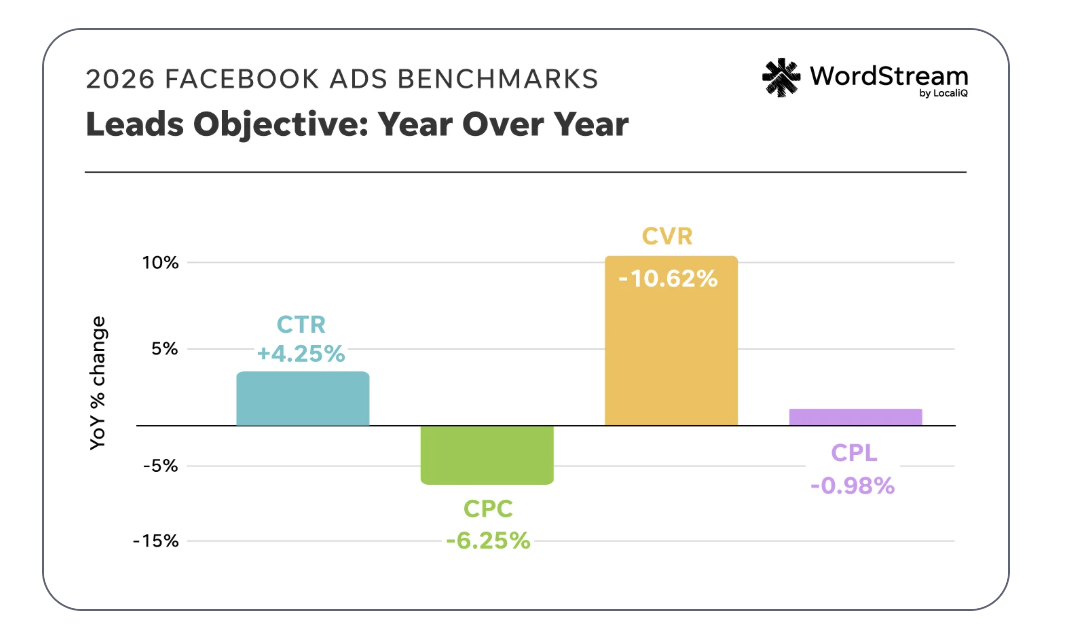
- Stable Lead Costs: While traffic became significantly more affordable, lead-generation campaigns managed to secure cheaper clicks while holding average cost-per-lead (CPL) metrics virtually flat.
- The Cross-Channel Comparison: Google Ads CPCs currently average more than double Meta’s average CPC, reinforcing Facebook’s value as a top-of-funnel efficiency play—even if Google Search continues to capture higher-intent bottom-of-funnel traffic.
- Algorithmic Efficiency: Experts attribute these gains primarily to Meta’s continuous refinement of its automated bidding, machine learning optimization, and targeted delivery mechanisms.
Chronology and Context: How Paid Social Reached This Milestone
The Post-IDFA Volatility Era (2021–2024)
To truly appreciate the health of the 2026 Facebook ads ecosystem, it is vital to contextualize the turbulence the platform experienced in the early part of the decade. Following Apple’s rollout of App Tracking Transparency (ATT) in 2021, paid social marketers faced unprecedented attribution blind spots. Cost-per-acquisition (CPA) metrics skyrocketed, signal loss crippled lookalike audiences, and return on ad spend (ROAS) plummeted across the board.
Brands were forced to completely restructure how they built creative, transitioned to broad targeting, and learned to trust Meta’s Advantage+ suite of automated tools.
The Algorithmic Pivot (2024–2025)
By mid-decade, Meta had successfully engineered a paradigm shift. Leveraging advanced machine learning models, the platform learned to optimize campaigns based on first-party signals, aggregated event measurement, and creative-led targeting. Advertisers stopped fighting the algorithm and began leaning heavily into dynamic creative optimization (DCO).
The Current Reality (2026)
The fruits of this multi-year technological evolution are fully visible in the 2026 benchmark data. Meta’s machine learning infrastructure has become so adept at matching ad inventory with high-propensity users that inefficiencies have been systematically compressed out of the marketplace. Advertisers are reaping the rewards through reduced click costs and higher engagement volumes.
Supporting Data: Traffic and Lead Campaign Deep Dives
To help digital marketers benchmark their own accounts against broader market averages, the WordStream report categorized performance metrics by campaign objective and industry vertical.
Traffic Campaigns: Winners and Losers
Traffic campaigns recorded a stellar year. Engagement climbed across the board, and the cost to acquire a click dropped significantly for the vast majority of sectors.

- The Exceptions (Increased CPCs): Only two industries bucked the trend by experiencing higher traffic CPCs year-over-year:
- Shopping, Collectibles and Gifts: Up a substantial 73.53%.
- Sports and Recreation: Up 43.90%.
- The Efficiency Champions (Decreased CPCs): Conversely, many sectors enjoyed massive relief in traffic acquisition costs.
- Real Estate: Recorded the single biggest CPC improvement, plummeting by 39.56%.
- Restaurants and Food: Saw CPCs drop by 37.50%.
- Industrial and Commercial: Noted a 37.21% decrease in click costs.
Lead Campaigns: Clicks and Conversion Realities
For businesses reliant on form fills, subscriptions, and quote requests, lead campaigns presented a similarly encouraging landscape.
- Cost-Per-Click Reductions: The vast majority of lead-generation advertisers saw cheaper clicks. Notable winners included:
- Automotive – For Sale: CPC fell by an impressive 44.17%.
- Dentists and Dental Services: CPC dropped by 41.72%.
- Health and Fitness: CPC declined by 30.30%.
- Resistant Sectors: Only two industries saw rising lead campaign CPCs: Education and Instruction (+4.24%) and Sports and Recreation (+0.93%).
Cost-Per-Lead (CPL) Variance
While click costs dropped, actual cost-per-lead (CPL) varied wildly depending on the intrinsic value of the target consumer and industry margins.
- Industries with the Lowest CPLs: Typically characterized by high-volume, lower-friction consumer offers, sectors such as local services, e-commerce lead capture, and broad-appeal consumer goods maintained the lowest barrier to entry for lead acquisition.
- Industries with the Highest CPLs: High-consideration, high-ticket industries—such as legal services, B2B enterprise software, and specialized financial services—commanded significantly higher CPLs, reflecting the high financial stakes of acquiring a qualified client.
Official Responses and Industry Expert Analysis
Industry analysts and platform specialists have been quick to dissect the implications of the 2026 benchmark data.
Anu Adegbola, Paid Media Editor at Search Engine Land, emphasized the strategic flexibility these trends afford marketing teams. "Facebook advertisers are effectively getting more engagement for less money," Adegbola noted. "Traffic clicks became 14% cheaper while CTR improved nearly 13%, and lead campaigns generated cheaper clicks while keeping average CPL virtually unchanged."
Commenting on how this alters multi-channel planning, marketing technologists point out the growing divergence in cost models between search and social. WordStream’s analysis highlights that Google Ads CPC is now more than double Meta’s average CPC. However, experts caution against direct apples-to-apples comparisons. While Meta excels at interrupting user behavior and generating cost-effective demand, Google Search captures active, bottom-of-funnel purchase intent.

Therefore, the 2026 data does not suggest abandoning search; rather, it elevates Meta’s status as an exceptionally cost-effective engine for customer acquisition and upper-to-mid-funnel nurturing.
Implications for Paid Media Strategists in 2026
The structural improvements identified in the WordStream by LocaliQ report carry several vital strategic takeaways for in-house marketing teams and agency leaders navigating the remainder of 2026:
1. Budget Reallocation and Blended ROAS
With Meta CPCs remaining low and engagement holding strong, media planners have a golden opportunity to rebalance their media mixes. Allocating a larger percentage of total digital ad spend to Meta can help lower blended customer acquisition costs (CAC). By using cheap, highly engaging Facebook traffic to build robust retargeting pools, brands can feed downstream conversion channels more efficiently.
2. Creative is the New Targeting
The data proves that Meta’s underlying algorithms are handling distribution and bidding with elite precision. Consequently, the primary variable for success is no longer hyper-complex audience segmentation—it is creative diversity. Advertisers who invest heavily in fresh user-generated content (UGC), dynamic video formats, and compelling copywriting are best positioned to capitalize on cheaper clicks and rising CTRs.
3. Acknowledging Intent Disparities
While Meta offers unmatched scale and cost efficiency, marketers must maintain realistic expectations regarding lead quality. Because Facebook is a discovery-driven platform, lead-generation campaigns often require longer nurturing cycles and more sophisticated email marketing automation compared to high-intent search traffic. Aligning CRM workflows with paid social traffic remains paramount to translating cheaper CPLs into closed-won revenue.
Bottom Line
The 2026 Facebook Ads benchmarks deliver an unequivocally optimistic message for digital advertisers. Through a combination of refined machine learning, smarter auction dynamics, and improved user engagement, Meta has managed to drive down click costs while keeping conversion metrics stable.
For brands looking to maximize efficiency without sacrificing scale, the current ecosystem offers unprecedented room to stretch paid social budgets and drive sustainable growth.
 Asep Darmawan
  Jia Lissa
  Nana Muazin