
 By Jia Lissa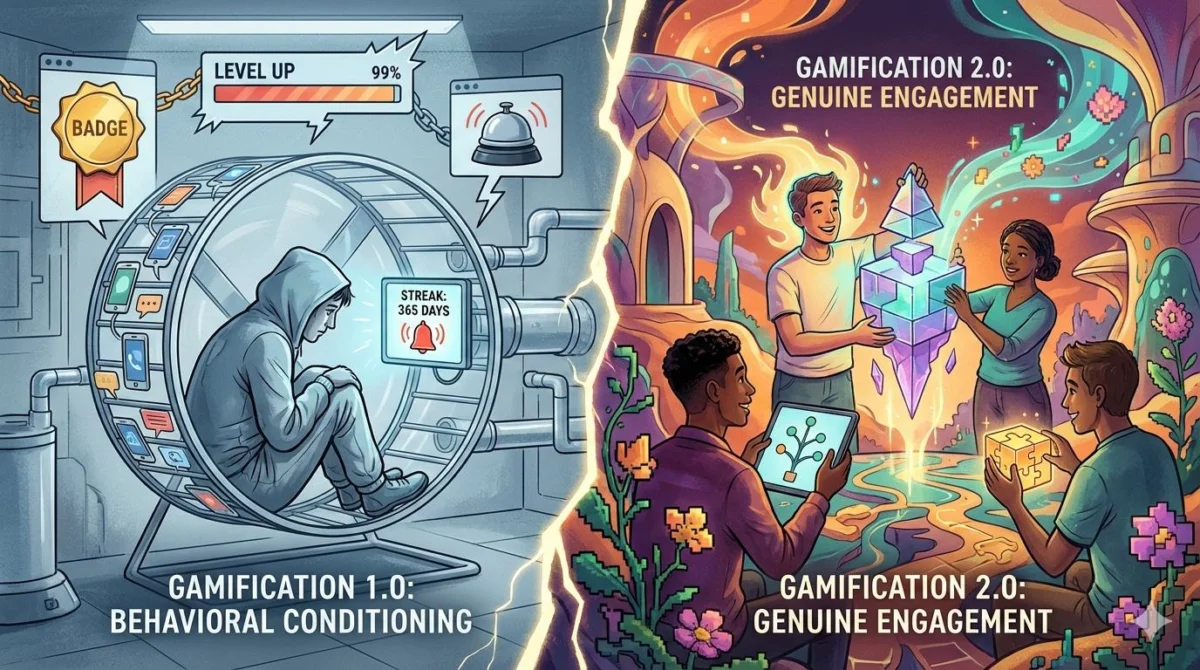
In the modern digital landscape, the term "gamification" has become a hollow buzzword. From language-learning apps that induce anxiety over broken streaks to professional networking platforms that incentivize meaningless profile updates, the digital experience is increasingly cluttered with what industry veterans call "gamification theater."
Montgomery Singman, a titan in the gaming industry with 39 years of experience—ranging from programming John Madden Football to leading international licensing for Street Fighter—argues that we are currently living through a "gamification cargo cult." In this opening chapter of his series on the future of design, Singman dismantles the current paradigm, arguing that we have mistaken cheap psychological manipulation for actual game design.
The Problem: The Gamification Cargo Cult
The term "cargo cult" refers to a phenomenon where observers mimic the appearance of a successful system without understanding the underlying mechanics that make it work. In World War II, islanders built bamboo control towers and wooden headsets in hopes of summoning supply planes. Today’s product managers are doing the same with digital interfaces.

"I see apps everywhere with ‘gamification’ that no actual gamer would tolerate for five minutes," says Singman.
The tell-tale sign of this failure is the reliance on extrinsic motivators: points, badges, and leaderboards. These mechanics, often implemented by growth teams or UX designers following generic best practices, treat users like laboratory rats. The assumption is simple, yet deeply flawed: provide a pellet (a badge), and the rat will press the button (open the app).
However, the data tells a different story. While these mechanics might spike engagement in the short term, they lead to inevitable abandonment. Once the novelty fades—usually within weeks—the user leaves, having only ever engaged with the superficial "theater" of the app rather than its core value.
Chronology of a Failed Trend
The history of modern gamification is a story of misapplied behavioral psychology.
- The Early 2010s (The Rise of Behavioral Mechanics): Gamification emerged as a buzzword, heavily influenced by behavioral economics and "hook" models. The goal was to manufacture habit-forming products.
- The Mid-2010s (The Metric Obsession): As data analytics tools became more sophisticated, product teams began optimizing for "Daily Active Users" (DAU) and "Retention Rates." Points and streaks became the primary lever to manipulate these metrics.
- The Present (The Fatigue Point): Users have become increasingly sophisticated. They now recognize the "guilt-tripping" tactics of streak-based notifications. The "cargo cult" has reached a saturation point where the cost of maintaining these systems often outweighs the marginal gains in user retention.
Supporting Data: Why "Behaviorist" Design Fails
The failure of current gamification stems from a fundamental misunderstanding of motivation. Behavioral psychology, specifically operant conditioning, suggests that behavior can be modified through rewards and punishments. While effective for training animals, it is a poor framework for building long-term human loyalty.
The Extrinsic Trap
Current gamification systems rely almost exclusively on extrinsic rewards. When an app rewards a user for completing a task, the user’s motivation shifts from "I enjoy this task" to "I am doing this to get the badge." Once the reward is removed, or the novelty loses its shine, the motivation evaporates.

Furthermore, users are adept at "gaming" these systems. They will click through tutorials without reading, check in without engaging, and perform meaningless actions just to clear a notification. This creates a feedback loop of vanity metrics that look good in a quarterly report but fail to reflect actual user satisfaction or product value.
Official Perspectives: The Developer vs. The Player
There is a widening chasm between how product teams view their work and how users experience it.
The Product Team’s View:
For many growth-focused teams, gamification is a "checklist" approach. It is a feature set that can be outsourced to a developer in a single gig: "Add points, badges, and a leaderboard." The success metric is immediate, quantitative, and easily displayed on a dashboard.

The Game Designer’s View:
Singman argues that real gamification—the kind that keeps a player immersed in a title like Elden Ring for over 100 hours or keeps a player solving Wordle every morning—has nothing to do with artificial rewards. It is about intrinsic motivation.
"Real games don’t bribe players to show up," Singman notes. "They make the experience worth showing up for."
Implications for the Future of UX Design
If the current playbook is broken, where do we go from here? The transition to "Gamification 2.0" requires a radical shift in philosophy.

1. From Metrics to Meaning
The first step is to stop designing for metrics and start designing for players. This means abandoning the "carrot-and-stick" approach in favor of systems that offer genuine autonomy, competence, and relatedness.
2. The Role of Intrinsic Satisfaction
Successful design identifies the "core loop" of the product—the primary action that provides value to the user. Instead of layering external rewards on top of this loop, designers should focus on making the core loop itself inherently satisfying. If an app requires a badge to make its core action engaging, the product itself likely has a fundamental design flaw.
3. Understanding Player Psychology
Designers must move beyond the "rat in a maze" mentality. Players are intelligent, creative, and socially driven. They find satisfaction in mastering complex systems, overcoming challenges, and building communities. By aligning product features with these deeper psychological drivers, developers can foster genuine loyalty rather than temporary compliance.

Conclusion: The Rescue Mission
This series is not an attack on the concept of games in technology; it is a "rescue mission." Gamification, when stripped of its superficial "cargo cult" elements, holds the potential to be truly transformative. It can make professional software more intuitive, educational tools more effective, and productivity apps more fulfilling.
However, the industry must first stop copying the mechanics of successful games and start understanding the why behind them. As we move into the next chapter of this series, the focus will shift from the failures of the past to the solutions of the future. It is time to retire the points, bury the badges, and start building experiences that respect the player.
About the Author:
Montgomery (Monte) Singman is a veteran of the gaming industry with 39 years of experience. Having served as a lead programmer for EA’s John Madden Football and technical lead for Capcom’s Street Fighter series, he has generated over $100M in licensing revenue across 50+ major titles. He continues to consult on the intersection of human psychology and digital experience.
 Lina Hope
  Asep Darmawan
  Ali Ikhwan