
 By Iffa Jayyana
The professional design landscape is currently undergoing a quiet, yet fundamental, identity crisis. As generative AI tools become ubiquitous in the product development lifecycle, a linguistic shorthand has emerged to describe the process of working with these systems: "vibe coding." While the term gained traction in early 2025 as a catchy descriptor for low-accountability, high-speed experimentation, its persistence has become a point of contention among senior design practitioners.
For many, the term is not merely a harmless label; it is a symptom of a broader erosion of design authorship. When designers adopt the terminology of engineering to describe their own creative labor, they inadvertently relegate their role from that of an intentional architect to that of a passive supervisor. This article explores the growing movement to replace "vibe coding" with "directed generation"—a methodology that centers human judgment as the primary driver of AI-assisted output.
The Genesis of a Misnomer: Chronology of a Concept
The term "vibe coding" was popularized by figures like Andrej Karpathy to describe a specific, legitimate workflow: a process characterized by loose, iterative prompts and a willingness to accept machine-generated outputs without granular intervention. In its original context, it was an honest, if blunt, description of low-accountability software experimentation.
However, in the months that followed, the term underwent a "semantic migration." It leaked into the high-stakes world of product design, where it began to be used to describe serious, highly intentional workflows. This is where the tension began. Designers who utilize AI to iterate on complex design systems, refine brand hierarchies, and solve architectural problems found their work being lumped into the same category as casual, "vibe-based" experimentation.
By failing to push back against this mischaracterization, the design community has allowed an external vocabulary—largely imported from engineering cultures that prioritize output over intent—to define the value and nature of their work. As George Orwell once posited, the slovenliness of language leads to the slovenliness of thought. When designers accept an imprecise label, they make it easier for stakeholders to misunderstand the rigors of their process, ultimately threatening the perceived value of design as a professional discipline.
The Core Divide: Authority vs. Automation
At the heart of this debate is not the adoption of technology—the vast majority of design teams have already integrated AI into their workflows—but the location of authority within that process.
The Passive Model
In the "vibe-based" approach, generation drives the decision-making process. The designer acts as a filter, accepting or rejecting outputs based on a subjective "vibe" or aesthetic preference. In this workflow, the AI is the primary agent, and the designer is merely the curator at the end of the pipeline.
The Directed Generation Model
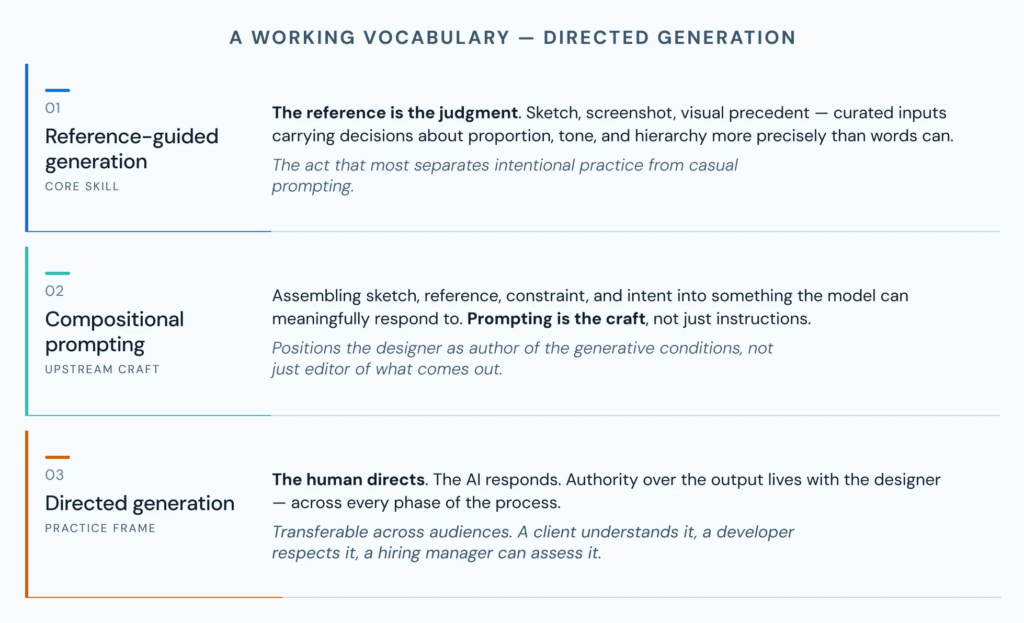
In contrast, "directed generation" places human judgment at the start of the chain. Here, the designer does not merely prompt; they provide a curated reference—a sketch, a screenshot, a specific visual precedent—that carries inherent intent. This reference acts as a constraint, forcing the model to adhere to specific principles of proportion, hierarchy, and tone. In this model, the AI responds to the designer’s expertise, not the other way around.
The distinction is crucial: in directed generation, the AI is a tool of high-fidelity execution, while the designer remains the sole author of the strategic intent.
Supporting Data: Why Intentionality Scales
The industry is seeing a shift in how design systems are being built and maintained. Traditional design systems have long been treated as static, documented artifacts. Consistency was achieved through rigid replication, a process that inherently sacrificed flexibility for the sake of strict adherence to guidelines.
Directed generation, however, allows for a more fluid approach. When a model understands a design pattern abstractly—viewing it not as a pixel-perfect export but as a set of spatial and behavioral relationships—it becomes possible to generate coherent, brand-consistent outputs across infinite contexts.
- Non-Deterministic Design: This is not a failure of the system; it is its primary strength. By defining the "conditions" under which good instances emerge, the designer moves their craft upstream.
- The Shift to Grammar: Designers are moving from being "pixel-pushers" to "grammarians." They author the underlying rules of a system, and the AI acts as the system’s speaker, capable of fluent expression across devices and screen sizes.
- Outsized Returns: Data suggests that teams adopting this hybrid approach—using directed generation for rapid exploration and cross-surface adaptation—experience higher velocity without the "freezing" that occurs when teams attempt to manually document every edge case of a static system.
Official Responses and Industry Sentiment
The professional design community is beginning to voice a collective pushback against the "vibe" narrative. Leading voices in the Design Systems Collective and various independent design studios have begun to formalize alternatives. The consensus is that the vocabulary must shift to reflect the sophistication of modern design-AI workflows.
Potential New Nomenclature:
- Directed Generation: Emphasizes the designer’s role in steering the AI toward a specific, pre-determined outcome.
- Reference-Guided Practice: Highlights the importance of the curated inputs (sketches, precedents) that prevent the "vibe" drift.
- Compositional Prompting: A technical term that describes the craft of assembling complex, multi-layered instructions to ensure high-fidelity output.
These terms serve as "handles" for the work. They are not merely labels; they are professional signifiers. When a designer presents their process as "directed generation" during a portfolio review, they are signaling to clients and peers that they are in control of their tools, not the other way around.
Implications: The Long-Term Value of Design
The implications of this naming debate extend far beyond the studio. As AI continues to commoditize the execution of design, the judgment—the ability to curate, constrain, and direct—becomes the designer’s most valuable asset.
The Risk of Silence
If designers do not name their own practice, others will. History serves as a cautionary tale: when UX design first emerged, those who took the time to define and name their methodologies (information architecture, interaction design, user research) were the ones who shaped how the industry was valued. Those who remained passive allowed adjacent fields to redefine the scope of their work, often to the detriment of their own authority and compensation.
The Path Forward
The path forward is not a rejection of AI, but a maturation of the practice. We are moving toward "agentic delivery," where systems will autonomously carry forward the intent embedded in the designer’s initial primitives. To survive this shift, designers must adopt a hybrid methodology:
- Deterministic for Production: Continue using established, fixed components for high-risk, high-consistency environments.
- Non-Deterministic for Exploration: Embrace directed generation for rapid conceptualization and systemic growth.
Ultimately, "vibe coding" is a useful label for low-accountability experimentation, but it is a poor descriptor for the rigor of professional design leadership. The sooner the industry distinguishes between "vibes" and "intent," the sooner we can focus on the real work: defining the future of how humans and machines co-author the digital world.
By taking ownership of our language, we take ownership of our practice. The tools have changed, but the necessity of clear, intentional, and authoritative design remains the foundation of our value.
 Ammar Sabilarrohman
  Neng Nana
  Sagoh
Sagoh 