
 By Lina Irawan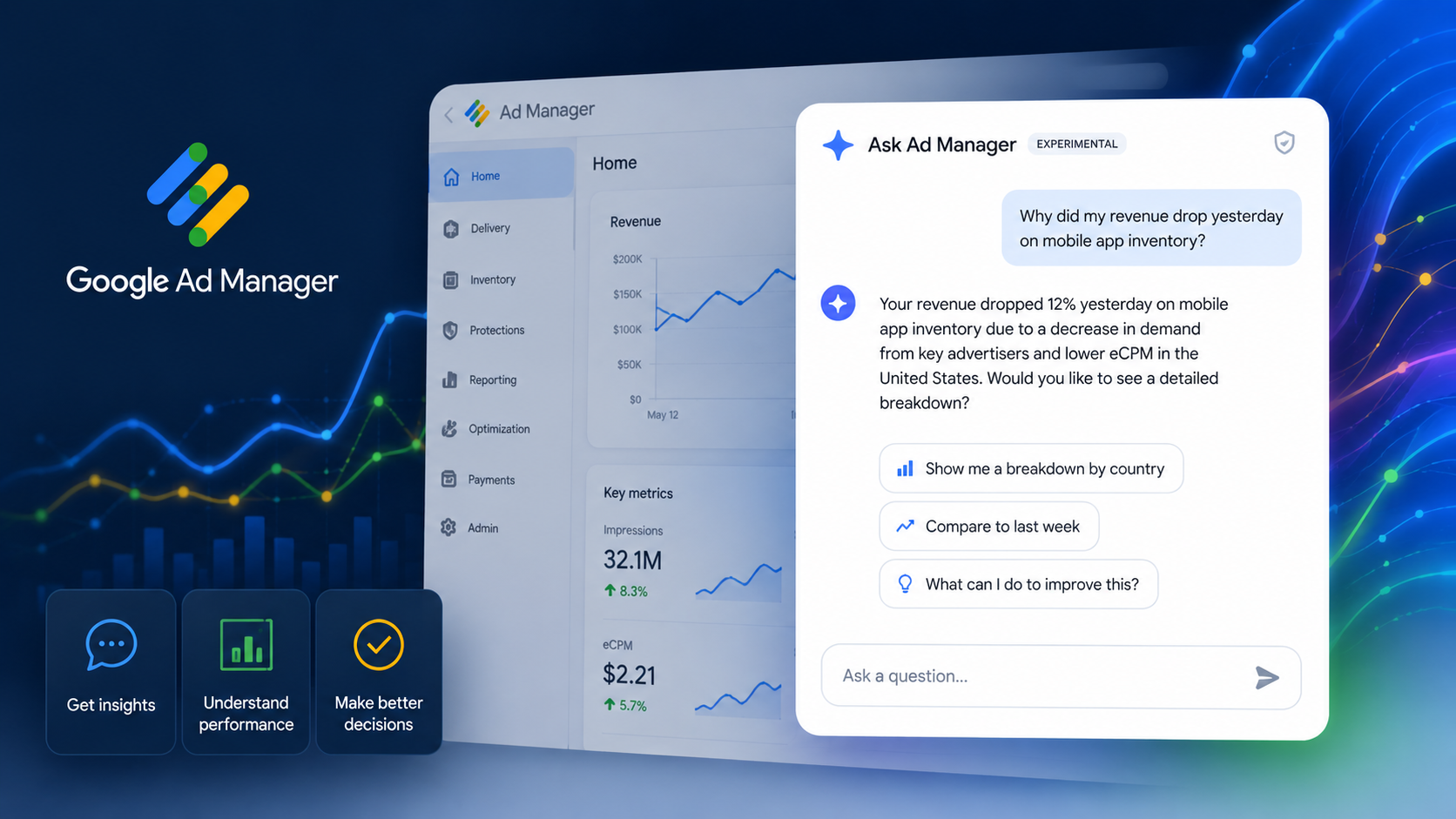
The landscape of digital advertising operations is undergoing a profound paradigm shift. For years, programmatic advertising has been characterized by its immense complexity, requiring specialized ad operations (ad ops) teams to navigate labyrinthine user interfaces, write complex database queries, and manually diagnose yield discrepancies.
In a major move to address these operational bottlenecks, Google has announced the launch of Ask Ad Manager, a generative AI-powered conversational assistant built directly into Google Ad Manager (GAM). Powered by Google’s proprietary Gemini large language model, the tool is designed to serve as an intelligent, natural-language interface for publishers.
This integration marks a transition from passive, search-based software interfaces to active, "agentic" workflows, wherein AI systems do not merely retrieve information but actively assist in troubleshooting, reporting, and platform navigation. The beta version of Ask Ad Manager is rolling out to select publishers this month, signaling a new chapter in AI-driven supply-side platform (SSP) management.
1. Main Facts: Inside the "Ask Ad Manager" Feature Set
Ask Ad Manager represents Google’s first major implementation of Gemini within its flagship publisher platform. Rather than acting as a simple help-center chatbot, the tool is deeply integrated into the publisher’s unique environment, accessing real-time data, configuration settings, and historical performance metrics.
Google has structured the initial beta of Ask Ad Manager around three core pillars of functionality:
Real-Time Troubleshooting of Delivery Issues
In programmatic advertising, diagnosing why an ad line item is underdelivering or why a specific yield optimization strategy is failing has historically required hours of forensic analysis. Publishers must typically review inventory exclusions, pricing rules, buyer blocks, and historical bids.
With Ask Ad Manager, publishers can bypass manual troubleshooting. Users can input natural language queries—such as, "Why did line item X experience a 20% drop in impressions yesterday?"—and the assistant will analyze the delivery chain, identify potential causes (such as creative rejection, bid-shading, or conflicting pricing rules), and outline specific remediation steps.
On-Demand Custom Reporting and Analytics
Traditional reporting in Google Ad Manager requires users to build complex queries by manually selecting dimensions, metrics, date ranges, and filters, and then exporting the data to spreadsheets for further manipulation.
Ask Ad Manager simplifies this process. Users can request tailored performance overviews, comparative benchmarks, and custom reports through conversational prompts. For example, a publisher can ask, "Generate a report showing our top-performing video ad units on mobile devices over the last 30 days, segmented by country," and the system will instantly construct the visualization and output the required data.
Intuitively Guided Platform Navigation
Google Ad Manager is notorious for its steep learning curve, featuring nested menus and highly technical configurations. Ask Ad Manager acts as an interactive copilot for navigation.
If a publisher asks how to implement a specific programmatic guaranteed deal or adjust a unified pricing rule, the AI agent will not only provide step-by-step instructions but will also direct the user to the precise page within the platform, automatically applying the relevant filters and settings based on the context of the conversation.
2. Chronology: The Evolution of AI in Google’s Ad Tech Suite
The rollout of Ask Ad Manager is the culmination of a multi-year effort by Google to transition its advertising ecosystem from heuristic, rule-based systems to fully automated, AI-first platforms.
[Pre-2018: Rule-Based Ad Ops] -> [2018-2022: Machine Learning Integration] -> [2023-2024: Generative AI & Performance Max] -> [Present (2025/2026): Agentic AI & Ask Ad Manager]- The Pre-AI Era (Before 2018): Ad operations were entirely manual. Publishers set hard pricing floors, manually managed waterfalls, and spent significant portions of their workweeks resolving line-item conflicts using static diagnostic tools.
- The Predictive Machine Learning Era (2018–2022): Google began heavily integrating predictive machine learning into its ad tech. This era saw the introduction of automated bidding strategies, smart pricing floors, and predictive forecasting within Google Ad Manager. While powerful, these systems operated as "black boxes," leaving publishers with little control or understanding of why certain algorithmic decisions were made.
- The Generative AI Breakthrough (2023–2024): Following the launch of Bard (now Gemini), Google began embedding generative AI into its advertiser-facing products. This included natural-language campaign creation tools in Google Ads and creative asset generation within Performance Max (PMax). However, the publisher-facing supply-side (Google Ad Manager) remained largely reliant on traditional interfaces.
- The Agentic AI Era (Present): With the launch of Ask Ad Manager, Google is bridging the gap between generative AI and back-end supply-side operations. This launch marks a shift from content generation (creative copy and images) to operational execution, laying the groundwork for autonomous, agentic systems that can manage complex software ecosystems on behalf of human operators.
3. Supporting Data: The Cost of Operational Complexity
The introduction of Ask Ad Manager comes at a critical time for digital publishers, who are facing unprecedented margin pressures and operational complexity.

According to industry data from the Association of Online Publishers (AOP) and programmatic yield specialists:
- Time Allocation: Ad operations teams spend an estimated 35% to 45% of their working hours on routine, manual tasks, such as generating reports, pulling data for sales teams, and troubleshooting delivery discrepancies.
- Revenue Leakage: Due to the complexity of modern header bidding setups and unified pricing rules, publishers lose an estimated 3% to 7% of potential ad revenue annually to undetected setup errors, misconfigured line items, and delayed troubleshooting.
- Talent Scarcity: A survey by AdExchanger highlighted that training a junior ad operations specialist to become proficient in enterprise SSPs like Google Ad Manager typically takes six to nine months, creating a major bottleneck for media companies facing high turnover rates.
By automating natural-language queries and accelerating troubleshooting, Ask Ad Manager aims to reduce the time-to-resolution for delivery issues from hours to seconds, directly mitigating revenue leakage and lowering the technical barrier to entry for junior staff.
4. Official Responses and Technical Roadmap
In its official product announcement, Google positioned Ask Ad Manager as the foundational step toward a highly automated, "agentic" future for digital media monetization.
"For publishers managing large inventories and complex campaigns, the ability to quickly surface insights and diagnose issues could significantly reduce operational workload and accelerate decision-making," the company stated in its official documentation.
Looking beyond the initial beta, Google has outlined a technical roadmap that signals deeper integration with broader developer and programmatic ecosystems:
- Developer Tools and REST APIs: Google plans to release robust REST APIs for Ask Ad Manager, allowing enterprise publishers to programmatically query the AI assistant and integrate its diagnostic capabilities into their own internal dashboards.
- Model Context Protocol (MCP) Server Integration: In a highly anticipated technical development, Google announced plans to support an MCP server. This open-source standard will allow Ask Ad Manager to securely read and write data across disparate third-party enterprise tools. This means the assistant could eventually interact with external Customer Relationship Management (CRM) platforms, order management systems (OMS), and financial software, automating workflows that span multiple platforms.
- Specialized Transactional Agents: Google is actively developing specialized AI sub-agents. These agents will go beyond diagnostics to assist publishers and advertising agencies in discovering premium inventory, negotiating complex programmatic agreements, and executing direct-sold campaigns with minimal human intervention.
5. Strategic Implications for the Digital Advertising Ecosystem
The launch of Ask Ad Manager has wide-ranging implications for publishers, agency partners, and the competitive ad tech landscape.
For Publishers: Democratization and Yield Optimization
For mid-market and enterprise publishers alike, Ask Ad Manager democratizes access to sophisticated data analysis. By translating complex database relationships into natural language, the tool allows non-technical team members—such as sales executives and inventory managers—to pull their own reports without relying on dedicated ad ops queues. This decentralization of data accelerates the sales cycle and allows yield managers to focus on long-term strategic growth rather than administrative firefighting.
For Ad Operations Professionals: A Shift in Job Descriptions
The automation of routine troubleshooting and reporting will inevitably redefine the role of the ad ops specialist. Rather than being "button-pushers" who manually configure settings and pull CSV files, ad ops professionals will transition into strategic analysts. Their primary value will lie in writing precise prompts, auditing AI-generated recommendations, and designing overarching yield strategies that the AI then executes.
For Competitors: The Race for AI-Enabled SSPs
Google’s aggressive push into agentic ad ops will likely force key competitors—such as Magnite, PubMatic, and Index Exchange—to accelerate their own generative AI roadmaps. SSPs that fail to offer intuitive, natural-language interfaces may struggle to retain publishers who increasingly demand reduced complexity and faster operational workflows.
Privacy, Security, and Data Governance
As with any enterprise generative AI deployment, the integration of Gemini into Google Ad Manager raises important questions regarding data privacy. Publishers possess highly sensitive data, including advertiser list prices, direct-sold contract terms, and proprietary audience metrics.
Google has emphasized that Ask Ad Manager operates under strict enterprise data protection guardrails. The system is designed to ensure that a publisher’s private operational data is used solely to ground that specific publisher’s conversational model, and is never used to train public Gemini models or shared with competing media companies. Maintaining absolute transparency regarding these data boundaries will be critical for Google to secure widespread adoption among premium, privacy-conscious publishers.
6. Conclusion: The Road to Autonomous Ad Operations
The launch of Ask Ad Manager is a clear signal that the future of digital advertising operations is conversational, automated, and agentic. By embedding Gemini directly into its supply-side infrastructure, Google is addressing the chronic complexity that has plagued programmatic advertising for over a decade.
While the tool is starting as a helpful diagnostic and reporting assistant, its roadmap—highlighted by MCP server support and specialized transactional agents—points to a future where programmatic campaigns are negotiated, optimized, and audited entirely by cooperative AI agents under human supervision. For publishers looking to survive in an increasingly competitive attention economy, the ability to operate at the speed of natural language may soon become a necessity rather than a luxury.
 Jia Lissa
  Nana Muazin
  Layla Zulfa