
 By Jia Lissa
 By the Editorial Desk
Published with files from Michelle Martin and Colleen Christison
In an era defined by an unprecedented deluge of machine-generated text, synthetic imagery, and automated noise, digital marketing strategists are facing a profound crisis of attention. With Pew Research indicating that over a third of U.S. adults regularly consume news and content via platforms like Facebook and YouTube, audiences are wading through more digital material than ever before. Much of it is forgettable.

Enter content curation: the strategic art of selecting, organizing, and sharing external content that resonates with a brand’s target demographic. Far from being a lazy shortcut or a replacement for original storytelling, modern content curation has evolved into an essential editorial filter. It cuts through the static, proves industry competence without overt bragging, and transforms brands from mere broadcasters into trusted community architects.
Main Facts: Defining the Modern Content Curation Playbook
At its core, content curation is the process of gathering valuable third-party material—ranging from industry reports and expert commentary to user-generated media and timely social shares—and delivering it to an audience with added context.

Think of a digital content curator as a museum director. The most effective curators do not simply display every artifact they encounter; they exercise acute taste, arrange the pieces with intentionality, and provide a vital narrative layer.
Curation vs. Creation: A Strategic Comparison
While content creation focuses on building owned assets, driving search engine optimization (SEO), and executing brand storytelling, curation offers a lighter, highly efficient complement. The two approaches are not adversarial; rather, they form the twin pillars of a robust social media strategy.
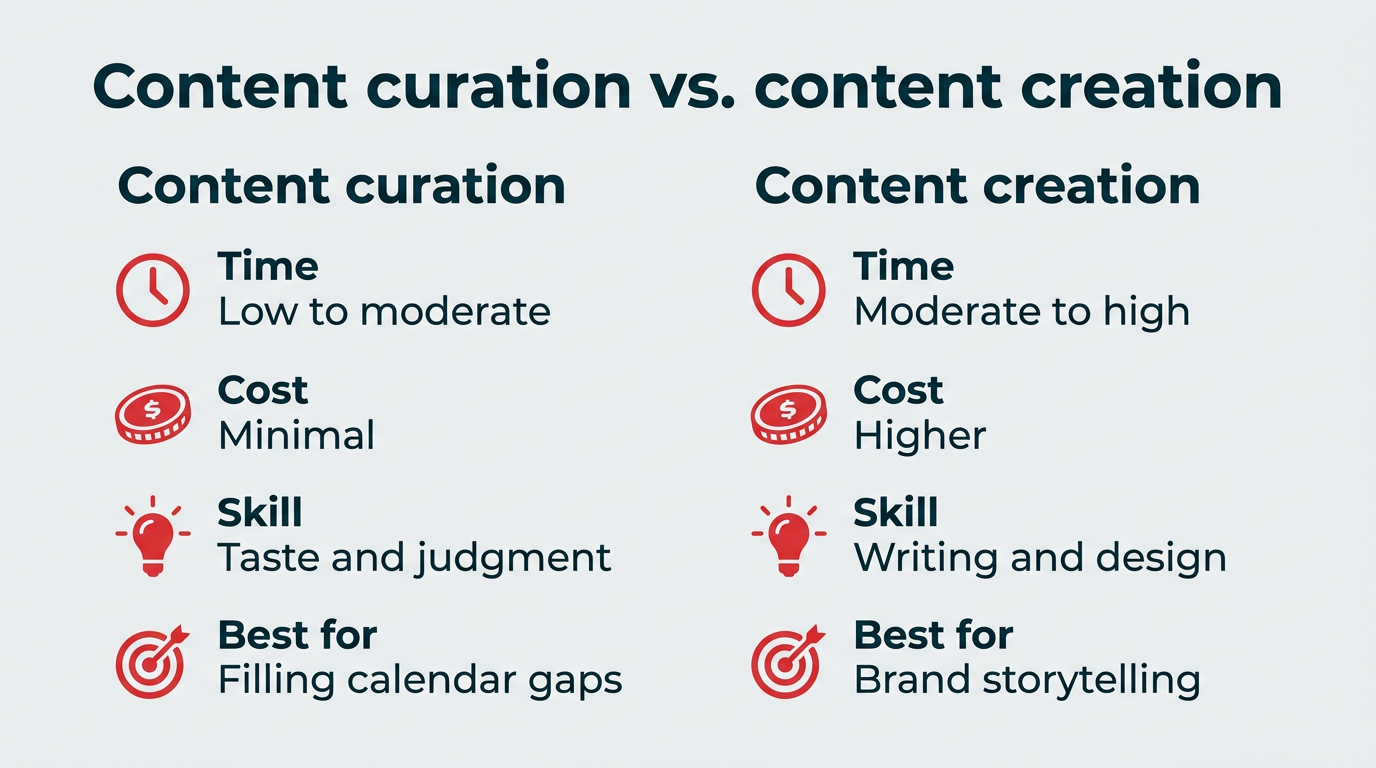
| Dimension | Content Curation | Content Creation |
|---|---|---|
| Definition | Finding, organizing, and sharing existing content | Producing original material from scratch |
| Time Investment | Low to moderate | Moderate to high |
| Cost | Minimal (primarily operational time) | Higher (design, copywriting, production cycles) |
| Required Skillset | Taste, editorial judgment, context-setting | Deep writing, graphic design, core strategy |
| Primary Utility | Filling calendar gaps, establishing thought leadership | Brand storytelling, product marketing, SEO |
| Practical Example | Sharing a major industry report paired with your own unique analytical take | Publishing an original, long-form blog post or whitepaper |
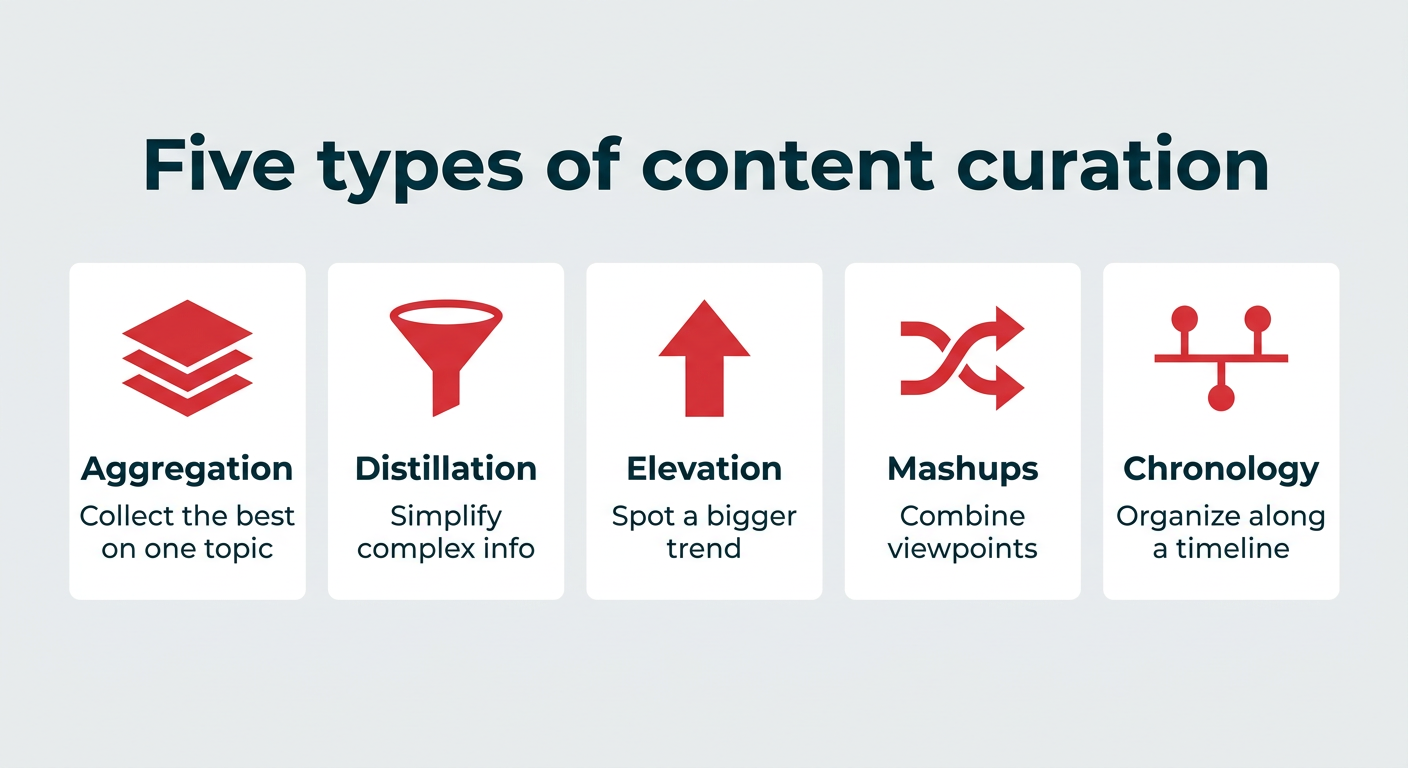
Understanding the nuances of curation requires recognizing its five primary typologies:
- Aggregation: Assembling the best decentralized content on a single topic into one unified destination, such as a weekly link roundup.
- Distillation: Stripping complexity out of dense data. For instance, condensing a 60-page research paper into a graphic highlighting four essential statistics.
- Elevation: Identifying a subtle, recurring pattern across disparate online conversations, naming the emerging trend, and presenting the evidence.
- Mashups: Combining competing or complementary viewpoints to synthesize a fresh perspective, such as a multi-practitioner expert roundup.
- Chronology: Organizing content along a timeline to illustrate how an industry or technical standard has evolved over a designated period.
Chronology: The Evolution of Curation in the Digital Age
Content curation is not a novel concept, but its mechanics and cultural weight have shifted dramatically over the past decade.
- The Early Web (Pre-2015): Curation began largely as a manual exercise. Marketers relied heavily on basic RSS aggregators and manual bookmarking tools to keep feeds active, often treating shared links as mere filler material to satisfy daily posting quotas.
- The Social Media Boom (2015–2020): As platforms prioritized algorithmic feeds, brands realized that relentless self-promotion bred audience fatigue. Curation transformed into a networking tactic. Brands began tagging original creators, fostering digital reciprocity, and positioning themselves within broader industry conversations.
- The AI Inflection Point (2020–Present): With the explosion of generative artificial intelligence, the internet has become hyper-saturated with low-effort content. Curation has consequently evolved into an exercise in high-value editorial judgment. In a landscape where anyone can generate volume, the ultimate competitive advantage belongs to the brand that provides trusted curation, human taste, and authoritative context.
Supporting Data: Why Modern Brands Rely on Curation
Data-driven social media management demonstrates that a hybrid model—blending original creation with strategic curation—yields superior community engagement and resource allocation.
1. Resource Efficiency and Budget Conservation
Producing high-end original assets requires coordinated workflows involving copywriters, graphic designers, and multi-layered approval cycles. Conversely, sharing a relevant, high-value industry resource takes minutes. By integrating curated content into a structured calendar, marketing teams optimize their operational budgets without sacrificing output frequency.

2. Relationship Building and Network Effects
Curating external content is inherently collaborative. When brands highlight an external expert’s work, properly credit them, and add respectful commentary, they open doors for organic networking. This strategy builds goodwill without demanding immediate quid pro quo.
3. Fostering True Community Engagement
Relying entirely on brand-centric messaging creates an echo chamber. Curating diverse opinions, challenging industry norms respectfully, and amplifying user-generated content (UGC) stimulate healthy debate. UGC, in particular, acts as a double-edged sword of community validation: it honors loyal followers while effortlessly supplying authentic content to the brand’s feed.
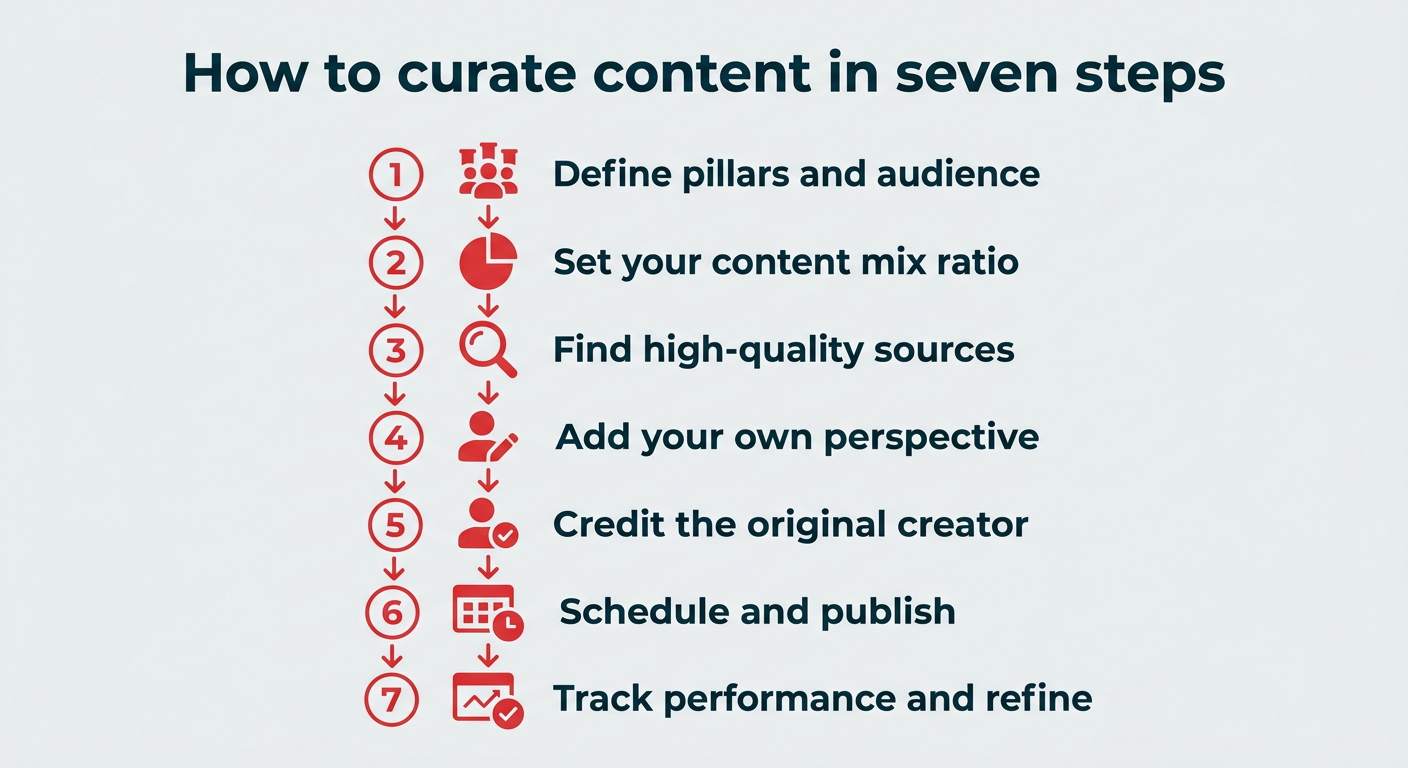
A 7-Step Workflow for Flawless Content Curation
Executing a successful curation strategy requires discipline. Randomly sharing links invites disorganization; executing a repeatable workflow ensures brand safety and audience retention.
- Define Content Pillars and Audience Boundaries: Establish three to five core themes that align with your brand identity. If a piece of external content does not fit these pillars, it is discarded. Furthermore, always evaluate the audience fit: Will this entertain, educate, or solve a problem for our specific buyer personas?
- Establish a Content Mix Ratio: Determine your distribution model in advance. Many organizations utilize frameworks like the 70/20/10 rule (70% proven foundational content, 20% innovative ideas, 10% high-risk experimental concepts) or settle on a balanced split where curated posts occupy 40% to 60% of the calendar.
- Source High-Quality Inputs: Diversify your discovery channels. Utilize industry publications, analyst whitepapers, newsletters, and social listening suites like Lumen within Hootsuite Social OS to catch conversations as they gain momentum rather than after they peak.
- Add an Editorial Layer: Never share bare links. Use proven caption frameworks to provide context. Explain why your audience should care, draw out a striking quote, or pair the link with an eye-catching graphic that associates your brand with the source material.
- Credit the Original Creator Explicitly: Plagiarism destroys brand equity. Always tag, attribute, and link directly to the original author or publication. If compiling multiple sources, provide transparent credits for each referenced item.
- Schedule for Consistency: Use social media management platforms to queue curated posts alongside original campaigns. This visibility helps uncover schedule gaps, prevents quiet weeks, and ensures optimal posting times based on channel analytics.
- Track Performance Metrics: Monitor engagement data specifically for curated posts. Analyze reach, click-through rates, shares, and comments to refine your curation mix continuously.
Implications: The Role of AI and Common Pitfalls to Avoid
As artificial intelligence solidifies its place in enterprise workflows by 2026, its impact on content curation is profound. AI excels at rapid content discovery, clustering trending topics, and drafting preliminary summaries. However, the ultimate responsibility of curating—exercising human taste, ethical attribution, and brand alignment—must remain strictly human.

Common Curation Mistakes to Avoid:
- The Echo Chamber Trap: Curating content solely from direct competitors rather than adjacent industries or thought leaders.
- Lazy Posting: Dropping raw URLs without commentary, failing to frame the conversation for your unique audience.
- Attribution Neglect: Forgetting to tag or credit original creators, risking both credibility and professional relationships.
- Over-Curation: Abandoning original storytelling entirely, leading audiences to wonder what unique value your brand actually produces.
- Ignoring Analytics: Publishing curated links blindly without measuring their performance against strategic key performance indicators (KPIs).
Conclusion
Content curation is no longer a peripheral task delegated to junior marketers; it is a sophisticated discipline that separates authoritative market leaders from the background noise of the internet. By mastering the art of discovery, adding thoughtful editorial context, and leveraging integrated management systems like Hootsuite Social OS, modern brands can build resilient, highly engaged communities while optimizing their creative resources.
Save time managing your social media marketing strategy with Hootsuite. Publish and schedule posts, find relevant conversations, measure results, and more—all from one centralized dashboard. Try it free today.
 Evan Lee Salim
  Pevita Pearce