
 By Nana Wu
In a field currently dominated by the massive, resource-heavy Transformer architecture, a new project has emerged from the open-source community that challenges the status quo of how machines process language. Known as the Plastic State-Space Architecture (PSSA), this model is not merely a variation of existing designs—it is a complete departure from the ubiquitous "attention is all you need" paradigm. By eschewing the standard deep learning frameworks like PyTorch and TensorFlow in favor of a custom, ground-up implementation in the Rust programming language, PSSA offers a glimpse into a future where language models are faster, more efficient, and inherently more adaptable.
The Core Innovation: Moving Beyond Transformers
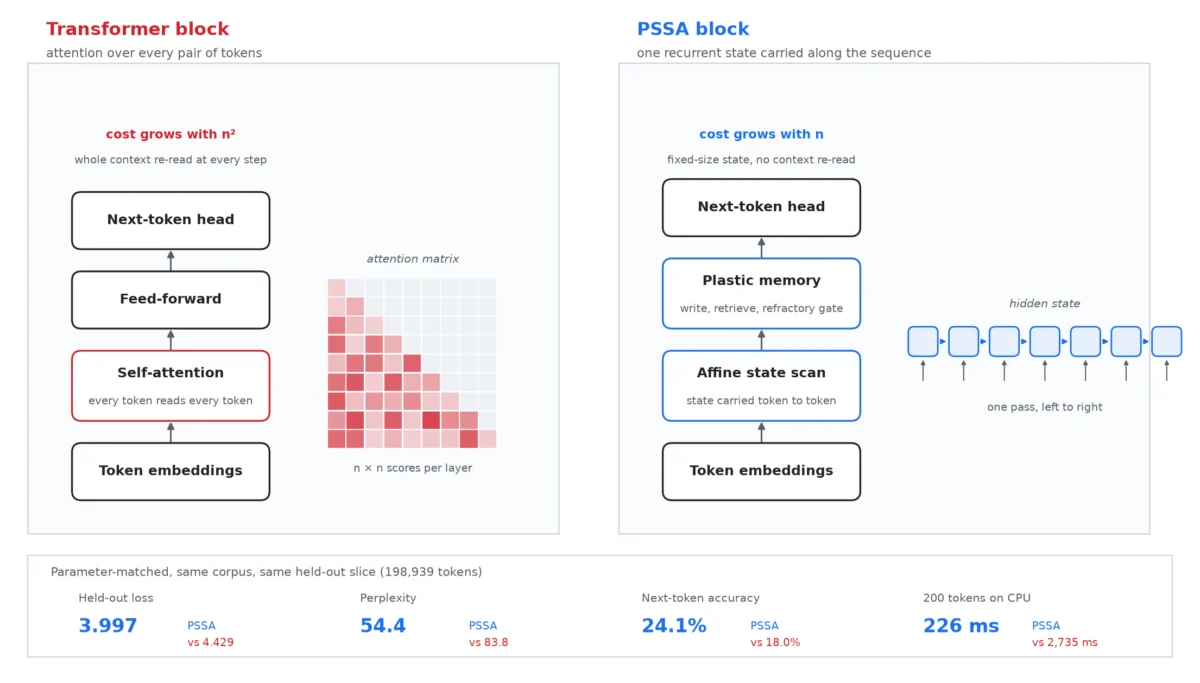
At the heart of the current AI boom is the Transformer model, which relies on a self-attention mechanism to weigh the importance of different words in a sequence. While powerful, this approach carries a significant drawback: the computational cost of self-attention grows quadratically with the sequence length. As a context window expands, the number of operations required to process a single token increases exponentially, making long-range memory expensive and slow.
PSSA replaces this with a recurrent state-space layer. Instead of re-reading the entire context window for every new token—a process that makes Transformers sluggish as conversations or documents grow—PSSA maintains a fixed-size internal state. As it reads text, it updates this state linearly. This allows for significantly faster generation speeds; internal benchmarks show PSSA generating text approximately twelve times faster than a parameter-matched Transformer on the same CPU.
However, the "Plastic" in PSSA refers to something even more radical: the ability of the model to rewrite parts of its own weights during the forward pass. By utilizing a bank of episodic memories and a mechanism for "plastic" weight updates, the model can store information and adapt its internal parameters on the fly, mimicking aspects of biological neural plasticity that traditional static models lack.
A Chronology of Development
The PSSA project began as an experiment in building an efficient language model without the abstraction layers of modern ML frameworks. The decision to use Rust was not driven by a desire for "speed points" or stylistic preference, but by necessity. Standard frameworks like PyTorch rely on "autograd" systems that make implementing non-standard, per-token weight updates and complex memory-bank interactions incredibly difficult.
To achieve the desired architectural behavior—specifically, the ability to differentiate through scalar-first linear algebra—the developers opted to write their own kernels. By doing so, they ensured that the model’s complex "plastic" updates could be rigorously checked against a reference implementation.

The development process prioritized mathematical verifiability. Every component of the model, from the selective state-space recurrence to the hyperbolic memory read, was designed to be checked term-by-term. This rigorous approach has allowed the team to maintain a gradient error threshold of approximately 3e-8, providing a level of reliability rarely seen in experimental AI research.
Supporting Data: Efficiency and Generalization
The performance metrics provided by the PSSA team are compelling. In a controlled study using 12.7 million tokens of cleaned WikiText-103, PSSA was compared against a standard Transformer with an identical parameter count, tokenizer, and optimizer schedule.
The results were stark: PSSA reached a training cross-entropy loss of 3.98, while the Transformer lagged behind at 4.43. More importantly, PSSA reached the Transformer’s final loss level in roughly one-sixth of the time. The training curves show that the two models never intersect; PSSA consistently outperforms the baseline, indicating that it is not just learning faster, but generalizing more effectively to unseen data.

When tested on a held-out slice of 198,939 tokens—data neither model had encountered during training—the gap remained consistent. PSSA achieved a perplexity of 54.4 compared to the Transformer’s 83.8, with a next-token prediction accuracy of 24.1% against 18.0%. These metrics suggest that PSSA’s architecture allows it to capture structural linguistic patterns more efficiently than the attention-based models currently in vogue.
Technical Architecture: Under the Hood
The PSSA layer operates through a sophisticated pipeline of operations for every token:
- Selective State-Space Recurrence: The model uses a diagonal recurrence where the step size, input map, and output map are all projections of the current token. This allows the model to selectively "forget" or "retain" information based on the input.
- Hyperbolic Memory Read: Unlike standard memory systems, PSSA stores information in hyperbolic space. This allows the model to keep "general context" and "specific episodes" distinct by utilizing the geometry of the Poincare ball. The read operation is bounded, ensuring that the cost per token remains constant regardless of the total memory capacity.
- Plastic Writing: This is the model’s most unique feature. When the incoming information is novel, the model triggers a write operation to its memory bank. It uses a refractory counter to prevent the system from overwriting stabilized memories, and utilizes a closed-form ridge regression to fold these fast-weight updates back into the base transition matrix.
- Gating and Adapters: A learned gate controls how much of the memory read reaches the residual stream, while a low-rank SiLU adapter provides the flexibility for targeted model updates.
Implications for the Future of AI
The success of PSSA poses a significant question for the AI industry: Are we over-relying on the Transformer architecture? While Transformers have enabled the current wave of generative AI, their reliance on quadratic-time attention may be a bottleneck that limits the development of truly autonomous, long-context models.

PSSA suggests that "plasticity"—the ability to update weights dynamically during inference—could be the missing link for models that need to learn in real-time without constant, expensive retraining. By shifting away from the massive, static "frozen" models of today toward smaller, more agile architectures, developers might be able to run state-of-the-art AI on consumer hardware rather than massive server clusters.
Furthermore, the rejection of "black-box" frameworks in favor of transparent, hand-written Rust code serves as a call to action for the research community. It highlights the potential for "clean-room" AI development, where the internal logic is visible, verifiable, and optimized for specific hardware constraints.
Current Limitations and Future Directions
Despite these impressive results, the developers are clear about the project’s current scope. PSSA is an experimental architecture. While it performs well at the 12.7 million token scale, it remains to be seen if these benefits translate to the multi-billion parameter scales used by commercial giants like OpenAI or Google.

The project currently faces a "compute barrier." Because the model was developed on entry-level hardware, many of the most interesting questions—such as whether the memory bank scales to massive datasets or if the performance gap widens as parameters increase—remain unanswered. The team has explicitly requested compute grants from the research community to scale up their testing, noting that "anything meaningfully above the entry-level card this ran on changes what can be asked."
Additionally, while PSSA outperforms the Transformer in next-token prediction, the developers admit that generation quality at this early stage of development remains limited. Both models produce fragmented or repetitive text, a common issue for small-scale language models.
How to Engage
For those interested in the technical mechanics of PSSA, the project is open-source and available for review. The codebase is designed to be accessible, with a CLI that supports everything from training and evaluation to real-time chat. The team encourages developers to contribute to the project, specifically in areas such as kernel performance optimization and the implementation of modern recurrent baselines for more rigorous comparison.

As the AI landscape continues to evolve, projects like PSSA remind us that innovation often happens on the periphery. By questioning the fundamental assumptions of modern deep learning, the creators of PSSA are paving the way for a more efficient, transparent, and dynamic future for artificial intelligence. Whether PSSA becomes a standard-bearer for new architectures or remains a brilliant proof-of-concept, it stands as a testament to the power of fundamental research conducted outside the constraints of corporate-backed AI labs.
 Sagoh
 Pevita Pearce
 Layla Zulfa
