
 By Iffa Jayyana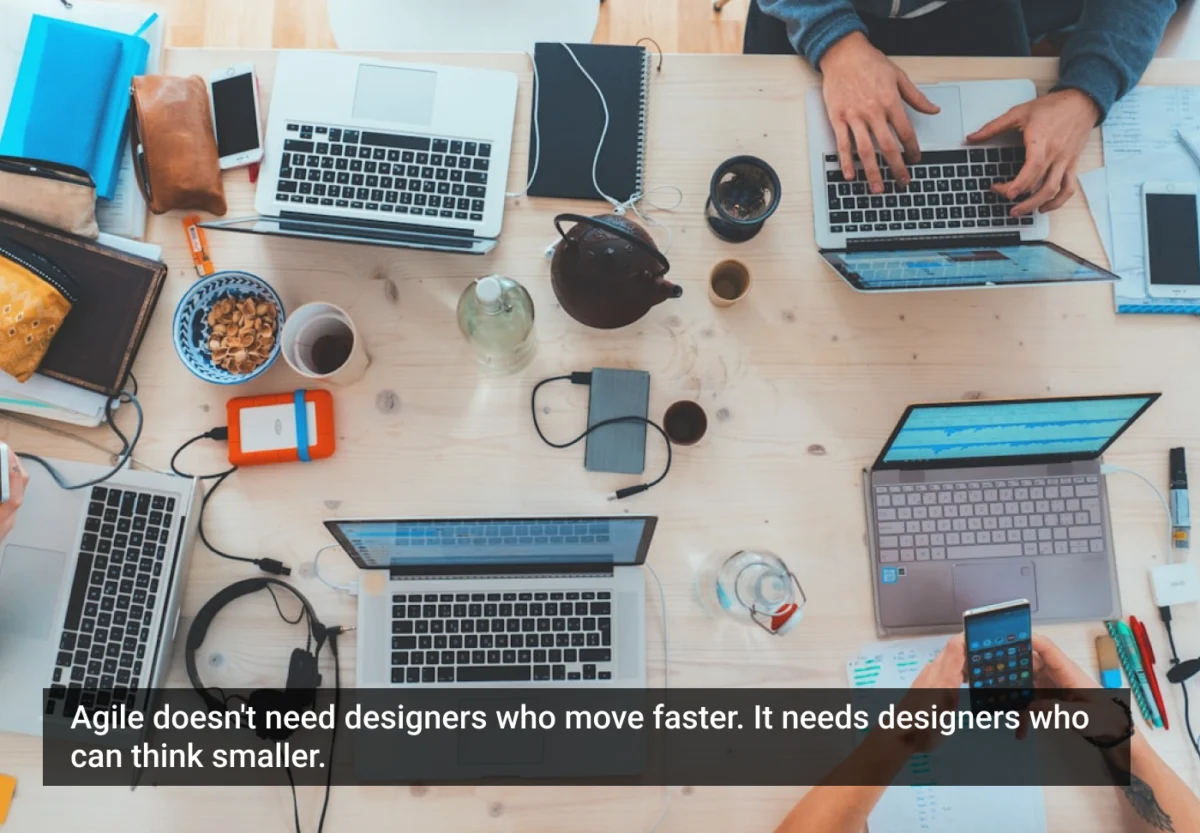
For over a decade, marketing professionals and product developers have operated under the banner of Agile. It has become the industry standard for software development, promising faster release cycles, improved team communication, and more responsive product management. Yet, for many UX designers transitioning into these high-velocity environments, the reality of Agile often clashes with the fundamental tenets of their craft.
The prevailing myth in the tech industry is that Agile is synonymous with speed. The pressure is constant: engineers are ready to build, product managers are churning out tickets, and the backlog is perpetually demanding more. The common assumption is that designers simply need to work faster to keep pace. However, as industry experts like Laura Klein have long argued, this framing is fundamentally flawed. Agile does not demand that designers work faster; it demands that they design smaller.
For a discipline trained to think in terms of holistic ecosystems and long-term structures, this shift in scale represents a profound professional challenge.
Main Facts: The Clash Between Holistic Design and Agile Slicing
The core conflict in modern product development lies between the designer’s instinct for systematic completeness and the Agile requirement for incremental delivery. UX design education typically emphasizes the "big picture"—understanding the entire user journey, the ecosystem of interactions, and the long-term scalability of a product.
This holistic approach is a strategic strength. It prevents fragmented experiences and ensures that a product can evolve without accumulating "design debt." However, in an Agile framework, teams rarely start with the full system. They operate in sprints, prioritizing small, buildable, and releasable slices of functionality.
When a designer is forced to abandon the "cathedral" in favor of a single "brick," the work can feel incomplete, risky, and intellectually unsatisfying. The designer is often left grappling with the discomfort of building a feature that lacks its full context, yet this is exactly where the value of Agile lies: the ability to ship, learn, and iterate.
Chronology: The Evolution of the "Small Slice" Philosophy
To understand why this friction exists, one must look at the evolution of software development methodologies:
- The Waterfall Era (Pre-2000s): Designers had the luxury of creating full-system specifications. Everything was mapped out from end-to-end before a single line of code was written. This provided comfort but led to massive failures when market needs changed midway through production.
- The Agile Pivot (2001–2010): With the introduction of the Agile Manifesto, the focus shifted to iterative development. Early adopters struggled, as designers were often treated as "pre-production" resources, creating static mockups that didn’t align with the technical realities of two-week sprints.
- The UX Integration (2010–Present): UX design began to embed directly into cross-functional teams. This brought the current tension to a head. Designers had to learn to operate within the "Sprint" cadence, leading to the current realization: the challenge isn’t speed, but modularity.
Supporting Data: The Anatomy of a Job Search Feature
To illustrate the difficulty of this shift, consider the development of a job search platform. A designer’s instinct is to design the entire experience: the homepage, the search filters, the job detail views, the application flow, the saved-jobs library, and the user profile.
If a team attempts to build this holistically, they face a months-long development cycle. If they fall into the trap of "horizontal slicing"—building all the backend search algorithms and filters first—they end up with a high-functioning search engine that has no content to display. The product is technically sound but useless to the end-user.
Data from product experiments consistently show that the most successful Agile teams ignore the "full system" approach in favor of the "Minimum Viable Value." In the job search scenario, the first slice might simply be a list of jobs with a rudimentary email-to-apply function. It lacks the polish of a full application system, but it yields immediate user data:
- Do users click the links?
- Do they understand the job descriptions?
- Is the current filter set relevant, or are they searching for something else entirely?
This data—collected in days rather than months—is the engine of Agile success.
Official Perspectives: Expert Insights on "Design Slicing"
Industry experts emphasize that the transition to designing smaller is a cultural shift as much as a technical one. Laura Klein, a prominent voice in the UX community, highlights that the "trap" of designing the whole system is a common pitfall for even the most talented designers.
"When you divide work by layers of functionality rather than by complete user value, you end up with pieces that cannot stand on their own," Klein notes. The official stance among modern design leaders is that if a slice of work does not provide enough value for the user to interact with it, the team has learned nothing from the release. The goal is to design a "slice of cake"—a vertical slice that includes a bit of the foundation, the structure, and the frosting—rather than a single layer of the cake.
Implications: The Future of the UX Professional
The shift toward designing smaller has significant implications for the future of the profession.
1. The Death of the "Big Design Up Front" (BDUF)
The days of spending weeks creating comprehensive documentation and full-system prototypes are waning. Modern UX professionals must become proficient at "just-in-time" design, where the detail is applied only when the feature is ready to be moved into a sprint.
2. Radical Prioritization
Designers are no longer just visual creators; they are product strategists. They must constantly ask, "What is the smallest version of this idea that still delivers real value?" This requires a deep understanding of business goals and technical constraints, pushing designers further into the realm of product management.
3. Embracing Incompleteness
Perhaps the most difficult implication is psychological. Designers must learn to find satisfaction in the "brick" rather than the "cathedral." Success is no longer measured by the elegance of the total vision, but by the effectiveness of the current, iterative release.
4. The Loop of Continuous Learning
Agile is not an end state; it is a learning loop. By designing smaller, teams reduce the cost of failure. If a design choice is wrong, the team has only lost a week or two of effort rather than months of work. The designer’s role, therefore, becomes one of a hypothesis-tester. They are not merely building what they think is correct; they are building to find out if they are wrong.
Conclusion: From Cathedral to Brick
For the designer who has spent years training to see the interconnectedness of all things, the Agile requirement to "think small" can feel like a degradation of the craft. Yet, when framed correctly, it is an elevation. It requires a more disciplined, evidence-based approach to design.
In an Agile environment, the "cathedral" still exists—it remains the designer’s North Star and long-term vision. But the act of building it has changed. We are no longer tasked with laying every stone according to a rigid, pre-ordained blueprint. Instead, we are tasked with laying one brick at a time, ensuring each is solid, useful, and contributing to the structural integrity of a vision that is constantly being refined by the realities of the user experience.
Designing small is not about reducing the quality of the work; it is about maximizing the intelligence of the process. For those who can master this transition, the result is a more resilient product and a more effective, data-informed design process. The cathedral will be built, but it will be built to survive the real world, one user-tested brick at a time.
 Nana Wu
  Sagoh
Sagoh  Nana
Nana 