
 By Lina Irawan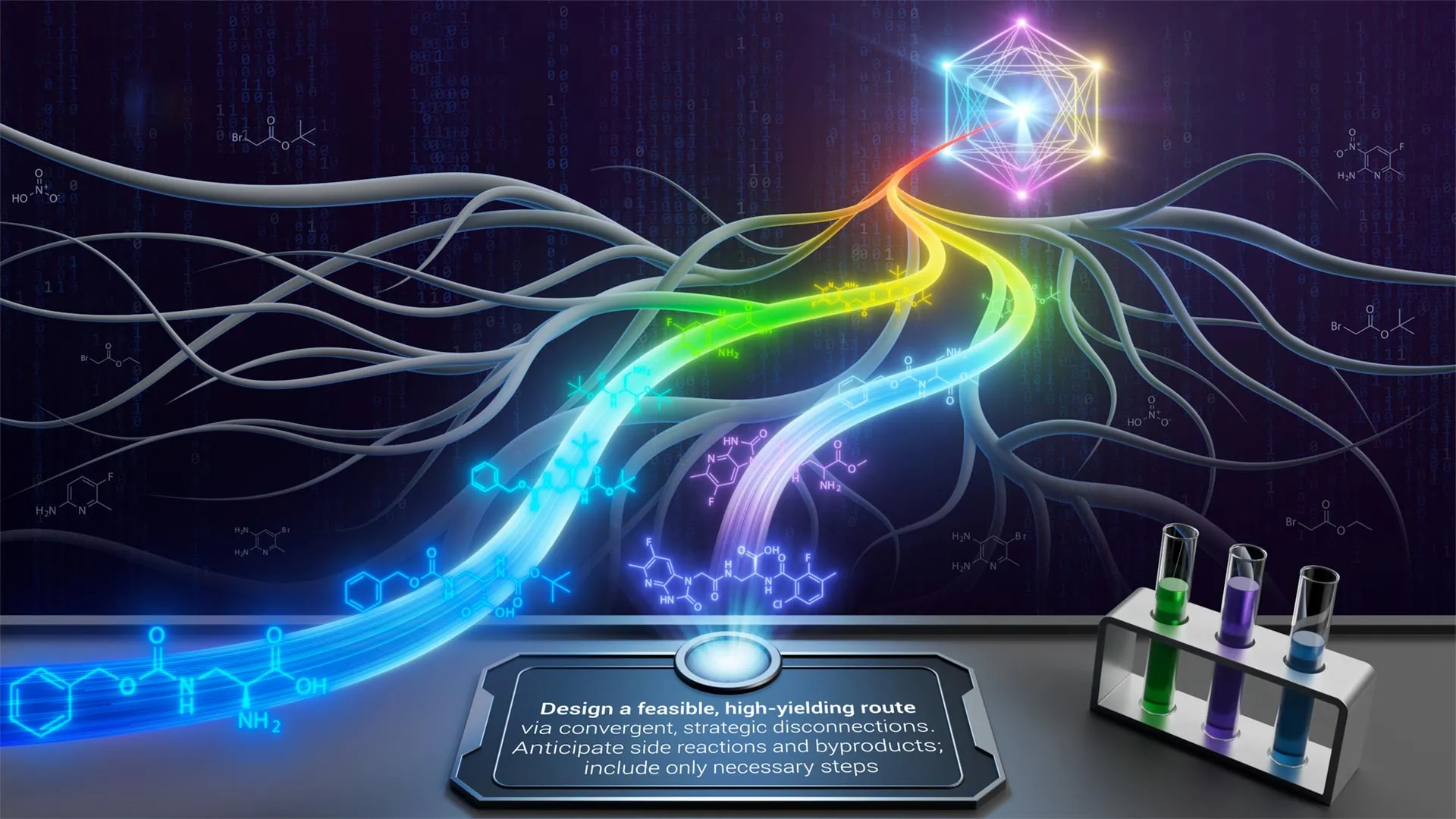
For decades, the synthesis of complex molecules has been the "Grand Challenge" of chemistry. Whether the objective is the creation of a life-saving oncology drug or the development of high-performance organic semiconductors for next-generation displays, the process remains an arduous, artisanal endeavor. Chemists must navigate a labyrinth of potential reaction pathways, balancing reactivity, yield, and safety, often relying on years of hard-won intuition to decide which route is worth pursuing in the laboratory.
However, a groundbreaking development from the Swiss Federal Institute of Technology Lausanne (EPFL) is poised to fundamentally alter this landscape. Researchers led by Philippe Schwaller have introduced "Synthegy," an innovative framework that leverages the reasoning capabilities of Large Language Models (LLMs) to act as a bridge between human strategic intent and computational chemistry. By allowing scientists to communicate their synthetic goals in natural language, Synthegy is not just automating chemistry—it is augmenting the cognitive process of discovery itself.
The Complexity of Retrosynthesis
To understand the significance of this advancement, one must first appreciate the magnitude of the problem known as "retrosynthesis." In this methodology, a chemist identifies a target molecule—the final, desired product—and works backward to deconstruct it into simpler, commercially available precursors.
This process is exponentially complex. A single molecule can theoretically be synthesized through thousands of different pathways. Chemists must make critical strategic decisions at every junction: Which bonds should be formed first? How can we construct complex rings without creating steric hindrance? Most importantly, are there sensitive functional groups within the molecule that require "protection"—the temporary addition of a chemical shield to prevent unwanted side reactions?
Traditionally, computational tools have struggled with this level of nuance. While software can scan vast "chemical spaces" faster than any human, these algorithms often lack the qualitative judgment that a seasoned chemist employs. A computer might suggest a mathematically "optimal" route that is practically impossible to perform in a wet lab due to subtle, context-dependent chemical constraints.
Chronology of a Chemical Revolution: From Heuristics to LLMs
The trajectory of computational chemistry has been marked by a move toward ever-increasing intelligence.
- 1960s–1980s (The Era of Rules): Early pioneers like E.J. Corey developed the first computer-aided synthesis planning programs, which relied on rigid, human-coded "if-then" rules. While visionary, these systems were brittle and incapable of learning from new, unpublished data.
- 2000s–2010s (The Era of Big Data): With the explosion of chemical databases, researchers began using machine learning to predict reaction outcomes based on historical patterns. These tools improved speed but still operated like "black boxes," often providing outputs without explaining the underlying chemical logic.
- 2023–2024 (The Era of Synthetic Reasoning): The emergence of the Synthegy framework represents the latest milestone. By treating chemistry as a language—where molecules, reaction mechanisms, and strategic constraints are interpreted as structured text—the EPFL team has enabled a "conversation" between the chemist and the machine.
Synthegy: A New Paradigm in Chemical Reasoning
The Synthegy framework, detailed in the journal Matter, functions not as a replacement for existing computational engines, but as an intelligent, conversational interface. It combines traditional search algorithms with the linguistic reasoning of an LLM.
The Mechanism of Action
When a chemist initiates a project, they no longer need to navigate cumbersome, menu-driven software. Instead, they provide a natural language instruction: "Synthesize this target, but prioritize an early formation of the piperidine ring and avoid the use of silyl protecting groups."
The system then performs the following steps:
- Search Generation: Traditional retrosynthesis algorithms generate a variety of potential synthetic pathways.
- Linguistic Translation: These pathways are converted into descriptive text.
- LLM Evaluation: The language model acts as an expert peer reviewer. It scores each route based on how well it adheres to the chemist’s specific strategic constraints, providing a written rationale for why a particular route is superior or inferior.
- Refinement: The chemist receives a ranked list of pathways, complete with reasoning, allowing them to iterate and refine their approach in real-time.
Supporting Data: Validating the AI Chemist
The efficacy of Synthegy was rigorously tested in a double-blind study involving 36 professional chemists. The researchers presented these experts with a diverse range of synthetic challenges to see if their professional judgment aligned with the AI’s recommendations.
The results were compelling. Across 368 valid evaluations, the chemists’ assessments matched the output of the Synthegy system 71.2% of the time. This high degree of correlation suggests that the model has successfully internalized the nuances of chemical "common sense."
Furthermore, the study highlighted a crucial observation regarding model architecture: performance scaled with size. Larger language models demonstrated a superior ability to interpret subtle chemical instructions and flag infeasible reaction steps compared to their smaller counterparts. This suggests that as models continue to grow in capability, the precision of Synthegy will likely improve, further reducing the reliance on costly, time-consuming trial-and-error in the laboratory.
Official Perspectives: Bridging the Gap
The team behind the research emphasizes that the goal is not to remove the human element from chemistry, but to empower it.
"When making tools for chemists, the user interface matters a lot," explains Andres M. Bran, the first author of the Synthegy paper. "Previous tools relied on cumbersome filters and rules that often frustrated users. With Synthegy, we’re giving chemists the power to just talk to the software, allowing them to iterate much faster and navigate more complex synthetic ideas."
Philippe Schwaller, the lead researcher, views this as a fundamental shift in how we approach chemical discovery. By integrating reaction mechanisms—the step-by-step movement of electrons—with retrosynthetic planning, the system provides a holistic view of the molecule’s life cycle. "The connection between synthesis planning and mechanisms is very exciting," Bran notes. "We usually use mechanisms to discover new reactions that enable us to synthesize new molecules. Our work is bridging that gap computationally through a unified natural language interface."
Implications for Future Discovery
The implications of this technology are far-reaching, touching several critical sectors:
1. Accelerated Drug Discovery
In the pharmaceutical industry, the speed at which a candidate molecule can be synthesized is often the primary bottleneck in drug development. By filtering out non-viable routes before a single drop of solvent is used, Synthegy can significantly shorten the "Design-Make-Test-Analyze" cycle, potentially bringing life-saving drugs to market months or even years earlier.
2. Enhanced Reaction Design
Because Synthegy can analyze reaction mechanisms in addition to retrosynthesis, it can help researchers understand why a reaction succeeds or fails. This predictive power is invaluable for optimizing yields and minimizing the production of toxic byproducts, aligning with the principles of "Green Chemistry."
3. Democratization of Advanced Chemistry
By replacing complex, rigid interfaces with natural language, these tools lower the barrier to entry for early-career researchers and scientists in smaller laboratories who may not have access to massive supercomputing clusters or the time to master legacy software.
Looking Ahead: The Future of Autonomous Labs
While Synthegy is a massive leap forward, the researchers at EPFL are already looking toward the next frontier: the fully autonomous "self-driving" laboratory.
If an AI can plan a synthesis, explain its strategy in human terms, and verify its own mechanisms, the final step is the physical execution of these steps by robotic platforms. As these language models become more adept at interpreting the physical realities of the lab—such as temperature constraints, solvent compatibility, and equipment availability—we move closer to a future where a scientist can simply describe a new material, and the facility itself handles the synthesis.
However, for now, the "Human-in-the-Loop" remains the core of the Synthegy philosophy. By positioning the AI as a consultant rather than a commander, the EPFL team has ensured that human creativity remains the driving force behind scientific advancement. The future of chemistry is not about machines replacing chemists, but about the synergy between human intuition and the infinite, structured reasoning of artificial intelligence. Through Synthegy, that future is beginning to take shape.
 Sagoh
Sagoh  Asro
Asro  Siti Muinah