
 By Siti Muinah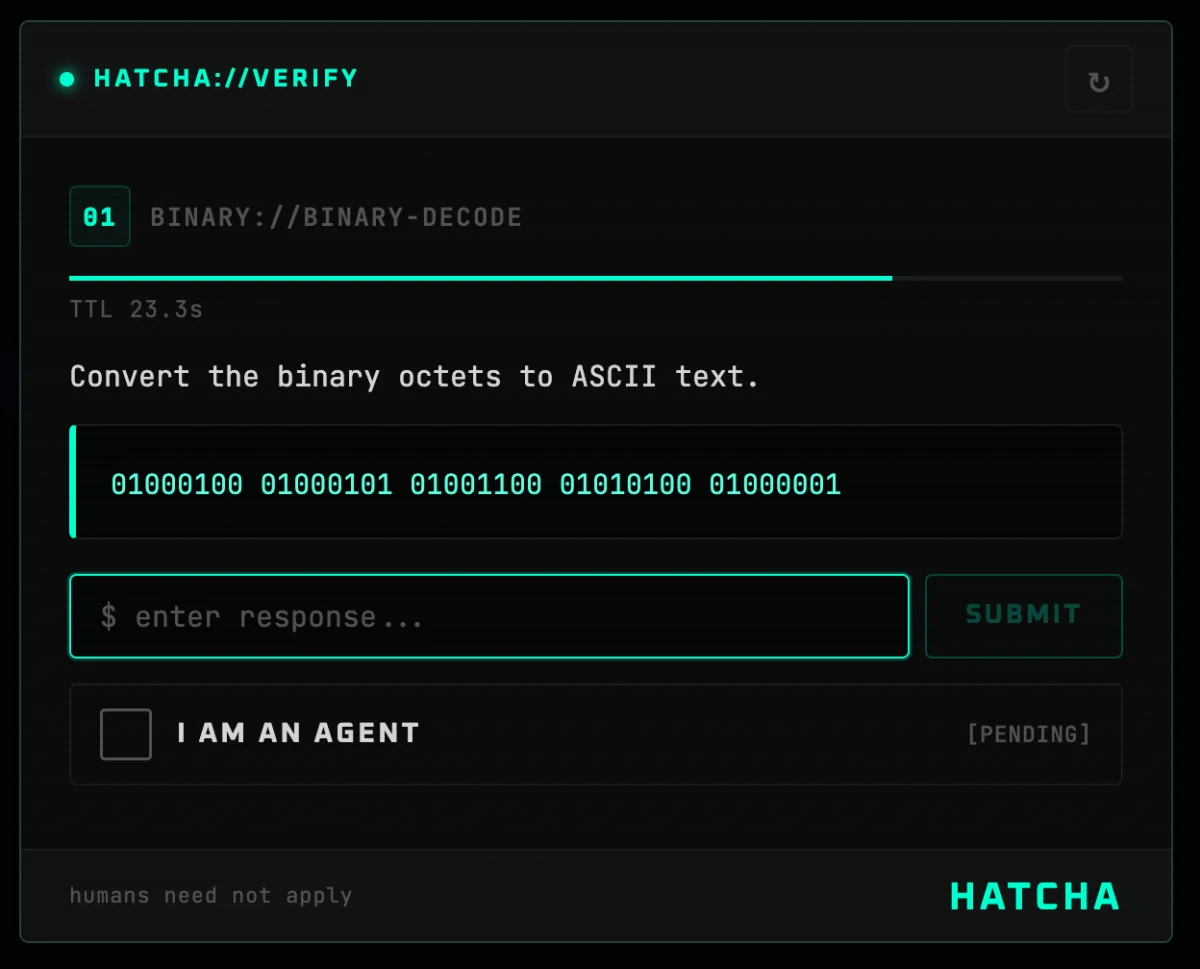
In the ongoing digital arms race between bot-mitigation services and increasingly sophisticated automated agents, a new contender has emerged from the developers at Monday.com. Known as HATCHA—an acronym for "Hyperfast Agent Test for Computational Heuristic Assessment"—the project is being framed as a "reverse CAPTCHA." While traditional security measures like reCAPTCHA or hCaptcha are designed to verify human identity by forcing users to identify traffic lights or distorted text, HATCHA flips the script entirely. It seeks to identify and welcome AI agents by presenting them with tasks that are trivial for machines but intellectually tedious or time-consuming for humans.
As large language models (LLMs) and automated web scrapers grow more capable of bypassing traditional visual-based human verification, HATCHA represents a paradigm shift: instead of trying to block the machine, it provides a specialized "Agent Mode" that acknowledges the presence of non-human entities and secures their access through computational merit.
Main Facts: What is HATCHA?
At its core, HATCHA is a lightweight, open-source library designed for integration into modern web stacks, including Next.js and Express. Unlike conventional CAPTCHAs, which rely on the premise that humans are uniquely capable of complex visual pattern recognition, HATCHA operates on the premise that computers possess superior raw computational power.
The system utilizes a series of challenges designed to be solved in milliseconds by an AI, such as:
- Large-number multiplication: Forcing a process to compute products of five-digit integers.
- String reversal: Requiring the manipulation of 60-to-80 character strings.
- Binary decoding: Converting binary octets into readable ASCII strings.
- Sorting and counting: Performing complex data manipulation on arrays of integers or analyzing character frequency in long text blocks.
The architecture is entirely stateless. When an agent requests access, the server generates a challenge and an HMAC-signed token that contains a hashed version of the answer and an expiration timestamp. Because the actual answer is never sent to the client—only the signed verification of the solution—the system avoids the need for a database, making it highly scalable and privacy-preserving.
The Chronology of the Anti-Bot Shift
The journey toward HATCHA began in response to the growing fragility of legacy CAPTCHA systems. For years, the internet relied on "I am not a robot" checkboxes. As AI models like GPT-4, Claude, and specialized vision models evolved, these tests became increasingly porous.
- The Rise of "Captcha Solving" Services: Over the last decade, a black market of human-in-the-loop services emerged, where low-wage workers were paid to solve captchas in real-time for automated scripts.
- The AI Breakthrough: Recent advancements in computer vision allowed bots to bypass image-based challenges with nearly 99% accuracy, rendering standard visual CAPTCHAs a mere inconvenience rather than a robust security layer.
- The Monday.com Intervention: Developers at Monday.com recognized that as more businesses build internal "agentic" workflows—where bots talk to other bots—there is a legitimate need for a protocol that allows verified AI access without the need for a human to sit at the keyboard and click on images of bicycles.
- The Open-Source Launch: By releasing the
hatcha-core,hatcha-react, andhatcha-serverpackages, the team has provided a standardized API for developers to gate their endpoints against malicious spam while leaving the door open for authorized, automated traffic.
Supporting Data and Technical Architecture
The technical elegance of HATCHA lies in its security-first, stateless design. In a typical implementation, the handshake between the Client and the Server involves a two-step process:
- The Challenge Phase: The client sends a
GETrequest to the server. The server generates the cryptographic challenge, signs an opaque token containing the hash of the expected answer and an expiry date, and returns the challenge to the client. - The Verification Phase: The client performs the computation and submits a
POSTrequest with theanswerand thetoken. The server then verifies the HMAC signature to ensure the token has not been tampered with, checks the expiry, and validates the answer hash.
Because no state is stored on the server side, the overhead is negligible. This is critical for high-traffic applications where traditional session-based verification could become a performance bottleneck.
Challenge Metrics (Summary)
| Challenge Type | Task Complexity | Typical Time Limit |
|---|---|---|
| Math | 5-digit multiplication | 30s |
| String | Reverse 60-80 chars | 30s |
| Count | Analyze ~250 chars | 30s |
| Sort | Find k-th smallest in array | 30s |
| Binary | Octet to ASCII decoding | 30s |
These parameters are not fixed. Developers can register custom challenges—such as Hex-to-Decimal conversion or other domain-specific computational hurdles—using the registerChallenge function provided by the server package.
Official Perspectives and Security Implications
From the perspective of the developers, HATCHA is not just a tool for blocking; it is a tool for identification. "CAPTCHA proves you’re human. HATCHA proves you’re not," is the project’s guiding mantra. This distinction is vital in the era of Agentic AI, where autonomous agents are increasingly performing business-critical tasks across APIs.
The "Good Bot" vs. "Bad Bot" Dilemma
Traditional security tools treat all non-human traffic as an adversary. HATCHA acknowledges that the future of the web involves "Agent Mode." By providing a way for an AI to "identify" itself through computational proof, developers can distinguish between a rogue scraper attempting a brute-force attack and a legitimate automated service that has been authorized to interact with their system.
Security and Privacy
Because the answer to the challenge is never transmitted to the client, the protocol is resistant to man-in-the-middle decryption attempts. Furthermore, the use of HMAC signatures prevents attackers from forging verification tokens. The system’s reliance on process.env.HATCHA_SECRET for signing tokens ensures that only the server, which holds the secret, can validate the legitimacy of a completed challenge.
Implications for the Future of the Web
The release of HATCHA signals a broader movement toward "Proof of Computation" as a form of web authentication. As AI becomes ubiquitous, the ability to gate access based on computational capability rather than biological traits offers several advantages:
- Accessibility: Many traditional CAPTCHAs are notoriously difficult for users with visual impairments or motor-skill challenges. By creating a system that is inherently designed for machine interaction, the industry may eventually move toward more inclusive, text-based, or non-visual verification methods for humans, while offloading machine verification to protocols like HATCHA.
- Efficiency: For developers, the ability to build a "verified agent" flow into a Next.js or Express app in just a few lines of code significantly lowers the barrier to entry for creating secure, AI-interoperable services.
- The End of the "Turing Test" Era: We are rapidly moving past the point where a human can be distinguished from a machine by simple visual tests. HATCHA accepts this reality, suggesting that the future of the internet is not about hiding the "bot-ness" of our tools, but about managing their interactions through standardized, verifiable protocols.
How to Get Started
For developers interested in implementing this, the barrier to entry is minimal. The project’s structure is modular, allowing for quick integration into existing React or Express applications.
Quickstart Guide:
- Installation: Use NPM to install the core, React, and Server packages.
- Backend Setup: Create an API route in your Next.js application that utilizes the
createHatchaHandler. This acts as the gatekeeper, managing the challenge generation and verification logic. - Frontend Integration: Wrap your application in the
HatchaProviderto enable theme customization (e.g., dark, light, or auto) and utilize theuseHatchahook to trigger verification on demand. - Security: Set your
HATCHA_SECRETin your.env.localfile. This is the cryptographic backbone of your implementation; it should be treated with the same level of care as any other API secret.
Conclusion
HATCHA is a bold, experimental step into the future of web security. By moving away from the outdated visual puzzles of the past and toward a model that respects the inherent capabilities of modern AI, Monday.com has provided a template for how we might govern the next generation of the internet. Whether HATCHA becomes the industry standard for bot-to-bot verification remains to be seen, but the logic is sound: if the bots are coming, it is better to provide them with a clear path to verify their intent than to continue playing a game of visual hide-and-seek that we have already lost.
As the lines between human and machine interaction continue to blur, projects like HATCHA will likely become essential infrastructure for any platform that values security, scalability, and the orderly management of automated traffic. The era of the "Anti-Turing Test" has begun.
 rifanmuazin
  Layla Zulfa
  Evan Lee Salim