
 By Sagoh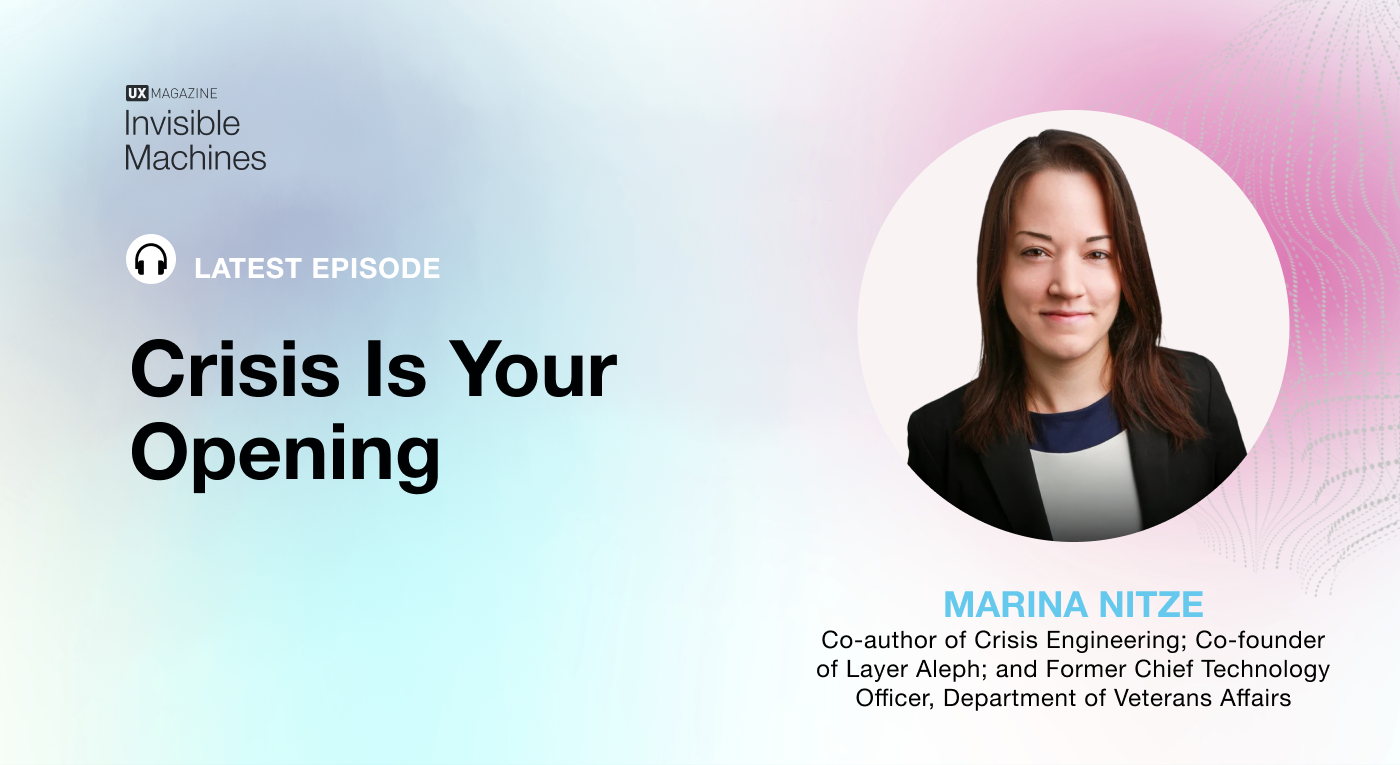
In the high-stakes world of organizational management, there is a pervasive, comforting fiction that leaders tell themselves: the machine works as documented. Processes are codified, org charts are clear, and systems—whether technical or human—are functioning as designed. But as Marina Nitze, former Chief Technology Officer of the Department of Veterans Affairs and co-founder of Layer Aleph, argues, this is rarely the case.
Nitze’s work centers on a concept called "sensemaking"—the process by which individuals and institutions construct stories to explain their environment. When these stories become detached from reality, organizations drift into a state of structural blindness. It often takes a systemic collapse—a "useful crisis"—to shatter these illusions and reveal how things actually work.
As we stand on the precipice of an AI-driven revolution, the gap between the "map" (how we think the organization works) and the "territory" (the reality of daily operations) is becoming a liability that few companies can afford to ignore.
The Phantom Call Center: A Case Study in Institutional Blindness
The most vivid illustration of this dissonance occurred during the COVID-19 pandemic. As California’s unemployment system buckled under unprecedented volume, the state’s leadership remained anchored to a single, reassuring narrative: "Don’t worry, we have the call center."
For weeks, executives and managers repeated this phrase like a protective talisman. They believed that despite the chaos, there was a centralized hub of operators ready to process the surge in claims. When Nitze and her team were brought in to troubleshoot the breakdown, they decided to verify the story. They walked into the building designated as the "call center" and found a vast, empty room of silent cubicles.
The reality was far more mundane—and far more disastrous. There was no centralized call center. There never had been. The "system" was merely a phone number that routed calls to the individual desks of unemployment specialists. When those employees were sent home due to the pandemic, the calls rang out into an empty office.
The employees weren’t lying, nor were the executives intentionally deceitful. They were victims of their own sensemaking. They had constructed a story of an efficient, functioning system based on fragmented, internal perceptions. Because the story was coherent, it was never stress-tested. It was only when the crisis forced a physical audit of the "territory" that the fiction was exposed.
The Anatomy of a "Useful Crisis"
Nitze’s framework, detailed in her book Crisis Engineering, argues that crises are not merely events to be survived; they are windows of opportunity to force institutional change. She defines a "useful crisis" through five specific, non-negotiable indicators:
- Fundamental Surprise: The event was not anticipated or modeled in risk assessments.
- Disruption in Core Function: Essential services, such as claim processing or order fulfillment, are completely halted.
- Rigid Timeline: There is no room for indefinite delay; the market or the public demands a solution within a fixed, unforgiving timeframe.
- High Visibility: The crisis is public, trending on social media, or sitting on the desk of a C-suite executive.
- Failure of Sensemaking: The internal narrative—the story of how the organization works—has been proven demonstrably false.
The fifth indicator is the engine of change. Humans and organizations possess a profound aversion to cognitive dissonance. When their mental models shatter, they scramble to assemble a new one. This short window of disorientation—lasting mere hours or days—is the only time that decades of bureaucratic inertia can be overcome in a single afternoon.
Bureaucracy vs. Novel Action: The Cost of Stalling
When a crisis hits, most organizations fall into a defensive, performative loop. They commission studies, assemble task forces, and produce progress reports. While this behavior is rewarded as "due diligence," Nitze notes that it is actually a stalling tactic designed to fill the window of opportunity until it closes.
The alternative, which she labels "novel action," requires the courage to test theories in real-time. Instead of holding six days of meetings to analyze a technical outage, an organization should treat the system as a hypothesis.
"I think it’s DNS," is a better starting point than "Let’s form a committee to audit the network architecture." If the theory is right, the problem is solved. If it is wrong, the organization has gained a vital piece of information about its actual operational reality. By prioritizing action over deliberation, companies can bypass the layers of "map-making" that usually obscure the truth.
Lessons from the Field: The Foster Care Bottleneck
The danger of ignoring the "territory" is not limited to tech stacks; it extends to the most critical human services. In her work with foster care systems, Nitze encountered a six-month delay in licensing foster grandparents.
The process involved a caseworker who had to submit a carbon-copy form to the DMV to request a driving record. The caseworker hated the form, blaming the DMV’s "19th-century" practices. Nitze, ignoring traditional jurisdictional boundaries, went straight to the DMV. The DMV employee was confused, noting that she had been receiving the requests via email for years and processing them in an hour.
The dysfunction wasn’t in the DMV or the child welfare department; it was in the gap between them. By simply introducing the two parties and reconciling their conflicting stories, Nitze reduced the timeline by 30 days. Eventually, the step was removed entirely because, upon examination, no one could justify why a driving record was required to care for a child. This is the power of "walking the process"—following a workflow from start to finish to see where the story breaks.
The AI Accelerant: Why the Stakes are Rising
As artificial intelligence begins to interface with legacy systems, the "call center" problem is about to scale exponentially. Consumer-grade AI agents are now capable of probing organizational systems, navigating complex IVR trees, and finding the human in the loop to extract concessions.
This is not a hypothetical future; it is already happening. When a Reddit forum discovered the TTY line for deaf claimants during the pandemic, the volume of calls exploded and effectively brought the system down. AI agents, capable of navigating such gaps at thousands of times the speed of a human, will expose every organizational fiction currently in existence.
If an organization automates without "walking the process" first, it is simply building a highly efficient engine for a broken car. They are encoding the "map" (the carbon copy form) into the code, rather than the "territory" (the actual need). This leads to a dangerous paradox: the more an organization automates a flawed system, the more catastrophic the eventual crisis will be.
Preparation: Building for the Inevitable
The ultimate takeaway from Nitze’s philosophy is that you cannot prevent every crisis, but you can prepare to thrive within one. Preparation, in this context, is highly specific:
- Infrastructure: Maintain a crisis engineering center and communication channels that operate independently of your primary infrastructure.
- "Spicy Days": Use planned events like product launches or traffic surges to practice your crisis response.
- The "Back Pocket" Plan: Always have a pilot project or a data-backed proposal ready. When the crisis hits, you will not have time to build a proposal from scratch. The organization will be looking for a new story to replace the shattered one; if you have a coherent, tested, and evidence-based plan ready, it will become the new reality.
As Robb Wilson of Invisible Machines noted, the foundational layer of AI adoption—knowledge management and institutional memory—is often the hardest to fund because it lacks the "flash" of automation. Yet, without it, AI is merely a tool that accelerates the failure of an organization to understand itself.
The crisis is coming. The windows of opportunity will open. The question for every leader, developer, and public servant is: when the old story fails, what are you prepared to replace it with? And more importantly, is that new story true?
 Laily UPN
  Lina Hope
  Asep Darmawan