
 By Reynand Wu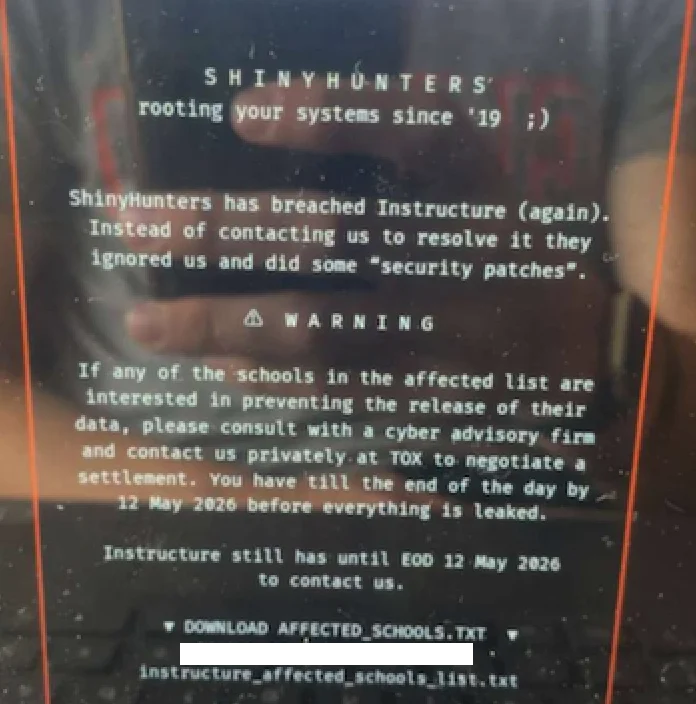
The digital infrastructure supporting the United States education system faced a seismic disruption in early May 2026, as the widely-used learning management system Canvas—operated by the parent firm Instructure—was compromised in a high-profile data extortion attack. The incident, orchestrated by the notorious cybercrime syndicate ShinyHunters, paralyzed classrooms and coursework across thousands of institutions, turning a routine technical update into a cautionary tale about systemic vulnerability in the EdTech sector.
The breach threatened the privacy of an estimated 275 million students and faculty members. It culminated in a public display of power when attackers defaced the Canvas login portal with a direct ransom demand, forcing the company to take its services offline at the height of the academic examination season.
Chronology of a Coordinated Siege
The crisis was not an isolated event but rather the climax of a persistent, eight-month campaign of digital infiltration.
The September 2025 "Proof of Concept"
While the public focus shifted to the events of May 2026, security analysts trace the origin of this campaign back to September 2025. At that time, the University of Pennsylvania suffered a significant leak of sensitive documents, including internal memos and donor records. While many observers initially treated the breach as a local university failure, forensic analysis by security firm Cloudskope revealed that the attackers had exploited an access path mediated by Instructure’s environment. This served as the initial "proof of concept" for ShinyHunters, demonstrating that they could leverage the interconnected nature of the Canvas ecosystem to extract data from high-profile targets.
The May 2026 Escalation
The situation intensified on May 1, 2026, when ShinyHunters successfully breached Instructure’s systems. By May 2, Instructure’s Chief Information Security Officer, Steve Proud, issued a public declaration that the incident had been "contained." However, this assessment proved premature.
On May 6, Instructure acknowledged a data breach involving user names, email addresses, and internal messages, while simultaneously insisting the platform was fully operational. Yet, by May 7, the situation spiraled into a public relations disaster. Users across the country reported that the Canvas login page had been replaced by a ransom note. Instructure was forced to pull the platform offline, citing "scheduled maintenance"—a move that was later heavily criticized by security experts as an attempt to downplay the severity of the intrusion.
Resolution and Data "Shredding"
Following days of instability, Instructure eventually admitted that the issue stemmed from vulnerabilities within "Free-for-Teacher" accounts. On May 11, the company made a controversial announcement: it had paid an undisclosed ransom to the attackers in exchange for the destruction of the stolen data. The company claimed it had received "shred logs" as digital proof that the stolen information had been purged, and it assured its partners that no further extortion would occur.
The Modus Operandi of ShinyHunters
ShinyHunters is a fluid and highly effective cybercriminal collective that has become a fixture in the modern threat landscape. Unlike ransomware groups that focus on encrypting data to block access, ShinyHunters specializes in data extortion—the theft of sensitive information followed by threats to publish it unless a ransom is paid.
The group’s methodology is remarkably consistent, favoring "soft" entry points over complex technical exploits. They frequently utilize voice phishing (vishing) and social engineering to impersonate IT personnel, tricking employees into granting them access to internal systems, such as Okta single sign-on accounts or Salesforce instances.
Their track record is extensive, with recent high-profile victims including:
- ADT: 5.5 million customer records compromised via an employee’s SSO account.
- Major Corporations: Organizations such as Medtronic, Rockstar Games, McGraw Hill, 7-Eleven, and Carnival cruise lines have all faced the group’s pressure tactics.
The group’s ability to "re-compromise" targets—as seen with Instructure—highlights their persistence. They view security patches as mere obstacles to be navigated, often returning to the same environment if they identify residual entry points.
Official Responses and Strategic Failures
Instructure’s handling of the crisis has drawn sharp criticism from the cybersecurity community. Dipan Mann, CEO of Cloudskope, highlighted a significant disconnect between the company’s internal rhetoric and the reality on the ground. By labeling the emergency outage on May 7 as "scheduled maintenance," Instructure lost the trust of the very institutions it serves.
Furthermore, the company’s initial claim that the incident was contained on May 2 was invalidated just five days later when the login portal was defaced. Critics argue that this demonstrates a failure in incident response maturity. By the time the company finally admitted the breach’s full scope, the narrative had already been controlled by the attackers.
In its official updates, Instructure maintained a stance of transparency, albeit delayed. They emphasized that they were working with law enforcement and that their priority was the protection of the user base. By the time of the final resolution on May 11, the company’s focus shifted to damage control, confirming that the ransom payment was a necessary step to protect students and faculty from future extortion attempts.
Implications for the EdTech Ecosystem
The Canvas breach serves as a watershed moment for the education technology sector, raising three critical concerns:
1. The Risk of Centralized Dependency
The modern education system relies on a handful of massive platforms. When a single provider like Instructure is compromised, the impact is not limited to a single school, but ripples across thousands of districts. This creates a "single point of failure" that cybercriminals are increasingly exploiting for maximum leverage.
2. The "Path of Least Resistance"
As noted by security experts, the education sector has historically preferred to handle breaches quietly, hoping to avoid the scrutiny that comes with public disclosure. However, this culture of silence allows criminal groups to thrive. If schools continue to pay ransoms or absorb the fallout without demanding more rigorous security standards from their vendors, the cycle of extortion will inevitably continue.
3. The Shift in Ransomware Tactics
The Canvas incident proves that data extortion does not require the encryption of files to be effective. By simply holding a login portal hostage and threatening the privacy of millions of students, attackers can exert immense pressure on a company’s stock price, reputation, and operational continuity.
Conclusion: A Call for Hardened Security
The May 2026 Canvas breach is not merely an IT issue; it is a fundamental challenge to the digital integrity of the American classroom. While the payment of the ransom may have ended the immediate threat of data leakage, the underlying vulnerabilities—specifically the "Free-for-Teacher" accounts and the reliance on human-centric authentication—remain significant risks.
As educational institutions look to the future, the reliance on third-party SaaS (Software as a Service) providers must be tempered with robust vendor risk management. The era of trusting platforms implicitly is over. For Instructure, the path forward requires not just technical remediation, but a total rebuilding of the trust that was lost during these nine days in May. Until then, the education sector remains a prime target for groups like ShinyHunters, who have demonstrated that they are willing to play the long game to turn student data into their next payday.
 Sagoh
Sagoh  Evan Lee Salim
  Ammar Sabilarrohman