
 By Muslim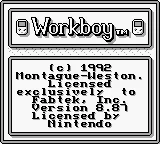
In the annals of gaming history, few artifacts remain as elusive or as historically significant as the Workboy. Originally conceived in the early 1990s as an ambitious accessory designed to transform Nintendo’s monochromatic Game Boy into a handheld personal digital assistant (PDA), the project vanished into obscurity, seemingly lost to time. For nearly thirty years, Workboy existed only as a ghost in the pages of trade magazines—a promised revolution in mobile computing that never reached the retail shelf. However, the 2020 discovery of the project’s source code and a functioning hardware prototype has allowed historians to finally piece together the story of the device that almost turned the Game Boy into the world’s first truly portable office.
The Vision: A Micro Workstation for the Handheld Era
Developed by Source and licensed through the enigmatic Montague-Weston, Workboy was positioned as a professional-grade add-on. At a time when the Game Boy was synonymous with Tetris and Super Mario Land, the idea of using the platform for productivity was revolutionary. The hardware was designed to be a comprehensive suite: a full QWERTY keyboard attachment that interfaced with a specialized Game Boy cartridge.
The software included within the Workboy ROM was remarkably advanced for 1992. It featured a robust set of utilities, including an address book, a scheduler for appointments, a calculator, a currency converter, a temperature unit converter, and a multi-lingual translator capable of cycling through five different languages. It was intended to be the ultimate companion for the traveling business professional, providing a level of utility that would not become commonplace in the consumer market for another decade.
A Chronology of Obsolescence
The timeline of Workboy is one of high-concept ambition followed by a quiet, mysterious cancellation.
1992: The Promotional Blitz
During the early months of 1992, Workboy appeared frequently in promotional material, most notably in Nintendo Power. The marketing imagery showcased a sleek, compact keyboard peripheral that snapped onto the Game Boy’s base, effectively turning the handheld console into a miniature laptop. The industry buzz was palpable; it promised to bridge the gap between entertainment and work.
1992–2020: The Silent Years
Despite the aggressive marketing, the product never materialized. For nearly three decades, Workboy was relegated to the status of a “vaporware” legend. It was assumed that the project had been scrapped due to technical limitations, manufacturing costs, or a lack of market confidence from Nintendo. As time marched on, the physical prototypes were presumed destroyed or lost in corporate storage.
September 2020: The Nintendo Leak
The narrative shifted dramatically in September 2020, when a massive data breach of Nintendo’s internal servers—often referred to as the "Gigaleak"—sent shockwaves through the gaming preservation community. Buried within the terabytes of source code, development documentation, and unreleased prototypes was the ROM for the Workboy cartridge. The discovery confirmed that the software was not only real but essentially complete, waiting for a hardware counterpart that the world still believed was lost.
December 2020: The Resurrection
The final piece of the puzzle fell into place just months later. Liam Robertson, a researcher and contributor for the DidYouKnowGaming? YouTube channel, successfully tracked down the lead developer of the Workboy project. Through this connection, Robertson managed to acquire one of the few surviving physical prototype keyboards. In a landmark video, he demonstrated the device in action: he plugged the keyboard into a standard Game Boy, inserted the leaked ROM, and the system functioned flawlessly, proving that Workboy was, for all intents and purposes, a finished product that simply never hit the market.

Supporting Data: Versioning and Internal Logic
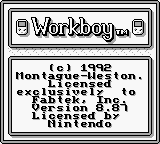
The technical analysis of the Workboy ROM, particularly regarding its versioning, reveals the meticulous nature of its development. While the title screen of the game proudly displays "Version 8.87," an investigation of the internal code reveals that the software was internally labeled as "Version 5.74."
This discrepancy highlights the iterative nature of the development process. When the software initializes, it performs a specific operation: it copies the text strings from the ROM to the system’s RAM. During this process, the software dynamically replaces the string "5.74" with the "8.87" found at specific memory offsets (0x00FEA-0x00FED). This suggests that the developers were frequently updating the build and needed a way to display the most current version number on the front-facing UI without hard-coding it into every language string.
The localization efforts were equally impressive. The ROM contains fully translated title screens for English, Spanish, Italian, German, and French. Each language reflects the legal and copyright requirements of 1992, citing "Montague-Weston" and "Fabtek, Inc." as the primary entities. The inclusion of these translations indicates that the project was intended for a widespread international release, further emphasizing the scope of the ambition behind the Workboy.
The Implications of the Workboy Cancellation
The failure of Workboy to reach the public is a cautionary tale regarding the volatile nature of the early 1990s gaming market. While the device worked as intended, several factors likely contributed to its demise:

1. Cost and Market Positioning
The manufacturing cost of a QWERTY keyboard accessory for a Game Boy would have been substantial. If the peripheral was priced too high, it would have been uncompetitive against dedicated electronic organizers like those from Casio or Sharp. Nintendo was a gaming company, and marketing a "work tool" to a demographic primarily interested in entertainment was a risky proposition.
2. The "Game Boy" Identity
Nintendo’s branding was laser-focused on play. Introducing a device that forced a child or professional to use their Game Boy for bank balance calculations and temperature conversion may have caused a brand dissonance that the company was not prepared to manage.
3. The Fragility of Hardware
As Robertson’s demonstration showed, the keyboard is a delicate piece of early 90s hardware. Had Workboy been released, it is highly probable that it would have faced significant durability issues. The mechanical nature of the keys, combined with the stress of being attached to a mobile device, would have likely led to a high rate of returns—a nightmare for both Fabtek and Nintendo.
Legacy and Preservation
The story of Workboy serves as a vital case study in the importance of video game preservation. Without the 2020 leak and the subsequent investigative journalism conducted by the preservation community, Workboy would have remained a mere footnote in magazine archives.

Instead, it now stands as a testament to the "what-if" scenarios of the 8-bit era. It represents a period where developers were pushing the boundaries of what a handheld console could do, long before the advent of the smartphone. The fact that the software was found in a near-final, localized, and functional state reminds us that history is often defined not just by what we played, but by the ideas that were left on the cutting room floor.
Today, the Workboy ROM is archived and studied by those interested in the evolution of consumer technology. It serves as a bridge between the analog organizers of the 1980s and the digital powerhouses of the 21st century. While it never changed the way we worked, it certainly changed the way we understand the history of the Game Boy, proving that even a "lost" project can offer profound insights into the creative ambitions of a bygone era.
The Workboy was never released, but in the digital age, its functionality has been preserved, ensuring that the work of the developers at Source is finally, belatedly, recognized for its ingenuity.
 rifanmuazin
  Layla Zulfa
  Evan Lee Salim