
 By Iffa Jayyana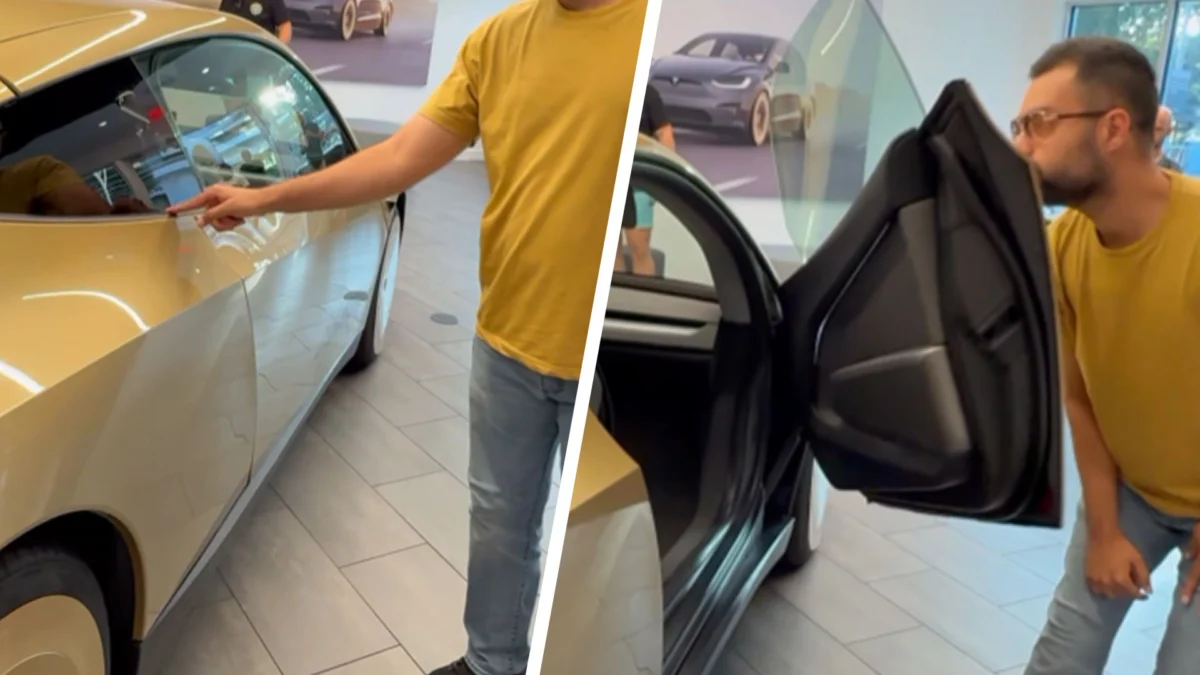
In the fast-evolving landscape of autonomous transportation, Tesla has consistently positioned itself at the vanguard of innovation. However, the company’s recent venture—the Cybercab—is finding itself at the center of a burgeoning design controversy. While Tesla’s vision of a future devoid of steering wheels and pedals is meant to signal a revolution in urban mobility, early observations of the vehicle’s physical interface have raised significant questions regarding safety, accessibility, and the practical realities of daily use.
At the heart of the debate are the vehicle’s dramatic, upward-swinging butterfly doors. While visually striking, these portals are now being scrutinized after social media reports surfaced suggesting that the doors do not consistently detect obstacles—or individuals—in their path, resulting in what some users have colloquially termed a "love tap."
The Anatomy of the Incident
The controversy ignited following the circulation of video evidence showing the Cybercab’s automatic door mechanism in operation. In the footage, the door, which sweeps upward in a cinematic arc, fails to halt its momentum when encountering a person standing in its blind spot.
The original poster (OP) of the video, while attempting to mitigate the potential for backlash, described the impact as a "love tap," insisting that the force of the collision was negligible and that the vehicle remains fundamentally safe. Yet, this framing has done little to soothe public anxiety. For a vehicle intended for mass-market deployment—meant to serve the elderly, children, and individuals with varying physical abilities—the notion that a passenger must be wary of "blind spots" during the simple act of ingress or egress is, for many, an unacceptable design oversight.
A Chronology of Design Friction
Tesla’s history with radical design choices is long and well-documented. To understand the current skepticism surrounding the Cybercab, one must look at the recent trajectory of the company’s hardware releases.
- The Cybertruck Prelude: The Cybertruck set the tone for Tesla’s "form-over-function" reputation. From the outset, the vehicle faced intense criticism regarding its stainless-steel exterior and angular geometry.
- Performance Realities: Following its launch, users reported a slew of practical failures. The vehicle struggled significantly in winter conditions, with reports of snow accumulation and mechanical issues. Furthermore, concerns regarding structural integrity at high speeds and the debunking of CEO Elon Musk’s claim that the truck could function as a "boat" created a growing narrative of over-promised, under-delivered design features.
- The Cybercab Unveiling: Building on the aesthetic language of the Cybertruck, the Cybercab was introduced as a fully autonomous solution. Its butterfly doors were lauded as a hallmark of luxury and futuristic design.
- The Current Backlash: As of late 2026, real-world testing and observation of the Cybercab have shifted the conversation from the vehicle’s technological capability to its mechanical etiquette. The emergence of the "door tap" videos has marked a pivotal moment where public perception of the car’s safety has begun to waver.
Supporting Data: The Practicality Gap
The core of the issue lies in the tension between high-end design and universal accessibility. When an autonomous vehicle operates in a high-density urban environment, it must cater to a diverse demographic. Critics argue that the current door mechanism assumes a level of physical agility and spatial awareness that not all users possess.
Accessibility Concerns
The "love tap" may be a minor inconvenience for an able-bodied adult, but it presents a substantial hazard for vulnerable populations:
- The Elderly: Reduced reaction times and fragility mean that even a "soft" impact from a heavy mechanical door could result in loss of balance or injury.
- Children: The height of the door mechanism poses a risk to children, who may be at eye-level with the closing hardware.
- Assistive Technology: Individuals using canes, walkers, or wheelchairs may find themselves in a position where they cannot easily move out of the way of the door’s path, turning a "love tap" into a barrier to access.
The Sensor Failure Hypothesis
Technical experts analyzing the footage suggest that the failure to detect obstacles is likely a software-hardware integration issue. If the vehicle’s sensor suite is calibrated primarily for vehicle-to-vehicle or vehicle-to-infrastructure detection, the "peripheral" zones—where a door would swing—may be suffering from a lack of high-resolution sensor coverage. If the vehicle is indeed "blind" to the area directly adjacent to the cabin, the doors represent a fundamental safety flaw in the autonomous ecosystem.
Examining Official Responses and Silence
As of this writing, Tesla has maintained a notable silence regarding the specific design of the Cybercab’s doors. This lack of public engagement is characteristic of the company’s crisis management style, which often relies on the fanbase to defend design choices while the engineering teams work behind closed doors to release over-the-air (OTA) updates.
Historically, Tesla has addressed hardware issues by claiming they are software-fixable. It is plausible that the company will attempt to rectify the door’s sensitivity through a firmware update that increases the sensitivity of the proximity sensors. However, critics point out that if the underlying hardware (the sensors themselves) lacks the necessary field of view, software updates may be insufficient to fully mitigate the risk.
Broader Implications: Aesthetics vs. Safety
The Cybercab controversy is a microcosm of a larger debate in the automotive design industry: Should autonomous vehicles look like robots, or should they be built like domestic appliances—safe, intuitive, and boring?
The "Elon Musk Effect"
Tesla’s design philosophy has always been tied to the vision of its CEO, Elon Musk, who famously prioritizes "first principles" and radical innovation. While this has allowed Tesla to disrupt the stagnant automotive industry, it has also led to a culture where "cool" features are pushed to production before the "boring" aspects of safety and ergonomics have been perfected. The butterfly doors are a clear example of this: they look spectacular in a showroom, but they perform poorly in a crowded, chaotic city street.
The Erosion of Trust
The implications for Tesla are significant. Trust is the currency of the autonomous vehicle market. If potential passengers feel that a vehicle is physically unpredictable, they will be less likely to adopt the technology. Furthermore, regulatory bodies are watching these developments closely. If the National Highway Traffic Safety Administration (NHTSA) or similar international bodies decide that the Cybercab’s door mechanisms pose an unreasonable risk to pedestrians or passengers, Tesla could face a recall or, worse, a pause in deployment.
The Future of Urban Mobility
If autonomous vehicles are to replace traditional taxis and ride-sharing services, they must be "idiot-proof." A taxi that taps its passengers, drops their belongings, or requires them to dance around a door’s swing radius is a failed product in the context of mass transit. The industry is currently moving toward a more conservative, utility-focused design aesthetic for robotaxis, which makes Tesla’s commitment to the Cybercab’s exotic form factor all the more risky.
Conclusion: A Design at a Crossroads
The "love tap" phenomenon is more than just a viral moment on social media; it is a critical bellwether for the future of Tesla’s design language. While the company has successfully captivated the public imagination with the sharp lines and futuristic doors of the Cybercab, it is now confronting the harsh reality that engineering for the real world requires a level of humility that design-led companies often struggle to embrace.
For the Cybercab to succeed, Tesla must move beyond the "it’s just a love tap" narrative. It must demonstrate that it can prioritize the safety and dignity of its users over the aesthetic appeal of its hardware. Whether through a redesign of the door sensors or a more transparent commitment to safety standards, the company needs to prove that it can learn from its past mistakes. If it fails to do so, the Cybercab risks becoming just another entry in a long list of Tesla design experiments that valued the look of the future more than the safety of the present.
 Jia Lissa
  Ali Ikhwan