
 By Ammar Sabilarrohman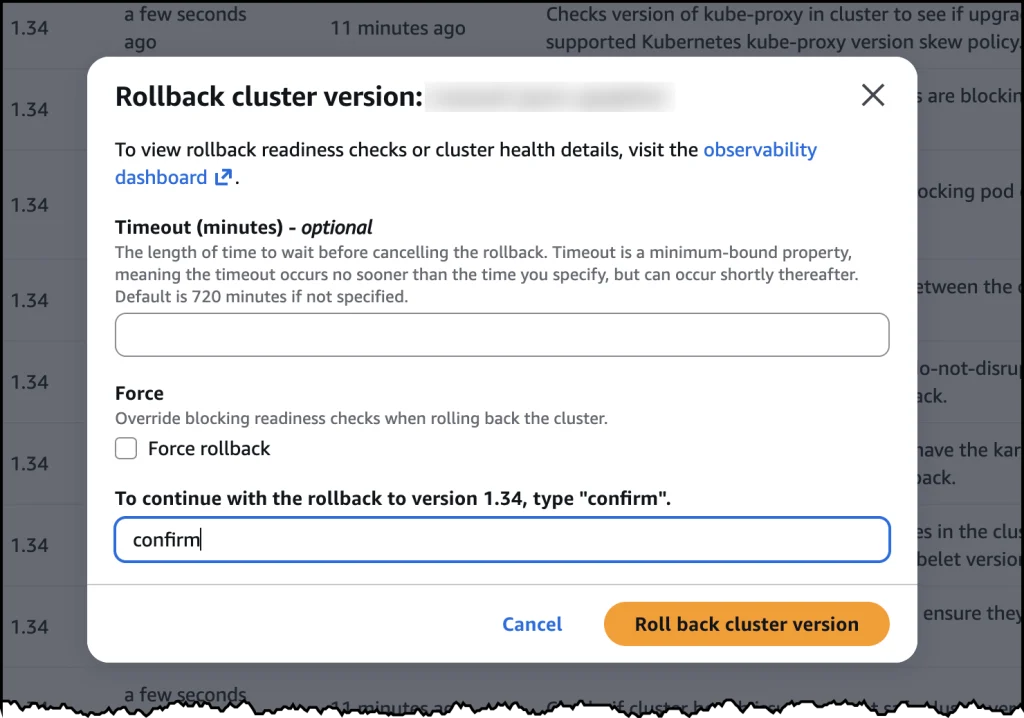
For as long as open-source Kubernetes has existed, upgrading its control plane has been treated as a proverbial "one-way door." Once an organization pushed the button to transition to a newer minor version, turning back was practically impossible.
While the broader open-source Kubernetes community has made incremental strides—such as KEP-4330 introducing emulated versions to ease the transition—the native reality has remained stark: once you upgrade, you live with it. This architectural constraint has long forced platform engineering teams to implement elaborate, exhausting risk-mitigation strategies. From extensive bake periods and staged rollout groups to rigorous automated sign-offs and agonizingly slow, months-long upgrade cycles, the fear of failure cast a long shadow.
Because Kubernetes releases three minor versions every single year, organizations managing hundreds of production clusters—particularly those operating within highly regulated financial, healthcare, and government sectors—frequently found themselves paralyzed. Faced with the daunting prospect of not being able to recover swiftly if a critical compatibility bug surfaced, many teams delayed upgrades entirely. The unintended consequence? Stagnant clusters trapped on aging versions, missing vital security patches, and rapidly approaching the dreaded cliff of extended support timelines.
That high-stakes paradigm shifted fundamentally today. Amazon Web Services (AWS) has announced the official launch of Kubernetes version rollbacks for Amazon Elastic Kubernetes Service (Amazon EKS). This landmark feature provides cluster administrators with a reliable safety net, effectively acting as an "undo" button for cloud-native infrastructure.
Main Facts: What is EKS Version Rollback?
At its core, the new EKS version rollback feature allows cluster administrators to reverse a Kubernetes version upgrade within a seven-day window if they encounter unforeseen compatibility, performance, or application issues post-upgrade.
Unlike alternative approaches—such as emulated versions that keep a cluster suspended in an awkward, transitional holding state—EKS version rollback reverts the cluster to a fully validated previous version that has already proven its stability in a live production environment.
- The "Undo" Button: If an engineering team upgrades a cluster from Kubernetes 1.34 to 1.35 and subsequently discovers a breaking dependency or unexpected behavior, they can initiate a rollback to version 1.34 at any point within seven days.
- No Rebuilding Required: Teams no longer need to panic, scramble to troubleshoot complex distributed system failures under extreme pressure, or completely tear down and rebuild clusters from scratch.
- Incremental Scope: The feature intentionally mirrors the incremental cadence of EKS upgrades, supporting rollbacks of one minor version at a time.
- Zero Additional Cost: The rollback capability is available starting today at no additional cost across all commercial AWS Regions where Amazon EKS operates. Customers pay only for standard EKS control plane fees and underlying compute resources.
Chronology: The Evolution of Kubernetes Upgrades and the Path to Rollbacks
To understand the magnitude of today’s announcement, it helps to examine the historical friction points of cloud-native infrastructure management.
The Era of Permanent Forward Motion
When Kubernetes burst onto the enterprise scene, its rapid release velocity—delivering three major/minor iterations annually—was celebrated for rapid feature delivery. However, operational realities quickly soured this enthusiasm. The upstream community prioritized forward-only migrations. If a custom resource definition (CRD), an admission webhook, or an internal controller broke due to deprecated APIs in a new minor release, mitigation meant forward-fixing the application code, not rolling back the orchestrator.
The Burden of Compensating Controls
To survive this limitation, enterprise platform teams spent years architecting complex safety nets. Bake periods stretched from days to weeks. Staggered deployment groups ensured that only a fraction of a fleet felt the pain of a bad release at any given moment. Yet, despite these precautions, "blast radiuses" remained uncomfortably large, and developer velocity ground to a halt as infrastructure teams exercised extreme caution before touching production clusters.
The Development of KEP-4330 and Emulated Versions
Recognizing the developer pain, the open-source Kubernetes community began discussing pathways to remediation, resulting in Kubernetes Enhancement Proposal 4330 (KEP-4330). While proposals for emulated versions aimed to soften the blow by mimicking older behaviors during transitions, they fell short of offering a true, stateful backward migration to a historically verified production footprint.

The AWS Breakthrough
Recognizing that enterprise adoption hinges on operational confidence, AWS engineers developed a native control plane mechanism capable of safely reversing state changes. By integrating deep snapshotting, cluster insight validation, and specialized automation for managed nodes, AWS has bridged the gap between enterprise risk aversion and rapid open-source innovation, culminating in today’s general availability release.
Supporting Data & Technical Architecture: How It Works Under the Hood
Implementing a rollback mechanism for a distributed system as complex as Kubernetes is an engineering feat. EKS handles this complexity through rigorous pre-flight checks and deep integration with managed infrastructure services.
Cluster Insights and Rollback Readiness
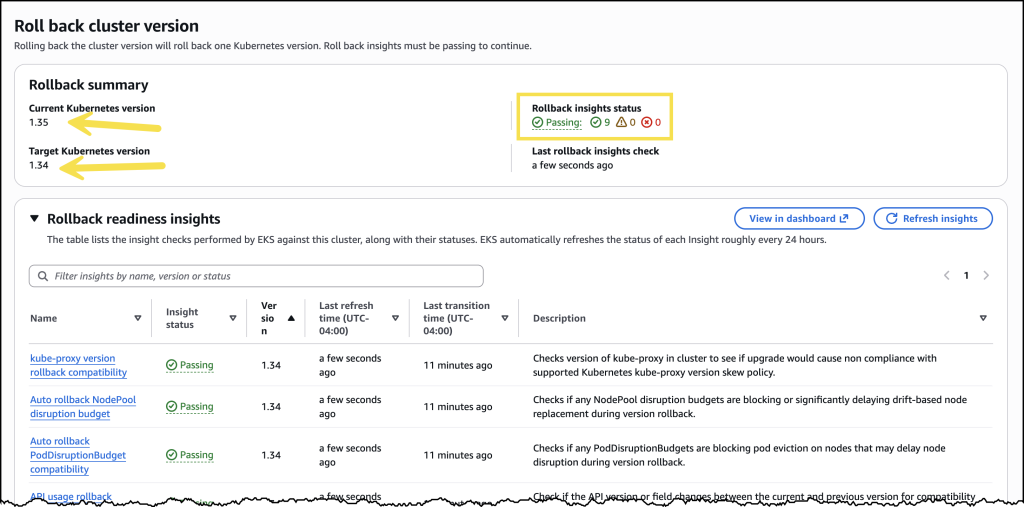
Before a team triggers a rollback, EKS automatically evaluates the cluster’s structural health via cluster insights. This automated diagnostic tool scans the environment for potential stumbling blocks, flagging items such as:
- Node version compatibility mismatches
- Add-on dependency conflicts
- Deprecated API usage that might fail in the older version
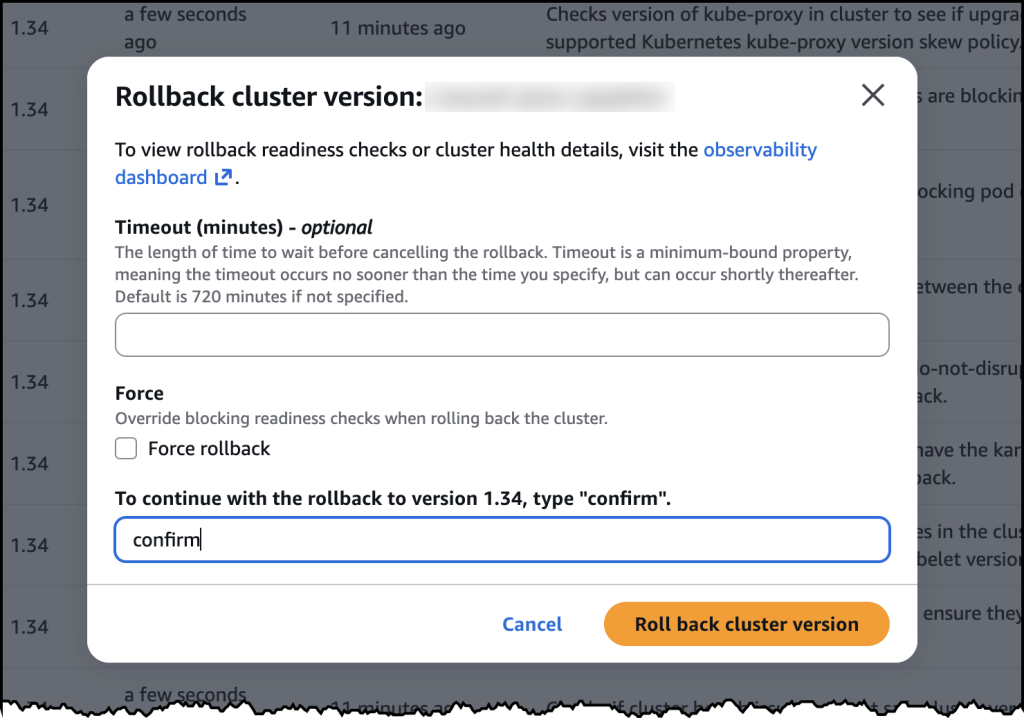
For teams that have already run exhaustive testing in staging environments and need to move with extreme urgency, AWS has provided an escape hatch: the --force flag. This command allows administrators to bypass automated insight checks and immediately execute the rollback sequence.
EKS Auto Mode: Managing the Compute Plane
While control plane rollbacks are universally available across all EKS clusters—regardless of whether users manage their own worker nodes or use AWS-managed infrastructure—fully managed environments introduce unique orchestration challenges.
Enter EKS Auto Mode, a feature designed for one-click production-ready cluster deployment that abstracts away compute, networking, and storage management. When performing a version rollback on an EKS Auto Mode cluster, both the control plane and the managed compute nodes must be reverted in tandem.
Because rolling back nodes requires draining workloads and terminating instances, EKS strictly respects existing Pod Disruption Budgets (PDBs) to ensure zero application downtime or data loss. Depending on the restrictiveness of a cluster’s PDBs, this process can take time.
To prevent administrators from getting stuck in long-running node rollbacks, AWS introduced a dedicated Cancel API. If an engineer determines that a node rollback is proceeding too slowly—or if they wish to alter their operational strategy—they can invoke the Cancel API at any point, adjust their disruption budgets to accelerate draining, or chart a new course entirely.
Step-by-Step Execution
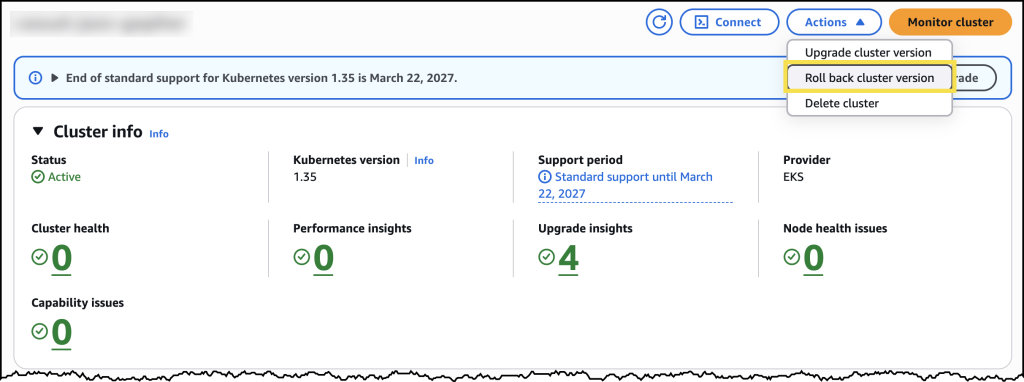
Executing a rollback via the AWS Management Console is streamlined:
- Navigation: The administrator selects the recently upgraded cluster within the Amazon EKS console.
- Review: The configuration page displays the active rollback window and remaining time.
- Inspection: The operator reviews rollback insights to verify node and add-on statuses.
- Execution: Upon confirmation, the control plane rollback initiates, typically completing within approximately 20 minutes (comparable to standard upgrade times). For Auto Mode clusters, nodes safely drain and revert in alignment with configured PDBs.
- Verification: The cluster successfully returns to its prior, fully operational Kubernetes version.
Official Responses and Industry Perspectives
The introduction of EKS version rollbacks has drawn significant praise from cloud architects, platform engineers, and enterprise IT leaders who have long struggled with upgrade paralysis.
Speaking on the launch, senior AWS infrastructure specialists emphasized that enterprise customers should not have to choose between keeping their clusters secure and maintaining absolute business continuity.
"For years, our enterprise customers told us that the fear of a failed upgrade was the single biggest bottleneck holding back their cloud-native modernization," noted a leading AWS product spokesperson. "By introducing native version rollbacks with a seven-day window, we are removing that anxiety entirely. It gives teams the freedom to innovate rapidly, knowing they have a verified, frictionless safety net if things don’t go according to plan."
Independent cloud-native analysts have similarly hailed the feature as a game-changer. In an ecosystem heavily focused on forward velocity, the acknowledgment that enterprises need safety mechanisms for backward transitions is viewed as a mature, pragmatic evolution in platform engineering. By absorbing the immense complexity of state restoration—particularly across managed control planes and auto-scaled compute nodes—AWS is lowering the barrier to entry for organizations looking to migrate mission-critical workloads to Kubernetes.
Implications for Enterprise IT and the Future of Cloud-Native Operations
The arrival of EKS version rollbacks carries profound implications for how organizations will architect their software delivery lifecycles, manage security compliance, and allocate engineering hours moving forward.
1. Accelerated Upgrade Cadences and Enhanced Security
With the safety net of a seven-day rollback window, platform teams no longer have to dread the release of new Kubernetes minor versions. Organizations that previously delayed upgrades for 12 to 18 months—running dangerous proximity to end-of-life support windows—can now adopt a continuous upgrade posture. This newfound agility ensures that clusters remain patched against newly discovered vulnerabilities, significantly strengthening overall enterprise security posture.
2. Reduction of Toil and Burnout
The burden of upgrading large Kubernetes fleets has historically fallen on elite platform engineering teams, leading to high-stress maintenance windows, weekend emergency calls, and chronic operational burnout. By transforming a high-risk, irreversible gamble into a simple, automated procedure with clear diagnostic insights and cancellation controls, AWS is dramatically reducing operational toil. Engineers can spend less time writing bespoke compensating scripts and more time building value-add features for their business stakeholders.
3. Raising the Bar for Managed Kubernetes
As hyperscalers compete fiercely for enterprise workloads, differentiated features like EKS version rollback and EKS Auto Mode set a new benchmark for what customers should expect from a managed container service. Open-source flexibility is vital, but enterprise-grade operational resilience is what seals the deal in boardrooms. AWS has effectively redefined the baseline of infrastructure management, putting pressure on alternative cloud providers and self-managed Kubernetes distributions to deliver comparable safety guarantees.
Summary and Next Steps
Kubernetes version rollbacks for Amazon EKS are available immediately at no additional charge across all commercial AWS Regions. Supporting clusters running any Kubernetes version covered under EKS standard and extended support, the feature is accessible today via the AWS Command Line Interface (CLI), AWS SDKs, and the Amazon EKS Management Console.
For enterprise organizations looking to modernize their infrastructure without gambling on irreversible state changes, the "undo" button has officially arrived. To explore technical documentation and begin testing version rollbacks in your own environments, visit the Amazon EKS User Guide or log directly into the AWS Management Console.
 Reynand Wu
  Suro Senen
  Asep Darmawan