
 By Evan Lee Salim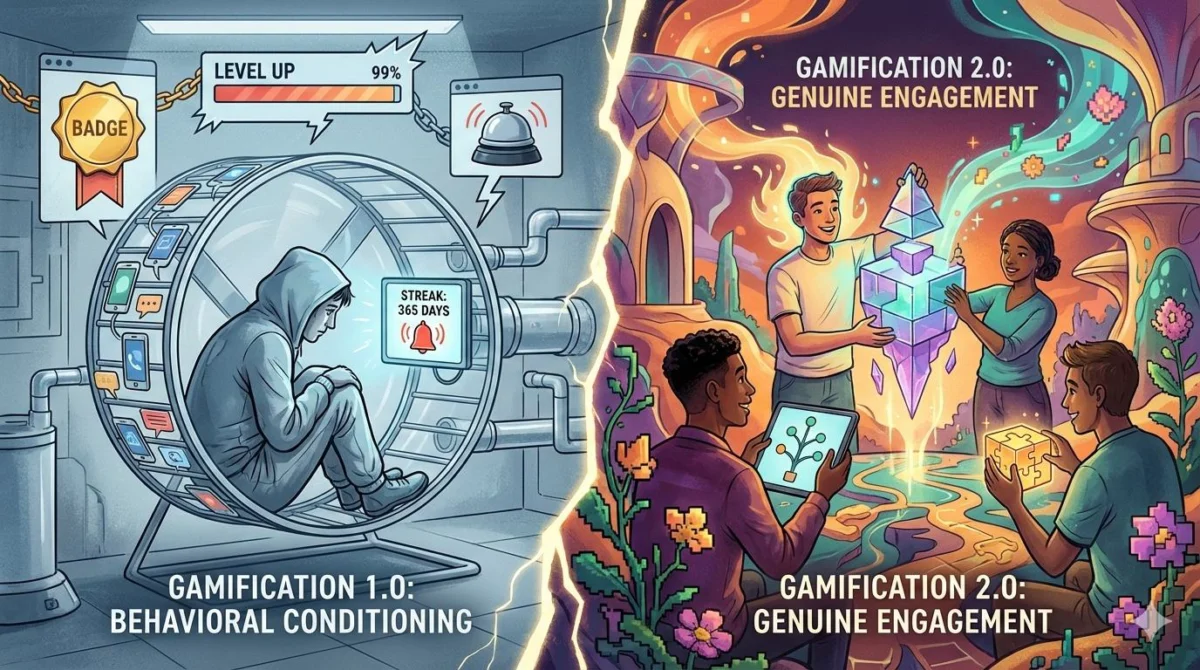
By The UX & Product Editorial Desk
Published in UX & Product Insights
Main Facts
The modern digital landscape is saturated with what industry veterans are calling the "gamification cargo cult"—an uninspired replication of shallow game mechanics by non-game developers who mistake points, badges, and streaks for genuine user engagement. Across the software ecosystem, apps ranging from language learners and professional networks to health-tracking wearables rely on psychological coercion rather than intrinsic motivation.
Prominent examples include Duolingo’s anxiety-inducing streak-shaming, LinkedIn’s hollow "All-Star Profile" designations (which primarily serve platform data harvesting rather than career advancement), and fitness trackers that witness massive initial engagement before being abandoned in bedroom drawers. Industry critics argue these mechanics are deployed by growth teams, product managers, and UX designers who have never shipped an actual video game. Instead of fostering loyalty, these systems breed compliance, manipulation, and eventual user abandonment.
Chronology: The Evolution of "Gamification" and Its Discontents
To understand how the software industry arrived at this systemic misapplication of game mechanics, it is necessary to examine the historical trajectory of user engagement strategies over the past four decades:
- The Golden Age of True Game Design (1990s): Industry pioneers spent decades engineering interactive experiences that captured millions of hours of voluntary user attention. Developers worked on foundational titles like John Madden Football (1991) and Capcom’s Street Fighter, generating hundreds of millions of dollars in global revenue. Crucially, these systems succeeded not through arbitrary rewards, but by tapping into deep psychological principles of mastery, autonomy, and social connection.
- The Rise of the "Gamification" Buzzword (Early 2010s): As smartphones proliferated, tech companies grew desperate to manufacture daily active users (DAUs). Lacking traditional game development expertise, product teams began borrowing superficial elements from social games (like FarmVille) and retrofitting them onto productivity, utility, and educational apps.
- The Fiverr-Gig Era of Product Design (Late 2010s–2020s): Gamification devolved into a commoditized checklist. Product design blogs and UX bootcamps popularized a reductionist approach: Add points, badges, and a leaderboard (PBL) to solve retention problems. This led to the modern era of automated guilt-trips, push notifications, and superficial milestone celebrations.
- The Current Reckoning (Present Day): A growing backlash from UX experts, veteran game designers, and exhausted consumers has brought the limitations of "Gamification Theater" into sharp focus. Users are actively gaming the system—checking in without reading, clicking through tutorials blindly—exposing the fragility of extrinsic-only product loops and sparking calls for a transition toward "Gamification 2.0."
Supporting Data and Industry Analysis
The fundamental issue with contemporary gamification lies in its reliance on extrinsic motivation—treating human users like laboratory rats in a behaviorist experiment. When product teams deploy the classic "PBL" (Points, Badges, Leaderboards) triad, they commit a foundational error in behavioral psychology.
+--------------------------------------------------------------------------+
|                     THE EXTRINSIC MOTIVATION TRAP                        |
+----------------------------------+---------------------------------------+
| Traditional Product Approach     | Real Game Design Approach             |
+----------------------------------+---------------------------------------+
| • Relies on "Points & Badges"    | • Fosters Intrinsic Flow States       |
| • Manufactured Urgency (Streaks) | • Meaningful Choice & Agency          |
| • Compliance over Engagement     | • Competence & Mastery                |
| • High Initial Drop-off Rates    | • Long-term Voluntary Investment      |
+----------------------------------+---------------------------------------+
The Behaviorist Trap: Compliance vs. Engagement
Data from user retention studies across the tech sector consistently show a stark curve: apps relying purely on gamified loops experience a massive spike in initial engagement, followed by a steep drop-off within weeks or months.
- The Fitbit Phenomenon: Millions of consumers purchase smart fitness wearables at the start of the year, racking up high step counts during an initial enthusiastic phase. However, longitudinal usage patterns reveal that a vast percentage of these devices are quietly discarded into desk drawers once the novelty of digital badges wears off.
- The Duolingo Dilemma: While the platform boasts impressive daily active user numbers, user behavior analysis reveals a phenomenon of "streak preservation anxiety." Users frequently perform low-effort, rote language exercises solely to protect an arbitrary number, rather than retaining linguistic comprehension.
- The LinkedIn Illusion: Professional networks leverage gamification to encourage users to complete their profiles down to the last detail. Yet, "All-Star Profile" statuses serve as a proxy for platform data collection and profile completeness metrics, providing negligible tangible career leverage for the individual user.
The "Cargo Cult" Metaphor Explained
The term "cargo cult" originates from South Pacific islanders during World War II who observed airstrips, bamboo control towers, and coconut-shell headphones used by military personnel. Believing these artifacts summoned valuable cargo planes, the islanders replicated the physical forms without understanding the underlying mechanics of aviation.
In the digital product world, modern product managers act as the cargo cultists. They copy the visual trappings of video games—progress bars, confetti animations, and level-up sounds—while ignoring the structural mechanics that make actual games compelling. If a product’s entire gamification strategy can be outlined in a single low-cost freelance gig request ("Add points, badges, and a leaderboard to my app"), it is not true gamification; it is cargo cult theater.
Official Responses and Perspectives from Industry Veterans
Veteran figures from the interactive entertainment industry have begun speaking out against the trivialization of game design principles within the broader software engineering community.
Industry veterans who spent decades building massive global franchises emphasize that real games do not bribe players to show up—they make the underlying experience intrinsically valuable.
"I’ve spent 39 years making games," notes one veteran game developer and industry executive. "I programmed John Madden Football in 1991. I produced Street Fighter at Capcom. I’ve watched generations of players obsess over games for thousands of hours—not because we awarded them badges, but because we understood something fundamental about human motivation that most ‘gamification experts’ have never studied."
According to these design leaders, the current wave of product designers has confused instrumental conditioning with immersive design. B.F. Skinner’s operant conditioning chamber (the Skinner box) taught psychologists that animals will repeatedly press a lever for food pellets. While this model successfully forces short-term human compliance, it fails to build long-term, affectionate brand loyalty or deep cognitive engagement.
Furthermore, digital product associations and UX design collectives are increasingly debating the ethical implications of leveraging anxiety, fear of missing out (FOMO), and artificial scarcity to drive daily active user metrics. Critics argue that guilt-tripping users over a broken language-learning streak or an incomplete profile crosses the line from persuasion into emotional manipulation.
Implications: The Road to Gamification 2.0
The systemic failure of shallow gamification carries profound implications for product development, UX design, and business strategy across the global digital economy. As consumers grow immune to hollow notifications, badges, and arbitrary points, tech companies must rethink how they build digital experiences.
1. The Shift from Metrics to Players
Product teams must stop viewing users merely as telemetry data points to be optimized for retention graphs. Designing for "players" means respecting user intelligence, providing genuine autonomy, and allowing individuals to derive intrinsic satisfaction from mastering a utility or service.
2. Embracing Intrinsic Motivation
The success of phenomena like Elden Ring (where players willingly endure hundreds of deaths out of a desire for mastery) or Wordle (which features zero points, no monetization, and no badges) proves that human beings crave intellectual challenge, creative expression, and authentic achievement. Future product design must focus on making the core utility of an application inherently enjoyable rather than masking a boring experience with superficial rewards.
3. A Call for Cross-Disciplinary Integration
To move past the cargo cult era, tech companies must invite seasoned game designers, behavioral psychologists, and interaction theorists into product development cycles. True gamification is not a superficial layer applied at the end of a sprint; it is an architectural philosophy rooted in agency, challenge, and reward structure.
Up next in the "Gamification" series: Gamification 2.0: Beyond Points and Badges—Designing for Players, Not Metrics. Chapter 2: The Solution.
 Nila Kartika Wati
  Nana Wu
  Azzam Bilal Chamdy