
 By Raul Delapena Setiawan
In the rapidly evolving landscape of 2026, the distinction between "running a business" and "operating a store" has never been more pronounced. For entrepreneurs and digital agencies alike, the temptation to search for an "all-in-one" solution often leads to tool fatigue. Two of the most prominent names in the industry—Shopify and Basecamp—frequently appear on the shortlists of growing businesses. However, the most critical realization for any founder is that these platforms are not competitors; they are fundamental, non-overlapping pillars of a modern commerce stack.
After a rigorous, full-sprint analysis of their feature sets, pricing models, and operational utility, the conclusion is clear: Shopify runs your store, while Basecamp runs your team. If you are scaling an online business, you are likely not choosing between them; you are determining how to integrate them.
The Core Problem: Why Comparisons Often Miss the Mark
The industry often mischaracterizes Shopify and Basecamp as rivals. This "versus" mentality stems from the belief that if you are paying for software, you should be paying for a centralized command center. However, ecommerce requires two distinct engines: a transactional engine to process money, products, and inventory, and an operational engine to facilitate human collaboration, project tracking, and creative workflows.
Shopify is a hosted ecommerce powerhouse, while Basecamp is a project management and communication sanctuary. They solve entirely different categories of friction. Using one to replace the other is akin to trying to use a luxury car to build a house, or a hammer to process credit card payments.
Chronology of Evolution: From Simple Tools to Essential Infrastructure
Shopify’s Ascent to Commerce Dominance
Shopify began in 2006 with a singular goal: to make online selling accessible. Over the last two decades, it has evolved from a simple shopping cart into a multi-billion dollar operating system for retail. By 2026, Shopify has moved beyond the browser, integrating deeply with physical point-of-sale (POS) systems, social commerce platforms, and advanced B2B wholesale portals. Its trajectory has been one of "feature-saturation"—if an ecommerce business needs it, Shopify has either built it or enabled an app developer to provide it.

Basecamp’s Philosophy of Calm
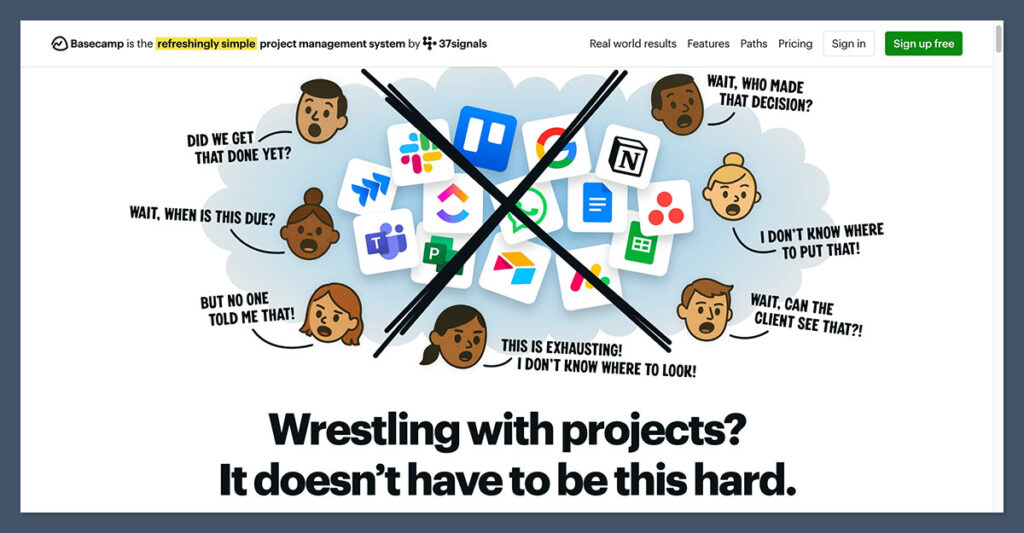
Basecamp, conversely, has taken the path of "intentional limitation." While its competitors (Asana, Monday, ClickUp) spent the last several years piling on features like complex Gantt charts, AI-driven automation, and granular dependency tracking, Basecamp doubled down on its "calm company" ethos. It has remained a bastion of simplicity, focusing on the human side of work—messaging, document storage, and task lists—rather than the surveillance-heavy metrics of modern corporate productivity software.
Economic Implications: Pricing Models at Scale
The financial strategy of these two platforms reveals their intended user base.
Shopify: Scaling with Revenue
Shopify’s pricing is tied directly to your growth. As your business succeeds, your subscription tier, app ecosystem costs, and payment processing fees scale accordingly.
- The Cost of Complexity: While the $39/month entry point is accessible, the "true" cost of Shopify involves payment processing fees (typically 2.9% + $0.30) and the monthly recurring costs of essential apps for reviews, loyalty, and shipping.
- The Value Proposition: For a business owner, this cost is viewed as a "tax on success." You are paying for a platform that guarantees uptime, security, and global payment compliance.
Basecamp: The Predictability of Flat Pricing
Basecamp’s pricing is an anomaly in the 2026 SaaS market. By offering a flat monthly fee for unlimited users and projects, Basecamp eliminates the "seat tax" that plagues agency growth.
- The Cost of Growth: For a 30-person agency, Basecamp represents a fixed operational expense. Unlike per-seat models, adding a new hire or a guest contractor does not result in an invoice increase.
- The Value Proposition: This model favors predictability. It allows managers to focus on output rather than budget-policing every new collaborator added to a project.
Feature Deep-Dive: Where They Excel
Shopify: The Commerce Engine
If your goal is to exchange goods for currency, Shopify is the industry standard.

- Sales Architecture: Shopify offers a comprehensive product catalogue, inventory management across multiple channels (Instagram, TikTok, Amazon), and a robust checkout system that handles over 100 payment gateways.
- Retail Integration: Shopify POS connects your online and physical inventory, a vital requirement for the hybrid retail models of 2026.
- The "Magic" Layer: Shopify’s integrated AI tools (Shopify Magic) now automate product descriptions, email marketing drafts, and store-copy refinement, effectively acting as an in-house marketing assistant.
Basecamp: The Human Operating System
Basecamp succeeds because it refuses to be a "data" tool. It is a "communication" tool.
- Project Spaces: Every project in Basecamp is a contained unit: a message board for long-form discussion, a to-do list for action items, a schedule for deadlines, and a "Campfire" for real-time chat.
- Asynchronous Culture: Basecamp is built to kill the "urgent" notification culture. By encouraging message boards over real-time Slack-style threads, it allows teams to work across time zones without the anxiety of constant interruption.
The Integration Mandate: How to Build the Stack
The "versus" question dissolves once you understand that the most successful ecommerce brands use both, connected via middleware like Zapier, Make, or custom API workflows.
The Ideal Workflow:
- Event: A high-value order or a "customer complaint" flag is triggered in Shopify.
- Middleware: A tool like Zapier detects this specific event.
- Action: The middleware creates a "To-Do" in a specific Basecamp project, attaching the customer’s order history or support context.
- Result: Your team coordinates the resolution in Basecamp, while the transaction and shipping data remain safely within the Shopify ecosystem.
This architecture ensures that the "Source of Truth" for your money (Shopify) remains separate from the "Source of Truth" for your work (Basecamp).
Comparative Matrix: A Summary for Decision Makers
| Feature | Shopify | Basecamp |
|---|---|---|
| Primary Goal | Revenue generation | Team coordination |
| Pricing | Tiered/Scale-based | Flat/Unlimited |
| Customer Support | 24/7 Live Chat | Email-first/Human-centric |
| Extensibility | 8,000+ Apps | Opinionated/Minimalist |
| Target User | Founders/Retailers | Agencies/Operations Leads |
Expert Verdict: The Path Forward
The decision to adopt these tools is not simultaneous; it is sequential.
Phase 1: The Launch
When starting your ecommerce journey, prioritize Shopify. You cannot manage a team if you don’t have a product to sell. Spend your time, energy, and budget on the store setup, product photography, and payment configurations. Use basic email or simple free tools for team coordination during this phase.
Phase 2: The Operational Bottleneck
Once you reach a point where "the store is running but the team is chaotic," it is time to bring in Basecamp. If you find yourself losing track of launch tasks, missing client deadlines, or drowning in a sea of email threads about product variants, Basecamp will provide the structure necessary to scale your human operations without the complexity of enterprise-grade project management suites.
Final Thoughts
In 2026, the complexity of online business is increasing. Success is no longer about finding the one "perfect" tool, but about building a robust ecosystem of specialized software. Shopify provides the foundation for your commercial success, and Basecamp provides the clarity for your team’s execution. By viewing these platforms as complementary pieces of a singular stack, you move from merely running a store to building a resilient, scalable enterprise.
Stop asking which one is better. Start asking how both can make your business run faster, cleaner, and more profitably.
 Dwi Wanna
  Lina Irawan
  Basiran