
 By Ali Ikhwan
In the rapidly evolving world of e-commerce, few comparisons generate as much confusion as the one between Shopify and Pirate Ship. New entrepreneurs often view them as rivals—two platforms competing for the same slice of the merchant’s budget. However, this is a fundamental misunderstanding of their roles in the digital marketplace.
Shopify is a comprehensive ecosystem designed to build, run, and scale an online business. Pirate Ship is a specialized utility designed to slash the cost of logistics. For the vast majority of physical product sellers in the United States, the most effective strategy is not to choose one, but to integrate both: using Shopify to manage the storefront and Pirate Ship to optimize the shipping labels.
The Core Distinction: Infrastructure vs. Optimization
To understand why these two platforms are rarely direct competitors, one must examine their fundamental architecture.
Shopify: The Total E-commerce Platform
Shopify serves as the "operating system" for retail. It provides a hosted storefront, a customizable theme engine, a secure checkout, integrated payment processing, and a suite of marketing and inventory management tools. It is built to house the entire customer experience, from the moment a shopper discovers your product to the moment they complete their transaction.
Pirate Ship: The Specialized Shipping Tool
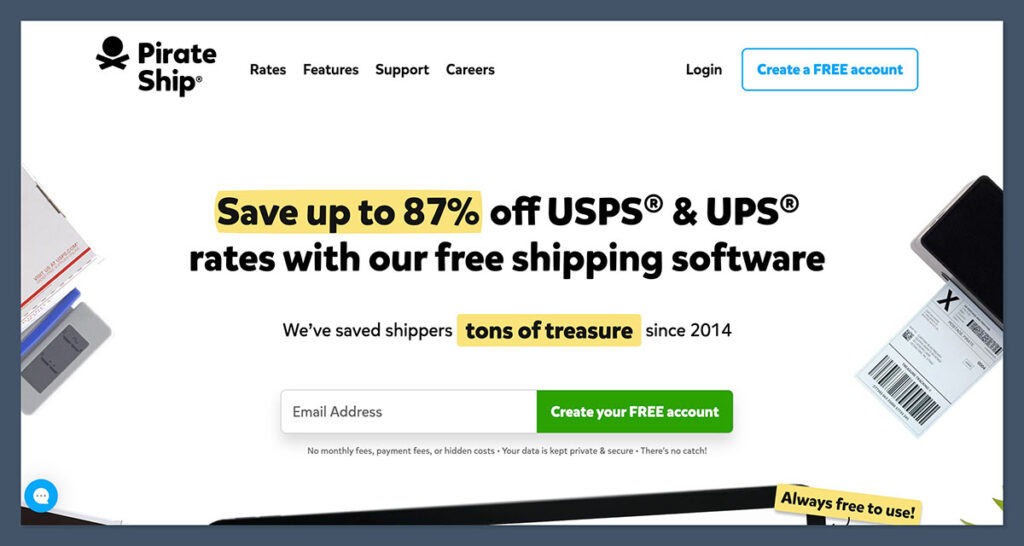
Pirate Ship occupies a much smaller, albeit vital, niche. It does not provide a storefront, a catalog, or a checkout page. Instead, it functions as a highly specialized interface for purchasing postage. It aggregates shipping volume to secure deep discounts from carriers like USPS and UPS, passing those savings directly to the merchant without a monthly subscription fee or service markup.
Chronology: How the Logistics Landscape Shifted
The rise of these two platforms reflects the broader democratization of e-commerce.

- Pre-2010s: Merchants were largely beholden to retail postage rates at the post office or expensive, complex enterprise-level shipping software.
- The Rise of Shopify (2006–Present): Shopify revolutionized the industry by lowering the barrier to entry for store creation. As it grew, it integrated "Shopify Shipping," allowing users to print labels directly from the dashboard, removing the need for third-party integrations for casual sellers.
- The Pirate Ship Disruption (2014–Present): Pirate Ship entered the market with a singular focus: removing the complexity and cost of shipping. By offering "Commercial Pricing" to small businesses, it leveled the playing field, allowing a solopreneur to access the same rates as a massive retailer.
- The Modern Integration: Today, the two have become codependent. Most sophisticated Shopify merchants now use an official app to link their store to Pirate Ship, creating a seamless automated pipeline.
Supporting Data: The Economics of Shipping
When analyzing why a merchant would choose one over the other—or both—the decision often comes down to the "P&L" (Profit and Loss) impact of shipping costs.
Cost Structure Comparison
| Feature | Shopify | Pirate Ship |
|---|---|---|
| Monthly Fee | $29–$299+ | $0 |
| Primary Focus | Store Operations | Shipping Rate Optimization |
| Carrier Access | USPS, UPS, DHL | USPS, UPS |
| Checkout Integration | Real-time carrier rates | Not available |
| Batch Processing | Basic | Advanced (No limit) |
The "Rate Gap" Analysis
While Shopify Shipping offers competitive rates, data consistently shows that Pirate Ship’s specialized volume-based agreements provide deeper discounts, particularly for:
- USPS Priority Mail Cubic: A service based on size rather than weight, which is significantly cheaper for small, heavy items.
- UPS Ground Saver: A service optimized for non-urgent, cost-effective shipping that frequently undercuts standard ground rates.
For a merchant shipping 100 packages a month, a savings of $1.50 per label—a common delta between Shopify and Pirate Ship—results in $1,800 of additional annual profit.
Official Stances and Technical Integration
Both companies have acknowledged the symbiotic nature of their relationship. Shopify’s app ecosystem is designed to be open, allowing third-party developers like Pirate Ship to access store data via API.
When a merchant installs the Pirate Ship app on Shopify, the following workflow occurs:
- Sync: Shopify orders are automatically pushed to the Pirate Ship dashboard.
- Label Purchase: The merchant selects the cheapest rate.
- Fulfillment: Once the label is generated, Pirate Ship automatically updates the Shopify order status to "Fulfilled" and pushes the tracking number back to the customer.
This "two-tool" approach is officially supported and encouraged by the developer communities of both platforms.

Strategic Implications for the Merchant
Deciding how to allocate your shipping operations requires a candid assessment of your business stage.
The Case for Shopify-Only
If you are a new merchant or a low-volume seller, simplicity is your greatest asset. Buying labels inside Shopify keeps your dashboard clean and minimizes the number of platforms you need to log into. The time you save by not toggling between apps may be worth more than the $0.50 or $1.00 saved on a shipping label.
The Case for the "Hybrid" Model
As your business grows, the "simplicity" argument loses weight against the "efficiency" argument. When you are shipping 50+ packages a week, the ability to:
- Use "Batch Shipping" to generate labels for 50 orders with one click.
- Utilize "Package Presets" to auto-calculate weights and dimensions.
- Access "End of Day" SCAN forms that simplify drop-offs at the post office.
These features make Pirate Ship an essential "back-office" tool. The hybrid model is the gold standard for scaling e-commerce brands.
Frequently Asked Questions (FAQ)
Is Pirate Ship really free?
Yes. Unlike many SaaS tools, Pirate Ship does not charge a subscription fee or a markup on shipping labels. Their revenue is generated through volume-based incentives provided by the carriers themselves.
Can I use Pirate Ship if I don’t have a Shopify store?
Absolutely. Pirate Ship integrates with various platforms, including eBay, Etsy, Amazon, and WooCommerce. If you sell on multiple channels, Pirate Ship acts as a central hub for all your shipping, regardless of where the order originated.
Does Pirate Ship replace the need for Shopify?
No. Shopify provides the digital infrastructure to display products, handle secure payments, and manage customer accounts. Pirate Ship has no storefront or checkout capabilities. You cannot build a business solely on Pirate Ship.
Which carrier is better?
Both platforms support USPS and UPS. Shopify also supports DHL Express out-of-the-box, which is a major advantage for brands with a significant international customer base. Pirate Ship is primarily focused on domestic US shipping.
Final Verdict: Why You Should Probably Use Both
The debate of "Shopify vs. Pirate Ship" is a false dichotomy. These tools were never meant to be mutually exclusive.
- Choose Shopify if: You need to sell online. It is the backbone of your store.
- Choose Pirate Ship if: You need to optimize your bottom line. It is the specialized engine that makes your fulfillment process faster and cheaper.
For the modern entrepreneur, the winning strategy is to leverage the robust, user-friendly storefront of Shopify while utilizing the specialized, low-cost logistics capabilities of Pirate Ship. By integrating these two industry-leading tools, you create a business that is not only easy to manage but also highly optimized for profitability.
As your shipping volume grows, the marginal savings from Pirate Ship will eventually pay for your Shopify subscription entirely. In the long run, the question isn’t which one to pick, but how quickly you can integrate the two to begin maximizing your margins.
 Dwi Wanna
  Lina Irawan
  Basiran