
 By Jia Lissa
In the crowded landscape of print-on-demand (POD) platforms, few names command as much historical weight as Fine Art America. For over a decade, it has served as a digital storefront for hundreds of thousands of photographers, illustrators, and fine artists. Unlike mass-market competitors that focus on cheap apparel and stickers, Fine Art America (FAA) has carved out a niche centered on professional-grade wall art and home decor.
However, as the creator economy evolves and new, tech-forward competitors emerge, the platform finds itself at a crossroads. Is it still the premier home for serious artists, or is it a legacy system struggling to keep pace with modern digital marketing needs? This comprehensive review, based on hands-on testing, market analysis, and community sentiment, breaks down everything you need to know about the platform in 2026.
The Core Philosophy: Control, Quality, and Customization
Fine Art America is built on a simple, yet powerful premise: provide the artist with total control over pricing while handling the logistical heavy lifting of printing, framing, and shipping.
The feature that distinguishes FAA from the "pack" is its markup model. While platforms like Society6 or Redbubble dictate the artist’s royalty percentage—often trapping them in a low-margin cycle—Fine Art America allows the artist to set their own markups. You determine the final retail price, and you retain 100% of the difference between the base manufacturing cost and your chosen price point.
Chronology and Evolution of the Platform
Founded in 2006, Fine Art America began as a modest marketplace for independent photographers to sell prints. By 2010, it had integrated a robust print-on-demand fulfillment network, allowing for the automatic production of canvas, metal, and acrylic prints. Throughout the 2010s, it grew alongside its sister site, Pixels.com, effectively becoming a global manufacturing behemoth with 14–16 facilities worldwide.
In recent years, the platform has faced the "marketplace maturity" challenge. With over 700,000 artists currently listed, the internal discoverability of new work has become significantly more difficult, leading to a shift in how professional artists utilize the platform—moving away from relying on organic marketplace traffic toward using it as a white-label backend for their own external brands.
Technical Performance and User Experience
Onboarding and Dashboard Workflow
Signing up for a Standard account is entirely frictionless. There is no credit card requirement and no barrier to entry. Upon landing in the artist dashboard, you are met with a utilitarian, albeit dated, interface.

The workflow is logical:
- Upload: You provide high-resolution JPEGs.
- Configure: The system automatically generates mockups across the entire product range.
- Markup: You define your profit margins for various product categories.
Unlike the drag-and-drop ease of Shopify or the AI-driven design tools of modern competitors, Fine Art America’s backend feels like a legacy system. It is functional, but the navigation is cluttered. Settings are often buried under "Behind the Scenes" menus, which can be frustrating for digital natives accustomed to modern SaaS aesthetics.
The Storefront Experience
If you are looking to build a visually stunning, custom-branded website, Fine Art America is likely not your first choice. The standard profile page is templated and rigid. However, the $30/year Premium plan offers a white-label website and an embeddable shopping cart widget. This is the "power user" approach: keep your beautiful, custom-built website on WordPress or Squarespace, and use FAA’s invisible backend to handle the production and fulfillment.
Supporting Data: Market Positioning and Performance
To understand the current state of Fine Art America, we must look at the hard data. As of early 2026, the platform’s performance is a study in contrasts.
| Metric | 2026 Data Point |
|---|---|
| Annual Revenue (2025) | ~$144.8M |
| March 2026 Monthly Sales | $10.5M |
| Average Order Value (AOV) | $100–$125 |
| Conversion Rate | 2.50% – 3.00% |
| Monthly Sessions | 3.3 Million |
While the platform is seeing a 5–10% year-over-year revenue decline, it maintains a remarkably high average order value compared to competitors like Redbubble ($50–$75). This is indicative of a "serious buyer" demographic—individuals willing to spend $150 on a large-format metal print are inherently different from those buying a $20 sticker.
Print Quality and Fulfillment Integrity
One of the most significant advantages of Fine Art America is its proprietary manufacturing network. Unlike competitors that act as a middleman between you and third-party printers (like Printful or Gelato), FAA owns and operates its production facilities.
Consistency as a Competitive Edge
Because Fine Art America controls the full production stack, color accuracy and material consistency are generally superior. Photographers—often the most discerning of all artists—consistently rank FAA’s reproduction quality alongside high-end professional labs.
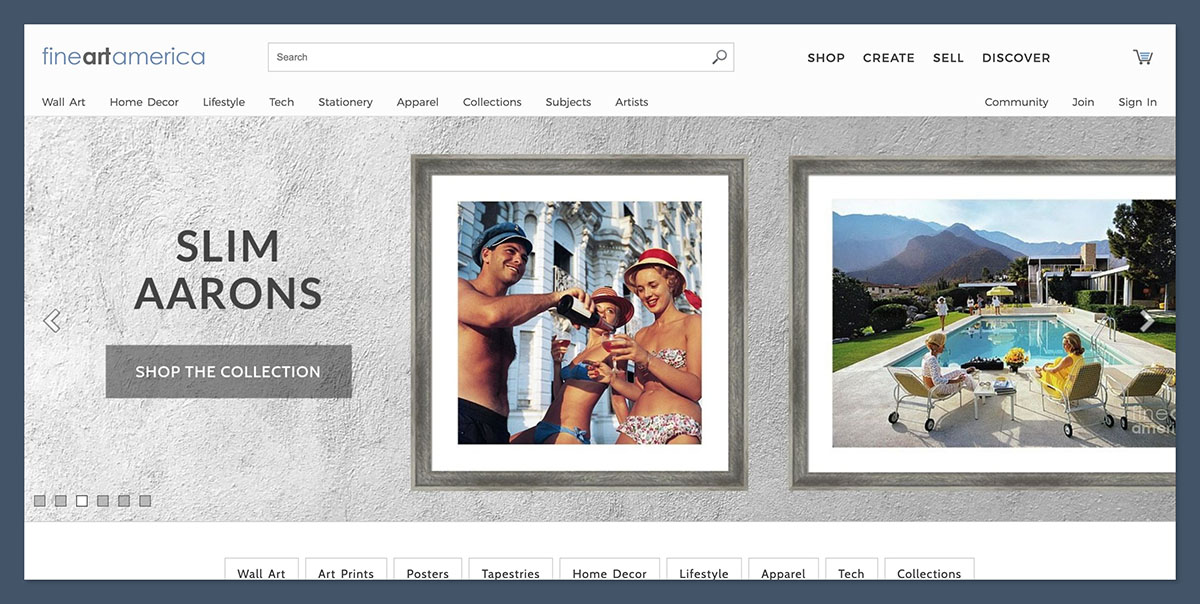
The Product Catalog includes:
- Wall Art: Canvas, metal, acrylic, wood, and museum-quality paper.
- Home Decor: Throw pillows, blankets, towels, and shower curtains.
- Lifestyle: Apparel, tech accessories, greeting cards, and tote bags.
- Originals: A unique feature allowing for the sale of physical, one-of-a-kind art pieces.
Implications: The Risks and Rewards of the FAA Ecosystem
The "Artist Trap"
The primary implication of building an art business on Fine Art America is the trade-off between convenience and ownership. You do not own the customer relationship. You do not receive the customer’s email address, and you cannot build a newsletter list directly from your sales.
For the casual artist, this is irrelevant. For the "Artist-Entrepreneur" who wants to build a long-term brand, this is a massive bottleneck. If you rely solely on FAA’s marketplace traffic, you are essentially a tenant in their building, subject to their search algorithm changes and policy shifts.
Official Responses and Community Feedback
Fine Art America has historically been opaque regarding its internal support structure. While buyers report generally good experiences with shipping and returns, the artist community has expressed recurring frustrations:
- Support Responsiveness: Reports of long wait times for account-related tickets.
- Policy Transparency: Occasional frustration regarding account limitations or "shadow-banning" of specific products without detailed warnings.
- Cash Flow: The 30-day return window, which delays payouts until the 15th of the following month, can be a major hurdle for artists trying to manage operational costs.
Final Verdict: Is it Right for You?
Who should use Fine Art America?
- The Professional Photographer: If you have a portfolio of high-resolution images and want a "set it and forget it" fulfillment partner, the quality here is unmatched.
- The Low-Overhead Tester: If you are unsure if your art will sell, the Free Standard account is the best risk-free testing ground in the industry.
- The Hybrid Seller: If you have an existing website and need a reliable print-on-demand partner to integrate via a shopping cart widget.
Who should avoid it?
- The Brand-Focused Designer: If you want full control over your customer data, email marketing, and custom branding, a self-hosted Shopify store with a dedicated POD integration (like Gelato or Printful) is the better path.
- The Speed-to-Payout Merchant: If you need rapid access to your funds to reinvest in your business, the 30-day payout delay may prove too restrictive.
The Bottom Line
Fine Art America remains a titan of the industry for a reason: it delivers high-quality prints to collectors who are willing to pay for them. While it is not a "growth engine" that will magically make you famous, it is a stable, reliable, and cost-effective engine for fulfilling professional artwork.
For 2026, the strategy is clear: Use the free plan to validate your work. If you gain traction, upgrade to Premium for the white-label features, but continue to drive your own traffic through social media and your own personal website. Do not rely on the marketplace alone—but certainly do not ignore the massive, curated infrastructure Fine Art America offers to those who know how to use it.
 Dwi Wanna
  Lina Irawan
  Basiran