
 By Sagoh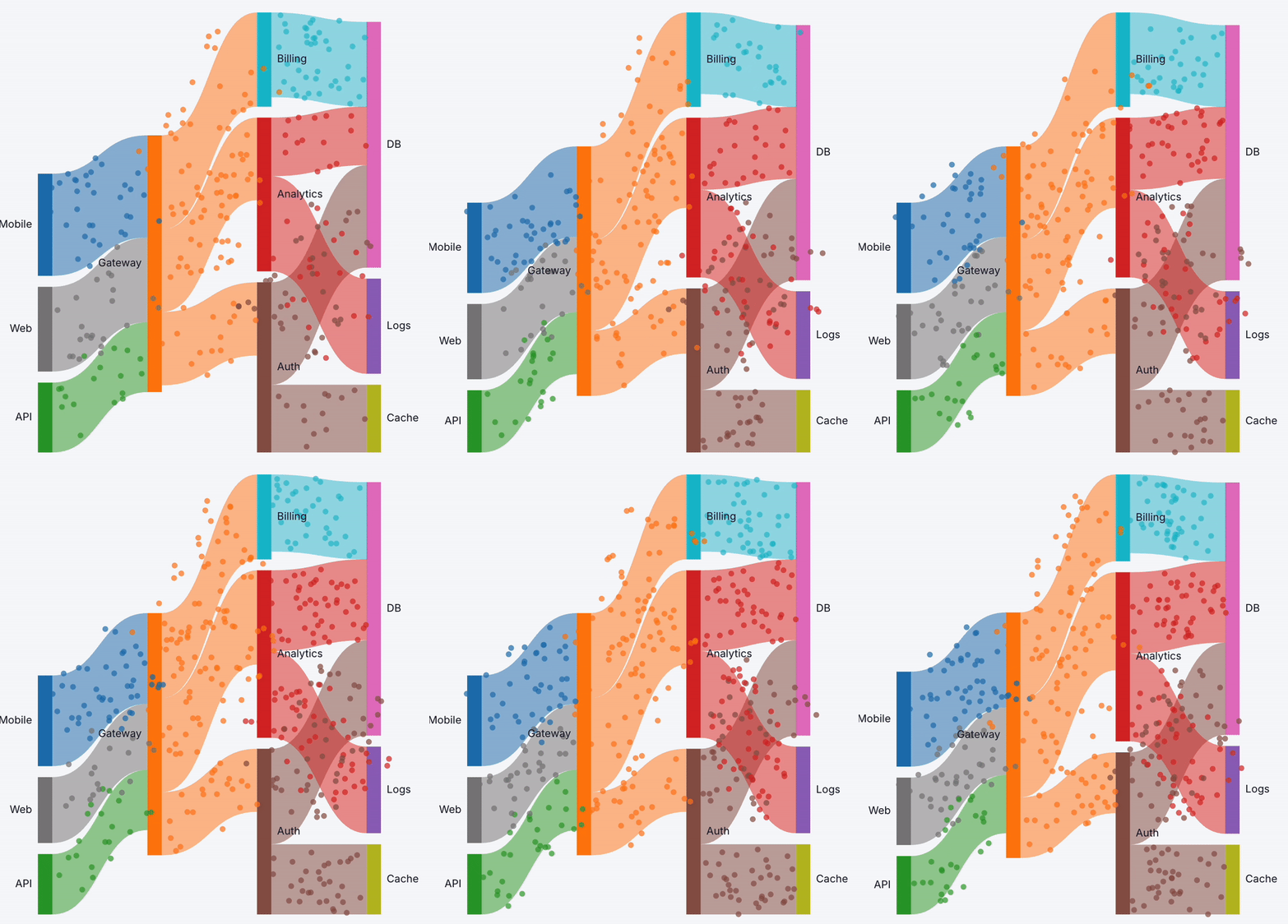
In the fast-paced world of software engineering, few things are as difficult to sustain as a niche, high-performance open-source library. Elijah Meeks, a veteran in the data visualization space and currently a Principal Engineer at Confluent, understands this better than most. Today marks a significant milestone in the evolution of his flagship project, Semiotic, with the release of Semiotic 3.
This iteration is not merely a feature update; it represents a fundamental shift in how the library is built, maintained, and consumed. By integrating AI as a core development partner, Meeks has transformed Semiotic from a legacy-burdened project into a modern, real-time-first data visualization powerhouse.
The Chronology of a Data Vision
To understand the significance of Semiotic 3, one must look at the lineage of the project. Its origins date back to Netflix, where it was born as the Abacus Viz Framework. At the time, Abacus served as the internal backbone for Netflix’s reporting and A/B testing applications.
“Without the early contributions of James Womack and the design sensibilities of Susie Lu, Semiotic would have remained a mere tech demo,” Meeks reflects. The library eventually gained traction, earning over 2,000 stars on GitHub, but it never achieved the ubiquitous adoption of its contemporaries.
Over the years, the project became a magnet for elite engineering talent. Tom MacWright overhauled its build systems, and Oleksii Raspopov pushed its performance limits to support sophisticated tools like Data Prism at Noteable. Despite this, Meeks acknowledges that the library was often hampered by his own design obsessions. He favored complex, flexible "frames" that allowed for infinite customization but created a high barrier to entry for developers who weren’t D3.js experts.
The "Goldilocks Zone" of AI Collaboration
The most provocative aspect of Semiotic 3 is its origin story: it was built in close collaboration with Artificial Intelligence. In an industry where developers often fear the encroachment of Large Language Models (LLMs), Meeks offers a more pragmatic perspective.
“I am not the best programmer, and I’ve never claimed to be,” Meeks admits. “But I have spent a decade figuring out what a data visualization library should be. I know the bottlenecks, I know which abstractions are load-bearing, and I know which ones are vanity.”
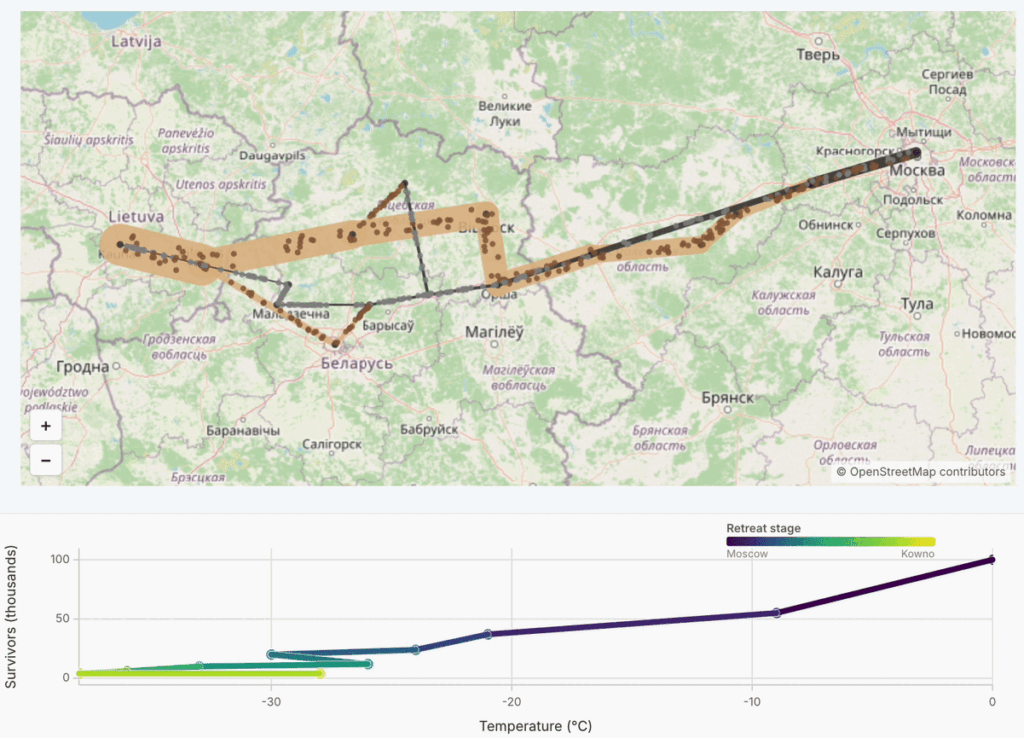
Meeks describes a "Goldilocks Zone" for AI-assisted development. He found that AI struggled with high-level architectural decisions—such as determining the philosophical core of a library—but excelled at executing technical requirements once they were defined with precision. By providing clear instructions like, "This component needs to handle streaming updates by diffing incoming data against a rolling window," Meeks was able to bypass his own technical limitations.
In this sense, AI did not replace the expert engineers he worked with in the past; rather, it provided him with a team of "unrecruitable" developers who could implement performance optimizations and build robust test suites that previously sat on his backlog for years.
Technical Implications: Real-Time as a First-Class Citizen
The technical pivot in Semiotic 3 is rooted in a concept Meeks encountered while working with Flink: the idea that streaming data is not an anomaly, but a superset of static, batch-processed data.
Key Technical Improvements:
- Streaming-First Architecture: Almost every chart in the library now features a native streaming mode, allowing developers to visualize live data flows with minimal latency.
- Server-Side Rendering (SSR): The library now supports robust SSR, significantly improving performance and accessibility for enterprise applications.
- Modernized Abstractions: The "frames" of the past have been replaced with higher-order components that are intuitive for everyday developers, removing the need for deep knowledge of D3 internals.
- Comprehensive Testing: By leveraging AI, the library has achieved a level of test coverage that was previously unattainable for a solo maintainer, ensuring long-term stability.
These improvements directly address the performance critiques that plagued earlier versions of Semiotic. By offloading the heavy lifting of data pipeline optimization to AI, Meeks has created a library that is not only faster but significantly easier to maintain.
The Philosophy of "Vibe Coding"
Perhaps the most forward-looking aspect of Semiotic 3 is its accessibility. Meeks argues that the library should treat both traditional UI developers and "vibe coders"—those who use AI to generate code via natural language prompts—as first-class citizens.
He notes that the development process for Semiotic 3 was fundamentally different from typical AI-assisted coding. While most users ask AI to solve problems they don’t understand, Meeks used AI to bridge the gap between his domain expertise and the machine’s execution speed. This creates a blueprint for how technical founders and engineers can leverage LLMs: by serving as the architect and "product manager" for the AI, rather than simply asking it to write code in a vacuum.
Industry Impact and Future Outlook
For companies like Confluent, where real-time streaming data is the lifeblood of the business, Semiotic 3 is a game-changer. It enables stakeholders to visualize data as it happens, moving beyond static dashboards to reactive, living interfaces.

Beyond enterprise utility, Meeks expresses a personal satisfaction in the new capabilities of the library—most notably the implementation of Sankey diagrams with particle physics. "Do you know how long I’ve wanted to give people the ability to make particle sankeys?" he quips. This blend of technical rigor and creative flair is what has kept the Semiotic project alive through its various iterations.
Addressing the Competition
Semiotic 3 also takes a distinct stance in the crowded ecosystem of charting libraries. While acknowledging the success of libraries like visx, Meeks notes his personal aversion to XML-heavy composition for data visualization. By offering an alternative that prioritizes ease of use and performance without sacrificing the depth of control, Semiotic 3 aims to occupy a space that other libraries have ignored.
Conclusion: A New Standard for Open Source
Semiotic 3 is more than a release; it is a proof-of-concept for the future of open-source maintenance. As technical debt becomes increasingly difficult to manage for individual contributors, the integration of AI-assisted engineering provides a path forward.
By defining the "what" and the "why" with a clarity born from ten years of experience, Elijah Meeks has successfully modernized a project that many thought was destined for retirement. As the industry moves toward more reactive, streaming-centric architectures, Semiotic 3 stands ready to provide the visual language that those systems so desperately need.
For developers looking to experiment with the future of data communication, the barrier to entry has never been lower. Whether you are a seasoned visualization expert or a newcomer using AI to bridge the gap, Semiotic 3 offers a toolkit that is as powerful as it is accessible.
 Lina Irawan
  Nana
Nana  Nila Kartika Wati