
 By Iffa Jayyana
The digital marketing landscape is undergoing one of the most disruptive transformations since the inception of the commercial web. For over two decades, search engine optimization (SEO) operated under a relatively straightforward paradigm: publish keyword-optimized content, secure a high volume of backlinks to build Domain Authority (DA), and watch search engine results page (SERP) rankings and organic traffic climb.
Today, that playbook is rapidly becoming obsolete. The rise of Large Language Models (LLMs), Google’s AI Overviews, and increasingly sophisticated algorithmic search updates have fundamentally rewritten the rules of search behavior. Traditional SEO metrics—such as raw traffic volume, keyword positioning, and domain authority score increases—no longer guarantee commercial success. Brands can secure top positions on traditional SERPs and still experience stagnant conversion rates, largely because generative AI engines increasingly answer user queries directly on the search page, bypassing the need for users to click through to external websites.
To survive this transition, search marketers are shifting their focus from volume-based link acquisition to what industry experts call link building for legitimacy. This strategic framework prioritizes earning authoritative backlinks, brand mentions, and high-tier media coverage that signal trust, expertise, and credibility directly to both search engine algorithms and generative AI models.
Main Facts: The New Era of Legitimacy-Driven Link Building
Link building for legitimacy represents a fundamental shift from transactional link acquisition to relationship-driven digital public relations (PR). Instead of treating links as mere "votes" in a popularity contest, search engines now treat them as editorial citations that validate a brand’s real-world authority and trustworthiness.
+-------------------------------------------------------------------------+
|                  THE SHIFT IN OFF-PAGE SEO PARADIGMS                    |
+------------------------------------+------------------------------------+
|       TRADITIONAL LINK BUILDING    |    LEGITIMACY-DRIVEN LINK BUILDING |
+------------------------------------+------------------------------------+
| • Focus on link volume & DA        | • Focus on editorial trust & E-E-A-T|
| • Scaled outreach & guest posts    | • Digital PR & proprietary research|
| • Vulnerable to algorithm updates  | • Resilient to search engine shifts|
| • Targets traditional search bots  | • Feeds LLMs and AI Overviews      |
+------------------------------------+------------------------------------+
Several core realities define this new era:
- The Demise of Link Quantity: Google’s spam detection algorithms have grown highly adept at identifying and devaluing manufactured link profiles, such as those built through private blog networks (PBNs), reciprocal link schemes, and paid guest posting. High link volume from irrelevant, low-tier sites no longer moves the needle; in many cases, it triggers algorithmic suppression.
- The Rise of RAG (Retrieval-Augmented Generation): Modern search systems and LLMs use Retrieval-Augmented Generation to source information. To avoid hallucinating or spreading misinformation, these systems favor proprietary data, primary research, and highly authoritative, recognized media outlets. If a brand’s data is cited by a top-tier publication, AI engines are far more likely to reference that brand in their generated summaries.
- E-E-A-T as an Off-Page Signal: Google’s Quality Rater Guidelines highlight Experience, Expertise, Authoritativeness, and Trustworthiness (E-E-A-T). While often associated with on-page content, search engines actively evaluate off-page E-E-A-T by analyzing who is linking to a brand, which journalists cite its executives as experts, and whether the brand is mentioned in authoritative industry discussions.
- The Value of Unlinked Brand Mentions: Search algorithms have evolved to recognize entity associations. When a highly credible media outlet mentions a brand name within a relevant context, search engines register this as an authority signal, even if the mention does not include a hyperlink.
Chronology: The Evolution of Search Algorithms and the Rise of AI
To understand why legitimacy has overtaken volume, it is necessary to examine the chronological evolution of search engine technology and user behavior over the past fifteen years.
[2012: Penguin Update] ──> [2018: E-A-T Introduced] ──> [2022: E-E-A-T & Link Spam] ──> [2023-Present: GenAI & RAG]2012–2016: The Crackdown on Web Spam
In 2012, Google launched the historic Penguin update, marking its first major, systemic effort to penalize websites using manipulative link-building tactics. Over the next several years, successive updates refined Google’s ability to detect link farms, keyword stuffing, and low-quality directory submissions. This era forced marketers to shift from automated link generation to manual blogger outreach, though the focus remained heavily on link quantity and domain metrics.
2018: The Core "Medic" Update and E-A-T
In August 2018, Google rolled out a massive core algorithm update—often referred to as the "Medic Update"—which heavily impacted Your Money or Your Life (YMYL) websites. Alongside this update, Google updated its Search Quality Rater Guidelines to formally introduce the concept of E-A-T (Expertise, Authoritativeness, Trustworthiness). For the first time, the algorithmic emphasis shifted explicitly toward the real-world credentials of content creators and the editorial integrity of the linking domains.
December 2022: The Evolution to E-E-A-T and Link Spam AI
Google added a second "E" for Experience to its evaluation framework, highlighting first-hand, real-world experience with a topic. Simultaneously, Google launched its December 2022 Link Spam Update, leveraging SpamBrain—an AI-based spam-prevention system—to detect outbound link selling and websites utilizing artificial link networks. This update effectively neutralized millions of low-quality, purchased backlinks overnight.
2023–Present: The Generative AI Revolution and Search Behavior Shifts
The launch of ChatGPT, Google’s AI Overviews (formerly SGE), and other LLM-driven search tools introduced a new paradigm. Rather than presenting users with a list of blue links, search engines began synthesize answers directly on the search page.
This technological leap coincided with a dramatic demographic shift in search habits. According to a 2025 study by research firm Resolve, 61% of Gen Z users now use generative AI tools in lieu of traditional Google search. This shift has forced search marketers to optimize not just for search engine crawlers, but for LLM training data and real-time retrieval databases.
Supporting Data: The Metrics and Case Studies Behind the Shift
The transition toward legitimacy-focused link building is supported by clear industry data and real-world performance metrics.

The Journalist-PR Disconnect
Securing high-tier media placements requires understanding the media landscape. The 2026 MuckRack State of Journalism Study highlighted a significant bottleneck in media outreach:
- 90% of journalists report that at least some of their published stories originate from PR pitches.
- However, 54% of journalists state that they "seldom or never" respond to the pitches they receive.
- The primary reason cited for this low response rate is a lack of relevance; nearly half of the surveyed journalists noted that the vast majority of pitches they receive are entirely unrelated to their specific beat or target audience.
Case Study: EZ Contacts
To measure the real-world impact of legitimacy-focused off-page SEO, digital agency Resolve executed a data-led digital PR campaign for eyewear e-commerce brand EZ Contacts.
Instead of pursuing standard directory links or low-tier guest posts, the campaign focused on producing highly shareable, original research and proprietary data regarding consumer habits and healthcare trends. This research was packaged into visual assets and pitched directly to journalists covering health, lifestyle, and business beats.
- Results: The campaign secured over 1,000 editorial media placements, including high-authority coverage in national outlets like the New York Post and Yahoo.
- AI Visibility Impact: As a direct consequence of these highly authoritative brand mentions and backlinks, EZ Contacts’ visibility and citation frequency within ChatGPT and Google’s AI Overviews doubled. This growth proved highly durable, remaining unaffected by subsequent search engine core algorithm updates.
Industry Perspectives: Off-Page Tactics That Signal True Value
Prominent industry analysts and search strategists emphasize that building a resilient brand authority profile requires a diversified, highly editorial off-page strategy. Successful modern campaigns rely on three primary pillars.
1. Creating High-Value, Linkable Assets
To earn natural editorial links from top-tier publications, brands must produce content that serves as an essential reference point for writers and researchers. Standard blog posts or "how-to" articles are no longer sufficient. High-value, linkable assets include:
- Proprietary Research & Surveys: Gathering and analyzing original data that addresses unanswered questions within an industry.
- Interactive Tools & Calculators: Creating functional web applications (e.g., financial calculators, diagnostic tools) that solve immediate user problems.
- Original Visual Assets: Designing high-quality infographics, diagrams, and data visualizations that journalists can easily embed in their articles.
- Thought Leadership Columns: Publishing deeply analytical, contrarian, or highly specialized commentary on industry trends.
2. Precision Digital PR
Digital PR acts as the bridge between brand building and technical SEO. Unlike traditional PR, which often measures success by offline reach, digital PR targets high-authority digital publications with strict editorial standards.

By executing creative, data-driven campaigns, brands can earn syndicated coverage across major media conglomerates. When a parent publication features a story, it is frequently republished across dozens of regional and subsidiary news sites, generating a network of high-authority backlinks and brand mentions simultaneously.
3. Cultivating Symbiotic Media Relationships
Modern outreach is built on mutual benefit rather than transactional pitching. Journalists are under constant pressure to deliver accurate, engaging stories on tight deadlines. PR professionals must act as reliable resources rather than self-promoting marketers.
Industry experts recommend several best practices for media relations:
                  THE MUTUALLY BENEFICIAL OUTREACH LOOP

+------------------------+                 +------------------------+
|       JOURNALIST       |                 |     PR PROFESSIONAL    |
| • Under tight deadlines|                 | • Provides unique data |
| • Needs accurate facts |<────────────────| • Offers expert quotes |
| • Seeks industry source|                 | • Respects beat limits |
+------------------------+                 +------------------------+
            │                                           ▲
            └───────────────────────────────────────────┘
Earns Trust & Future Placements- Respect the Beat: Only pitch journalists whose previous coverage aligns directly with the story’s subject matter.
- Lead with the Data: Avoid marketing jargon. Provide clear, verifiable facts, methodology details, and ready-to-use quotes from company executives.
- Offer Exclusivity: When dealing with high-tier national publications, offer the story or dataset exclusively to one journalist before distributing it widely.
Methodology: Constructing a Credibility-Focused Campaign
Transitioning an organization from traditional link building to an authority-focused strategy requires a systematic approach. The following framework outlines the essential steps to execute a modern, legitimacy-driven SEO campaign:
[Step 1: Ideation & Data Gathering]
              │
              ▼
[Step 2: Asset Creation & Packaging]
              │
              ▼
[Step 3: Targeted Media Outreach]
              │
              ▼
[Step 4: Performance Measurement]
Step 1: Ideation and Data Gathering
Analyze the target industry to identify data gaps. What questions are journalists asking that lack clear, empirical answers? Brands should leverage their internal data, run consumer surveys, or synthesize public datasets to create unique, proprietary insights.
Step 2: Asset Creation and Packaging
Translate the gathered data into highly polished, accessible formats. This includes writing comprehensive research reports, designing intuitive data visualizations, and crafting concise executive summaries that busy journalists can digest in under 30 seconds.
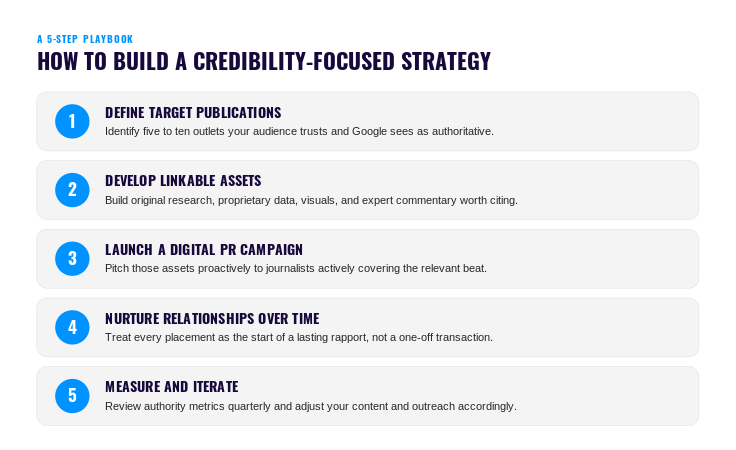
Step 3: Targeted Media Outreach
Build curated media lists of journalists, editors, and industry influencers who actively cover the campaign’s niche. Craft highly personalized, brief email pitches that clearly explain the significance of the research, why it matters to their readers, and how they can access the assets.
Step 4: Performance Measurement
Rather than focusing solely on raw link acquisition, evaluate the campaign’s success using modern authority metrics:
- Share of Voice (SOV): Measuring the brand’s visibility and mention frequency relative to its direct competitors across the web.
- Brand Mention Volume: Tracking both linked and unlinked mentions in high-authority media outlets.
- LLM Citation Frequency: Monitoring how often the brand is cited as a source in generative AI platforms like ChatGPT, Claude, and Gemini.
- Referral Traffic Quality: Analyzing the volume and conversion rate of users landing on the website via earned media links.
Implications: The Future of Brand Survival in a Generative Search Landscape
The implications of this shift are clear: brands that continue to rely on legacy SEO tactics and high-volume, low-quality backlink strategies will face declining visibility. As search engines and LLMs become more integrated and refined, their reliance on highly authoritative, verified entities will only intensify.
Investing in digital PR, original research, and genuine media relationships requires more time, budget, and strategic patience than purchasing cheap backlinks or scaling automated outreach. However, the resulting brand authority is highly defensible. While keyword rankings and search traffic can vanish overnight following a major core algorithm update, a brand’s reputation, trust, and established editorial relationships cannot be easily erased.
In the modern search ecosystem, legitimacy is no longer just an off-page ranking signal—it is the ultimate foundation of sustainable organic growth.
 Jia Lissa
  Nana Muazin
  Layla Zulfa