
 By Nana Muazin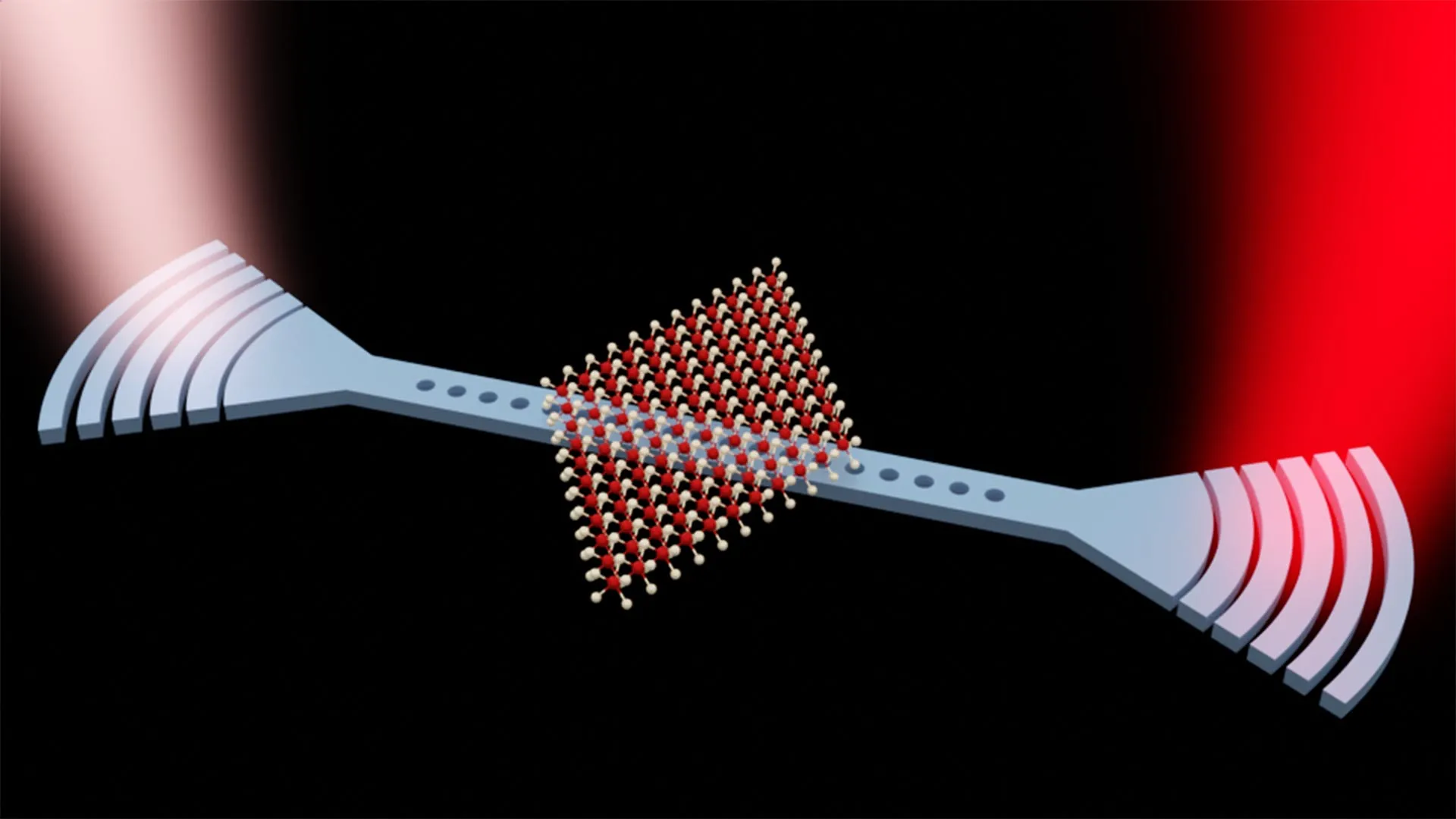
Eighty years after the University of Pennsylvania unveiled ENIAC—the gargantuan machine that birthed the digital age—the institution is once again standing at the threshold of a computational revolution. While ENIAC relied on vacuum tubes and the flow of electrons to solve the complex ballistics equations of World War II, modern computing has remained tethered to that same fundamental paradigm. However, as the global demand for Artificial Intelligence (AI) pushes silicon chips to their physical and thermal breaking points, researchers at Penn are looking away from the electron and toward a faster, cooler, and more efficient medium: light.
In a landmark study published in Physical Review Letters, a team led by physicist Bo Zhen has unveiled a breakthrough that could fundamentally alter the architecture of future processors. By engineering "exciton-polaritons," the researchers have bridged the gap between the speed of light and the logic of computing, potentially ushering in an era of photonic AI chips that consume a fraction of the energy required by today’s hardware.
The ENIAC Legacy and the Electronic Bottleneck
To understand the magnitude of this shift, one must first look back at the origins of modern computing. In 1946, J. Presper Eckert and John Mauchly introduced ENIAC (Electronic Numerical Integrator and Computer) to the world at the University of Pennsylvania. It was a marvel of engineering, utilizing 18,000 vacuum tubes to perform calculations thousands of times faster than any human operator.
For eight decades, the core principle of ENIAC has remained unchanged: computers function by manipulating the flow of electrons. Whether it is a smartphone, a supercomputer, or the massive server farms training Large Language Models (LLMs), the architecture is fundamentally "electronic." Electrons carry a charge, which makes them easy to steer with transistors—the tiny switches that form the binary language of 1s and 0s.
However, the laws of physics are beginning to impose a "tax" on this approach. Electrons, as they traverse the dense, microscopic architecture of a modern chip, encounter resistance. This resistance generates heat, which limits how fast a chip can clock without melting. Furthermore, moving electrons consumes significant power. As AI models require the simultaneous processing of trillions of parameters, the energy consumption of data centers has become a global environmental and economic concern. We are reaching the "thermal wall," where adding more transistors yields diminishing returns due to the sheer heat generated by electron traffic.
The Photonic Paradox: The Promise and the Problem
For years, scientists have looked toward photons—the particles that constitute light—as the logical successor to the electron. Photons are, in many ways, the ideal messengers for information. Because they are charge-neutral and possess zero rest mass, they can travel at the speed of light through fibers and waveguides with virtually no resistance and minimal heat generation.
"Because they are charge-neutral and have zero rest mass, photons can carry information quickly over long distances with minimal loss, dominating communications technology," explains Li He, co-first author of the study and a former postdoctoral researcher in the Zhen Lab, now an assistant professor at Montana State University.
Yet, light has a notorious "Achilles’ heel" when it comes to computing: it is notoriously bad at interacting with itself. In a computer, you need "logic"—the ability for one signal to switch another on or off. Because photons do not carry a charge, they pass through each other like ghosts, making them nearly impossible to use for the complex, non-linear switching operations that define a processor’s logic gates.
For decades, the scientific community has been caught in a paradox: electrons are excellent at logic but poor at transport, while photons are excellent at transport but poor at logic.
Bridging the Gap: The Exciton-Polariton Breakthrough
The team at Penn, led by Bo Zhen, the Jin K. Lee Presidential Associate Professor in the Department of Physics and Astronomy, has successfully resolved this paradox by creating a hybrid particle known as an "exciton-polariton."
The process involves sandwiching atomically thin semiconductor materials within an optical cavity. When photons are injected into this structure, they couple strongly with the electrons in the semiconductor. This interaction creates the exciton-polariton—a quasiparticle that inherits the best traits of both worlds. It possesses the light-speed mobility of a photon but gains the interaction capabilities of an electron.
This breakthrough allows for "all-light" switching. In current experimental photonic AI chips, whenever a calculation requires a non-linear activation function—a critical step in the neural networks that power AI—the system must convert the light signal back into an electronic signal, perform the operation, and then convert it back to light. This "electro-optic conversion" is the primary bottleneck in photonic computing; it is slow, bulky, and energy-intensive.
By using exciton-polaritons, the Penn team demonstrated that these logic operations could be performed entirely within the optical domain. Their experimental setup required only about 4 quadrillionths of a joule of energy to perform a switching operation—an amount so infinitesimally small it makes the energy required to power a single LED look like a massive industrial undertaking.
Chronology of the Research
- 1946: The University of Pennsylvania introduces ENIAC, establishing the electronic paradigm for global computing.
- 2010s: As Moore’s Law begins to stall, the industry shifts toward specialized AI hardware, increasing the pressure on traditional silicon-based chips.
- 2020-2021: The Zhen Lab at Penn receives funding from the US Office of Naval Research and the Sloan Foundation to explore light-matter interactions in semiconductors.
- 2023-2024: The research team designs and tests an optical cavity structure using atomically thin semiconductors, successfully observing and characterizing exciton-polariton behavior.
- 2024: The team publishes their findings in Physical Review Letters, demonstrating that these quasiparticles can perform logic gates with record-low energy expenditure.
Implications for the Future of Artificial Intelligence
The implications of this research are profound, particularly for the trajectory of AI development. As models like GPT-4 and its successors grow, the hardware requirements to train and run them are becoming unsustainable. A transition to photonic computing could potentially slash the power footprint of these systems by orders of magnitude.
1. Eliminating Data Conversion
If this technology scales, future AI chips would not require the constant conversion between electrons and photons. Cameras, which capture information as light, could stream that data directly into a photonic processor, where it would be analyzed, categorized, and acted upon without ever becoming an electronic signal. This would drastically reduce latency in real-time applications such as autonomous driving and medical imaging.
2. Quantum Computing Potential
While the current focus is on classical AI acceleration, the ability to control light-matter interactions at this scale is a critical step toward quantum computing. Quantum processors rely on the ability to maintain "coherence" between particles, and the exciton-polariton architecture provides a stable, controllable environment that could eventually support basic quantum logic gates.
3. Thermal Management
By moving away from current-heavy electronic architectures, photonic chips would generate significantly less waste heat. This would allow for much higher component density on a single chip, as engineers would no longer need to design for the massive cooling systems currently required to prevent chip failure in server environments.
Official Commentary and Academic Context
The study, which includes significant contributions from researchers Zhi Wang and Bumho Kim of the School of Arts & Sciences at Penn, represents a collaborative effort to solve the "last mile" problem of photonic integration.
"The goal has always been to make light behave like electricity when we need it to, without losing the advantages of light," says Professor Bo Zhen. "By creating this hybrid state of matter, we aren’t just making a faster switch; we are creating a new way to process information that is fundamentally aligned with the physics of the data we are trying to analyze."
The research has drawn attention from the broader scientific community for its potential to reinvigorate the field of optical computing, which has historically struggled with the scalability of its switching components. By utilizing atomically thin semiconductors, the team has ensured that their approach is compatible with current nanofabrication techniques, providing a potential pathway for integration into existing chip manufacturing foundries.
Conclusion: The Next Eighty Years
As the University of Pennsylvania marks the 80th anniversary of the ENIAC, this research serves as a poignant reminder that computing is an iterative journey. The electrons that defined the 20th century provided the foundation upon which our modern civilization is built. However, the 21st century’s hunger for intelligence requires a new medium.
By mastering the interaction between light and matter, the Penn team is not merely improving the current computer—they are envisioning a post-electronic architecture. While challenges remain in mass-producing these exciton-polariton chips, the demonstration of ultra-low-energy, all-light switching is a clear signal that the next eighty years of computing will likely be defined not by the movement of charged particles, but by the precise, lightning-fast dance of light.
As we stand on this precipice, one thing is clear: the future of AI will not be written in electricity, but in photons.
 Sagoh
Sagoh  Asro
Asro  Siti Muinah