
 By Asep Darmawan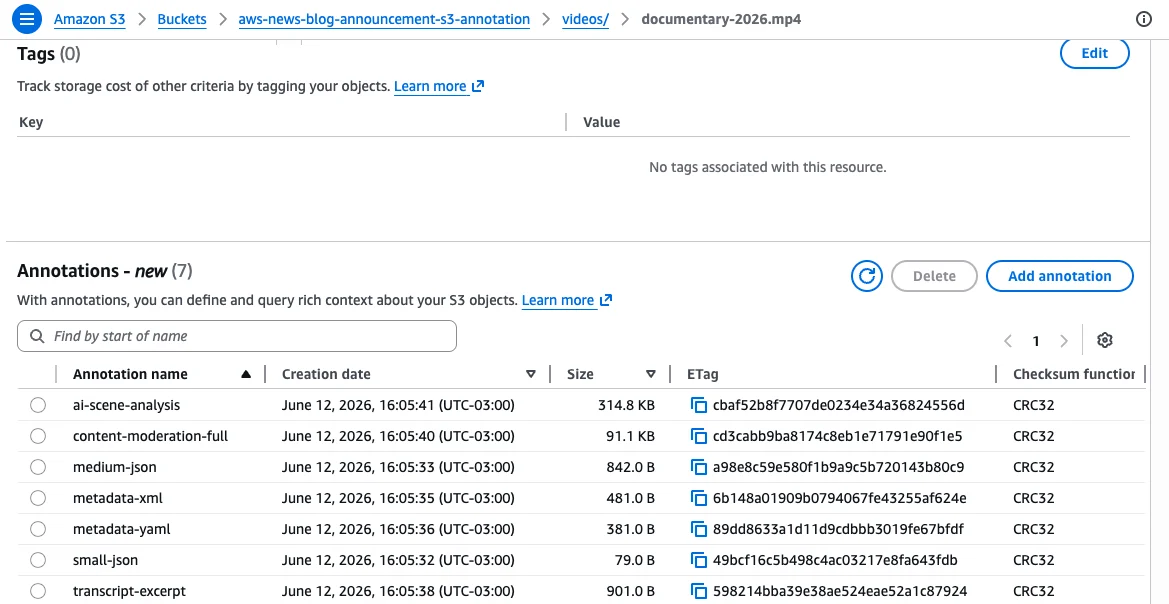
In a significant leap forward for cloud storage architecture, Amazon Web Services (AWS) has unveiled a transformative capability for its flagship object storage service, Amazon Simple Storage Service (Amazon S3). The introduction of S3 Annotations marks a paradigm shift in how organizations manage, query, and interact with massive datasets. By allowing users to attach rich, large-scale business context directly to S3 objects, AWS is effectively bridging the gap between raw data storage and the sophisticated requirements of modern, agentic AI systems.
The Core Innovation: What Are S3 Annotations?
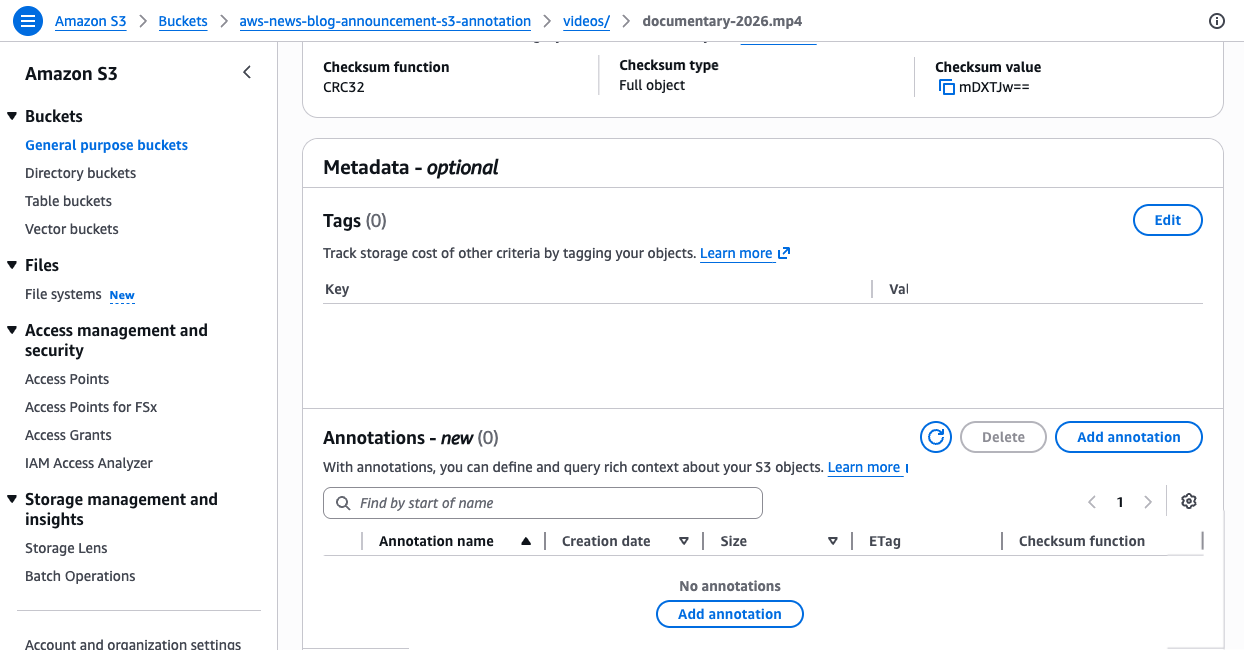
At its simplest, S3 Annotations allow users to append descriptive, mutable, and queryable metadata to any S3 object. Unlike traditional metadata, which has historically been limited by rigid size constraints or immutability, Annotations offer unprecedented flexibility.
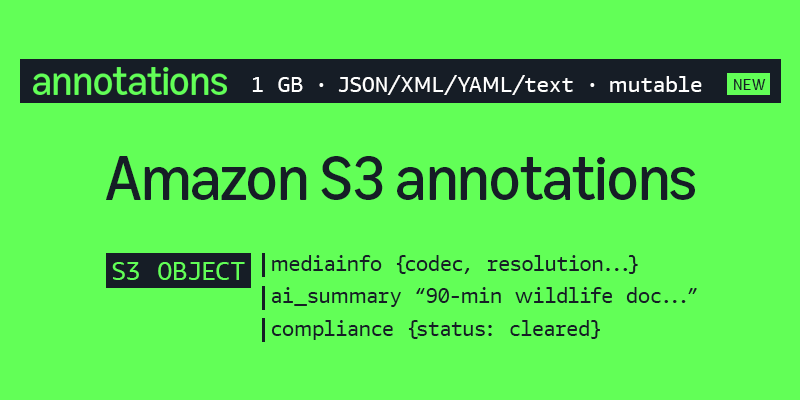
Organizations can now attach up to 1,000 distinct, named annotations to a single object, with each individual annotation supporting a payload of up to 1 MB. This provides a total capacity of 1 GB of metadata per object—a massive increase compared to the previous 2 KB limit of user-defined metadata headers. These annotations support a variety of formats, including JSON, XML, YAML, and plain text, allowing developers to embed anything from AI-generated image transcripts and content ratings to complex technical specifications directly within the storage layer.
A Chronology of Metadata Evolution in S3
To understand the magnitude of this release, one must look at the historical progression of S3 metadata management:
- The Era of Static Properties: Initially, S3 offered only system-defined metadata, such as object size, storage class, and creation timestamps. These were immutable and served solely for basic operational housekeeping.
- The Introduction of User-Defined Metadata: As cloud usage grew, AWS introduced basic custom key-value pairs. However, this was limited to a mere 2 KB per object, making it insufficient for the rich, descriptive context required by today’s data-heavy applications.
- The Rise of Object Tags: AWS later introduced tagging for lifecycle management, cost allocation, and access control. While powerful for operations, tags were never intended for deep, granular content description.
- The Annotation Breakthrough (Present Day): By providing a mechanism to store up to 1 GB of mutable, queryable context, AWS has moved beyond simple object tagging. Annotations are designed to evolve alongside the data, moving automatically with the object during replication or cross-region transfers, and being deleted cleanly when the parent object is removed.
Supporting Data: Comparative Metadata Capabilities
The following table illustrates why Annotations are a distinct departure from previous metadata methods:
| Capability | Max Size | Mutable? | Best Use Case |
|---|---|---|---|
| System Metadata | Fixed | No | Size, class, time |
| User Metadata | 2 KB | No | Small key-value pairs |
| Object Tags | 10 tags | Yes | Access, lifecycle, cost |
| Annotations | 1 GB | Yes | AI context, JSON/XML/YAML |
This structural leap allows enterprises to consolidate their metadata. Previously, companies were forced to maintain "sidecar" databases or external cataloging systems to track the nuances of their S3 assets. These systems often resulted in synchronization lag, increased costs, and massive architectural complexity. With Annotations, the context lives with the data.
Implications for AI and Autonomous Agents
The primary driver behind this launch is the explosion of autonomous AI agents. Modern AI models require more than just access to raw files; they need context to "understand" the data without human intervention.
Enabling Agentic Workflows
For an AI agent to perform complex tasks, it must be able to discover and filter information efficiently. By enabling S3 Metadata annotation tables, AWS allows these annotations to be ingested into fully managed tables that can be queried using Amazon Athena.
Furthermore, through the S3 Tables MCP (Model Context Protocol) server, AI agents can now interact with data via natural language. Instead of a developer writing complex scripts to traverse millions of files, an agent can be asked: "Find all high-resolution videos from 2023 with specific technical audio tracks." The system then executes a targeted query against the annotation table, retrieving the relevant data in seconds. This eliminates the need for expensive "data scans" or the restoration of archived objects just to check their contents.
Architectural Simplification
By moving metadata into the S3 layer, organizations can achieve:

- Lower Costs: No need to pay for secondary database storage or complex indexing services.
- Simplified Lifecycle: Annotations follow the object. If you move a file to Glacier or replicate it across regions, the metadata travels with it automatically.
- Real-Time Agility: Because annotations are mutable, they can be updated as the data changes—a critical requirement for training cycles where model labels or file summaries are updated iteratively.
Official Guidance and Implementation
According to AWS, getting started requires minimal friction. Once an IAM policy or bucket policy grants the necessary s3:PutObjectAnnotation and s3:GetObjectAnnotation permissions, users can begin enriching their datasets immediately via the AWS CLI or SDKs.
Developer Experience
The process is designed for modern pipelines. For instance, a media company can tag a 4K video with its technical specs (codec, resolution, frame rate) via a JSON file:
aws s3api put-object-annotation
  --bucket my-media-bucket
  --key videos/documentary-2026.mp4
  --annotation-name mediainfo
  --annotation-payload ./mediainfo.json
This modular approach allows different teams—such as a legal compliance team and a content engineering team—to attach separate, non-conflicting annotations to the same file. One team might add copyright metadata, while another adds AI-generated content summaries, all stored independently within the same S3 object.
Querying at Scale
The power of this feature is fully realized when S3 Metadata annotation tables are enabled. By creating a configuration via the CreateBucketMetadataConfiguration API, S3 automatically begins indexing annotations into an Apache Iceberg-compatible format.
This enables sophisticated SQL queries that were previously impossible at this scale. For example, to identify specific media assets across a massive bucket:
SELECT DISTINCT bucket, object_key
FROM "s3tablescatalog/aws-s3"."b_my_media_bucket"."annotation"
WHERE name = 'mediainfo'
AND CAST(json_extract_scalar(text_value, '$.audio_tracks') AS INTEGER) > 8
This query bypasses the need to open or "read" the actual video files, performing the operation purely at the metadata layer.
Future Outlook: The Intelligent Storage Layer
The release of S3 Annotations signals that AWS is positioning S3 not just as a "storage bucket," but as an intelligent, queryable foundation for the next generation of AI applications. By reducing the reliance on fragmented, external metadata stores, AWS is lowering the barrier for organizations to build truly autonomous, data-aware workflows.
Whether it is for media production houses managing petabytes of content, or financial institutions tracking compliance metadata for archived documents, the ability to store and query rich, mutable context at scale is a game-changer. As industries continue to integrate AI agents into their daily operations, the "Annotation" will likely become a standard, indispensable component of the cloud-native data stack.
For organizations ready to modernize their data management, the tools are available today in all AWS Regions. By integrating Annotations into their existing workflows, businesses can turn their "data lakes" into "data intelligence hubs," effectively future-proofing their storage strategies against the rapid advancements in generative AI and autonomous computing.
 Neng Nana
  Suro Senen
  Lina Hope