
 By Jia Lissa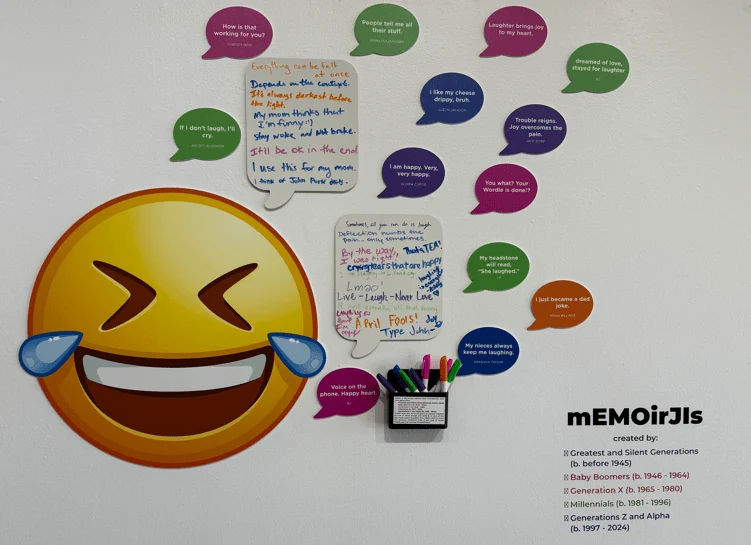
In the digital age, our conversations are punctuated by a visual shorthand that transcends traditional grammar. Emojis—those ubiquitous, colorful icons—serve as the modern world’s hieroglyphs, capable of conveying complex emotional states in a single click. Yet, beneath their seemingly universal appeal lies a profound ambiguity. Does a “Loudly Crying Face” signify genuine despair, hysterical laughter, or, as some Gen Z users suggest, an expression of intense excitement?
As researchers and sociologists begin to peel back the layers of digital communication, it has become increasingly clear that our emoji usage is heavily influenced by generational cohorts, cultural context, and personal interpretation. This tension between standardization and subjective meaning was the catalyst for "mEMOirJIs," a pioneering data-art project launched in the fall of 2024 that sought to bridge the gap between quantitative data and human narrative.
The Ambiguity of Icons: Why We Miscommunicate
The impulse to explore this topic was driven by a wave of recent studies highlighting the friction in digital discourse. For instance, a 2024 survey by Preply identified the "Nail Polish" emoji as one of the most frequently misunderstood symbols in the United States, sparking debate over whether it conveys confidence, apathy, or preparation.
Concurrently, researchers at the University of Ottawa have documented significant challenges among older adults in interpreting and adopting modern emoji usage, a phenomenon often attributed to the rapid evolution of digital slang. A CNN poll further illuminated this "generational divide," noting that younger users—specifically Generation Z—frequently deploy emojis with a heavy layer of irony, often subverting the original, literal meaning intended by the Unicode Consortium.
When these reports surfaced, it became apparent that traditional data visualization—charts, graphs, and heat maps—could only tell part of the story. To truly understand the "emoji gap," one needed to move beyond the statistical frequency of clicks and delve into the human stories behind the icons. Thus, "mEMOirJIs" was born: an experiment in extracting qualitative, human-centric data from the static nature of digital symbols.
Chronology of the Project
The development of the "mEMOirJIs" project followed a rigorous, three-phase trajectory, moving from theoretical inquiry to community-based research and, finally, public installation.

Phase I: Selection and Framework (Summer 2024)
The initial stage involved selecting six emojis known for their high potential for misinterpretation. The criteria for selection were simple: the emojis had to be widely recognized but frequently debated. By selecting these icons, the project aimed to create a control group for emotional expression.
Phase II: The Workshop Series (Fall 2024)
In partnership with various community and school groups in Shreveport, Louisiana, the project shifted into an active research phase. I led a series of writing workshops centered on the "six-word memoir" format. This literary device, famously attributed to Ernest Hemingway, requires authors to distill the essence of an experience into exactly six words. By using this constraint, participants were forced to strip away the noise of casual texting and focus on the core emotional resonance of the emoji prompt.
Phase III: Curation and Installation (Winter 2024 – Spring 2025)
The final phase involved synthesizing the collected narratives into a physical, interactive art installation. Held at the Artspace Gallery in Shreveport, the project was part of a larger exhibition titled "Data is Poetry." The installation transformed raw text data into a visual experience, allowing the community to view their collective, often contradictory, interpretations of these symbols.
Supporting Data: The Anatomy of a Response
The power of the project lay in its ability to capture the nuance of generational perspectives. When prompted with the "Loudly Crying Face," the responses were a testament to how differently we navigate the same digital landscape.
A Gen Z respondent offered a succinct, enthusiastic interpretation: “I have never been so excited.” This starkly contrasts with the millennial experience, which was often grounded in the domestic sphere: “Daycare dropoff: two sets of tears.” Meanwhile, a Gen Xer viewed the same icon through a lens of pragmatic health awareness: “Coping with cataracts? See a doctor.”
These snippets provided a qualitative richness that quantitative surveys lack. While a survey might tell us that the "Loudly Crying Face" is the fifth most popular emoji of the year, these memoirs reveal why it is used, highlighting the divergence between the emoji’s original design and its modern, vernacular application.

The Installation: Turning Data into Poetry
"mEMOirJIs" was designed with three distinct layers of engagement to ensure the data was accessible to a broad public audience.
1. Visual Engagement
At the most basic level, the installation utilized large-scale prints of the selected emojis. By blowing these icons up to massive proportions on 3mm PVC sheets, the project removed them from the context of a small smartphone screen, forcing the viewer to confront the facial expressions as pieces of art.
2. Narrative Engagement
For the second layer, 12 to 17 memoirs were selected per emoji and printed on PVC speech bubbles. By color-coding these responses according to the participant’s generation, the viewer could instantly perceive the "generational drift" in how each emoji was being interpreted. The effect was that of the emojis "speaking" the stories of the community.
3. Interactive Engagement
The final layer invited the public to contribute. Eight dry-erase speech bubbles were mounted on the wall, complete with color-coded markers. This allowed visitors to participate in the ongoing conversation, turning the installation into a living document of community sentiment.
Implications for Digital Literacy
The "mEMOirJIs" project serves as a compelling case study for how we might bridge the digital divide. The reactions were telling: visitors frequently remarked that the large, recognizable icons provided a non-threatening entry point into more complex discussions about technology, screen time, and artificial intelligence.
However, the installation also revealed the limitations of our current digital tools. Even when provided with clear instructions, participants frequently abandoned the "six-word" constraint, and the lack of eraser usage suggested a reluctance to let go of their own contributions, even when they crowded the available space. This behavior reflects a broader human desire for permanence in a digital world that often feels ephemeral.

Furthermore, the project highlights that emojis are not merely tools for convenience; they are cultural artifacts. As we continue to integrate AI into our communication—with predictive text and emoji suggestions becoming the norm—we risk standardizing our emotions. Projects like "mEMOirJIs" remind us that there is value in the ambiguity. The fact that the same icon can mean "heartbreak" to one person and "hilarity" to another is not a failure of the tool; it is a testament to the diversity of human experience.
Reflections on the Future of Communication
As I reflect on the months spent analyzing these responses, it is clear that my own relationship with these icons has fundamentally shifted. I can no longer view a "Melting Face" without seeing the collective anxiety and humor of the community members who contributed to this project.
The "mEMOirJIs" project was, at its heart, an exploration of how we see ourselves reflected in the digital tools we use every day. It serves as a reminder that data is not just found in spreadsheets and databases; it is found in the way we express our joy, our grief, and our day-to-day struggles in a six-word burst.
As we move forward into a future where AI and human expression become increasingly intertwined, we must remain vigilant about the language we use to connect with one another. Whether through words, emojis, or data-art, the goal remains the same: to be understood, to be heard, and to acknowledge that even in a world of standardized icons, our stories remain uniquely, beautifully our own.
Conclusion
The "mEMOirJIs" project has proven that the intersection of data and literature offers a unique vantage point for understanding human behavior. By stripping away the digital abstraction and placing these symbols into a community context, we gain a clearer view of the gaps—and the bridges—between our generations. As we continue to refine our digital vocabulary, let us remember that the most important part of communication is not the icon we send, but the intent we share. In the end, data may be the foundation of our modern digital life, but poetry is what makes it human.
 Lina Irawan
  Nana
Nana  Nila Kartika Wati