
 By Muslim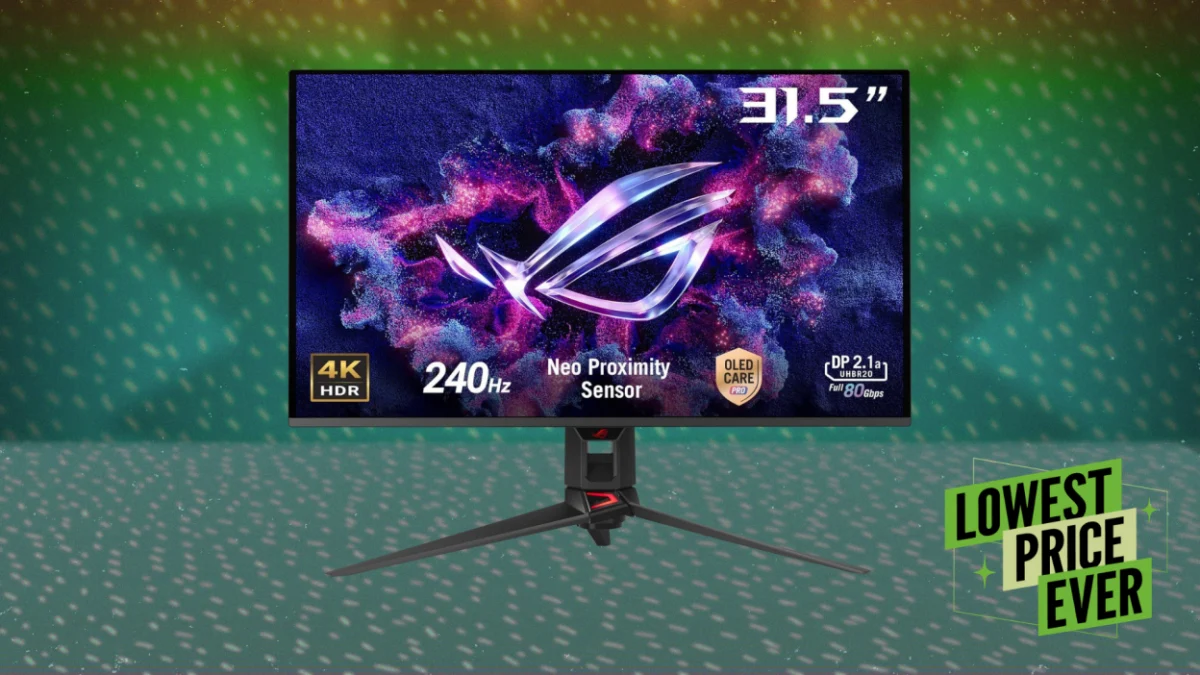
For years, the display market has been caught in a tug-of-war between the immersion of curved monitors and the professional versatility of flat-panel screens. While OLED technology has finally trickled down into the mainstream, finding a monitor that balances high-end competitive performance with everyday reliability has remained a challenge. Enter the Asus ROG Swift PG32UCDMR, an evolution of the award-winning PG32UCDM, which currently sits at a compelling price point of $899—a 30% discount from its original $1,299.99 MSRP.
As the gaming industry shifts toward higher fidelity and faster response times, this 32-inch powerhouse has emerged as a frontrunner for both esports enthusiasts and content creators.
Main Facts: The Hardware Under the Hood
The PG32UCDMR is not merely a refresh; it is a refined iteration of one of the most praised gaming monitors in recent memory. The core of this display is its cutting-edge QD-OLED panel, which provides the deep, inky blacks that OLED technology is famous for, paired with the vibrant, saturated colors afforded by Quantum Dot layers.
Key technical specifications include:
- Resolution: 3840 x 2160 (4K UHD)
- Refresh Rate: 240Hz
- Response Time: 0.03ms (GtG)
- Connectivity: DisplayPort 2.1, HDMI 2.1, USB-C, and an integrated USB hub.
- Brightness: Capable of hitting peak HDR highlights up to 1,018 nits.
- Sync Technology: AMD FreeSync Premium Pro and VESA Adaptive Sync.
Unlike many of its competitors that force a curvature on the user, the PG32UCDMR sticks to a flat form factor. This design choice is deliberate, catering to designers who require straight lines and gamers who prefer a traditional, distraction-free viewing experience.
Chronology: The Evolution of the ROG Swift Series
The journey to the PG32UCDMR began with the industry’s initial transition from standard LCD/LED panels to the OLED revolution.
- Early 2024: Asus launched the original PG32UCDM, which garnered immediate critical acclaim, including a PCMag Editor’s Choice Award. It set the benchmark for 32-inch 4K OLED gaming.
- Mid-2024 to Early 2025: Market feedback suggested a demand for more robust longevity features, particularly concerning burn-in protection, as well as a wider adoption of the DisplayPort 2.1 standard to accommodate next-generation GPU capabilities.
- Mid-2026: Asus released the "R" iteration (PG32UCDMR). This update refined the thermal management systems and integrated more aggressive "OLED Care" protocols, cementing its place as the definitive version of the 32-inch flat OLED monitor.
- Current Date: The monitor is currently being offered at a significant discount, signaling a push to get this premium hardware into the hands of a broader user base.
Supporting Data: Testing and Performance Metrics
In rigorous testing, the predecessor to the PG32UCDMR demonstrated that 4K resolution at 240Hz is the "sweet spot" for modern PC gaming. While 144Hz was once the gold standard, the move to 240Hz provides a noticeably smoother motion experience, particularly in fast-paced titles like Valorant, Counter-Strike 2, and Apex Legends.
The QD-OLED panel allows for a wider color gamut coverage compared to traditional WOLED panels. During testing, the display consistently hit high marks in DCI-P3 color space coverage, making it a viable tool for photo editing and video color grading. The VESA DisplayHDR 400 True Black certification ensures that when a scene calls for darkness—such as in a horror game or a cinematic cutscene—the pixels effectively turn off, creating infinite contrast that standard IPS or VA panels cannot replicate.
The inclusion of DisplayPort 2.1 is a critical future-proofing step. As GPUs move toward higher bandwidth requirements to push 4K at high refresh rates without heavy display stream compression (DSC), having the latest port standard ensures that the monitor will remain relevant for the next three to five years.

Official Responses and Industry Positioning
Asus has positioned the PG32UCDMR as a "prosumer" device. In official statements regarding the "OLED Care" suite, company representatives have highlighted the proprietary software designed to mitigate burn-in. The inclusion of the Neo Proximity Sensor is a standout feature in this regard; it detects the user’s presence and automatically puts the monitor into a power-saving standby mode, significantly reducing the cumulative hours the organic pixels spend illuminated while the user is away from their desk.
Industry analysts have noted that by offering a three-year warranty that explicitly covers burn-in, Asus is attempting to overcome the primary psychological barrier keeping many consumers from switching to OLED: the fear of degradation. This policy reflects a high level of confidence in their current thermal dissipation design, which uses custom heatsinks to draw heat away from the panel without the need for noisy, dust-prone internal fans.
Implications for the Gaming Ecosystem
The availability of such high-tier technology at the $899 price point has broad implications for the monitor market.
1. The Death of the "Premium Tax"
Historically, early adopters of OLED tech paid a massive premium for the privilege. With prices dropping, the "premium tax" is effectively eroding. This creates a competitive environment where other manufacturers are forced to improve their own specifications or lower their prices to compete with Asus’s aggressive value proposition.
2. The Standardization of "Flat" OLEDs
For a long time, the best OLED gaming monitors were exclusively curved. By doubling down on the flat-screen design, Asus is catering to a massive, underserved demographic of CAD designers, spreadsheet-heavy professionals, and flat-screen purists who have been waiting for OLED performance without the distortion of a curved arc.
3. Longevity as a Selling Point
The industry is moving away from "disposable" tech. By emphasizing the Neo Proximity Sensor and OLED Care Pro, Asus is signaling that the monitor is an investment, not a two-year purchase. This shift is essential for the sustainability of the gaming hardware industry, encouraging users to purchase high-quality gear that lasts rather than replacing budget displays every 18 months.
Conclusion: Is It Worth the Upgrade?
For the PC gamer, the decision to invest in the 32-inch Asus ROG Swift PG32UCDMR comes down to three factors: visual fidelity, competitive advantage, and longevity.
If you are currently running a standard 1440p high-refresh monitor, the leap to 4K OLED is profound. The clarity of text, the depth of shadow detail, and the speed of the 0.03ms response time offer a tactile improvement to the gaming experience that hardware benchmarks often fail to capture. At its current price, the "R" model offers a rare combination of enthusiast-grade specs and practical, everyday usability.
Whether you are a competitive gamer looking to shave milliseconds off your reaction time or a creative professional who needs perfect blacks for your workflow, the PG32UCDMR stands as one of the most well-rounded displays on the market. As the monitor space continues to evolve, this unit serves as a perfect case study of how refinements in software (OLED Care) and connectivity (DP 2.1) can extend the relevance of hardware, making this a top-tier choice for any high-end PC build in 2026.
 Layla Zulfa
  Asro
Asro  Reynand Wu