
 By Lina Irawan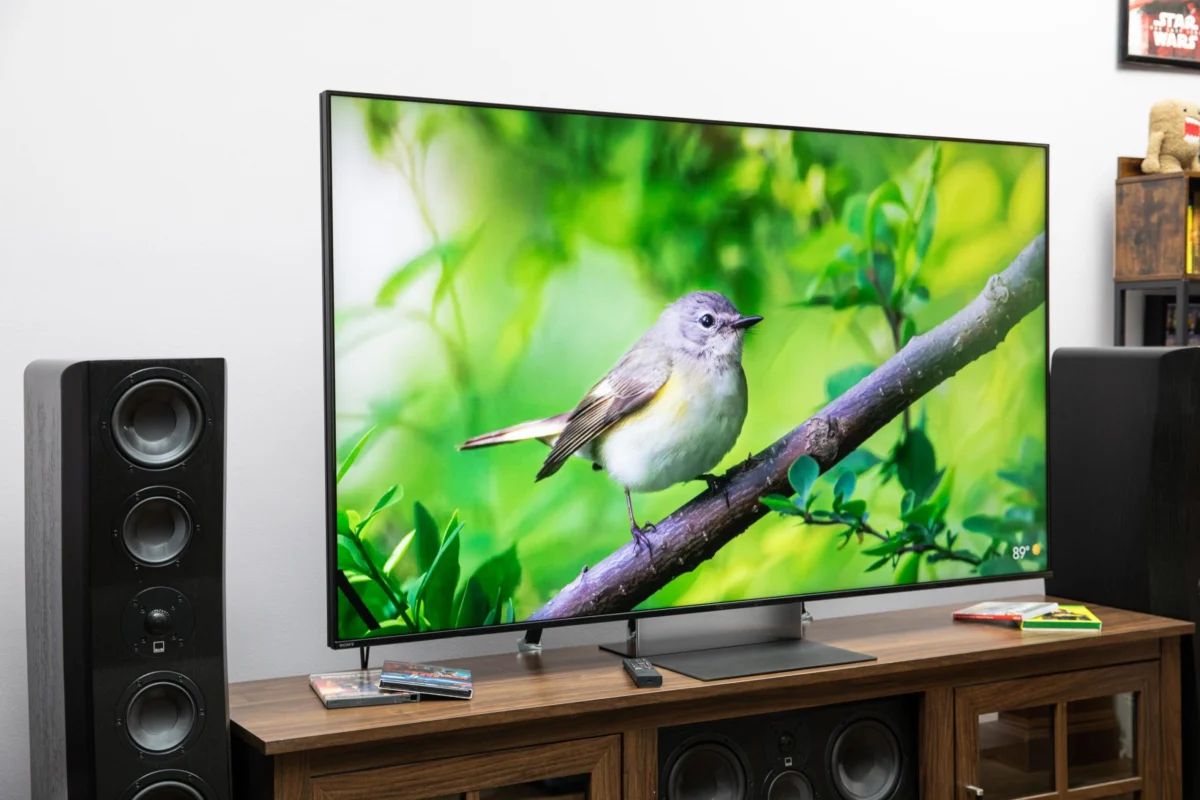
The television market in 2026 finds itself at a fascinating crossroads. While OLED technology has long held the crown for contrast and black-level perfection, the emergence of advanced RGB LED backlighting has forced a recalibration of what we expect from high-end displays. At the center of this transition is the Sony Bravia 9 II, a television that has been heralded as the most anticipated release in the company’s recent history.
As a successor to the highly regarded 2024 model and a step up from the impressive Bravia 7 II, the Bravia 9 II represents Sony’s most ambitious attempt to marry the brightness of LED with the color precision of professional reference monitors. But in a landscape crowded with exceptional OLED panels, does this flagship LED justify its premium price tag?
Main Facts: The New Standard for Bright-Room Performance
The Sony Bravia 9 II is, at its core, a testament to the power of Sony’s proprietary processing and backlight engineering. Utilizing a sophisticated RGB LED backlight system, the television moves away from the traditional blue-backlight-plus-phosphor approach used for decades. Instead, it employs distinct clusters of red, green, and blue LEDs that blend light with granular control, resulting in a color gamut that feels wider and more natural than previous generations.

Key highlights include:
- Peak HDR Performance: The display achieves a staggering 3,800 nits in peak highlights, ensuring that HDR content—from sun glints on water to the magical discharge of a wizard’s staff—retains its intended impact.
- Anti-Reflective Superiority: Perhaps the most significant "real-world" feature is the new anti-reflective screen coating, which effectively neutralizes ambient light, turning harsh glare into a manageable, soft glow.
- Intelligent Processing: Sony’s image processing algorithms remain the gold standard, providing upscaling and motion handling that elevate even lower-resolution content to near-4K fidelity.
- Design Language: The inclusion of the iconic "lenticular" stand, which hides cable management seamlessly behind the screen, reinforces the television’s position as a premium piece of living room furniture.
A Chronological Evolution of Sony’s Display Tech
To understand the magnitude of the Bravia 9 II, one must look back at the trajectory of Sony’s engineering efforts over the last two years.
Early 2025: The Tokyo Unveiling
Sony first teased the potential of its RGB LED technology at its Tokyo headquarters. Even in the prototype phase, industry observers were struck by the color purity. The goal was clear: to eliminate the "blue tint" common in traditional LED sets and achieve color accuracy that rivals professional mastering displays.

May 2026: The Bravia 7 II Precedent
The release of the Bravia 7 II set a high bar for mid-to-high-tier LED TVs. It introduced the world to the practicality of the lenticular stand and proved that the new RGB backlighting could hold its own in diverse lighting conditions. However, it lacked the sheer, blistering peak brightness and the specialized anti-reflective treatment that would eventually define the 9 II.
Late 2026: The Launch of the Bravia 9 II
The 9 II arrived as the culmination of these efforts, positioning itself not just as a screen, but as a complete home theater experience. It hit shelves with the promise of being the "best bright-room TV ever made," a claim that—following rigorous testing—appears to be empirically sound.
Supporting Data and Technical Analysis
Testing the Bravia 9 II requires a combination of subjective viewing and cold, hard data. Utilizing a Portrait Displays Calman suite, a Murideo 8K Seven pattern generator, and an X-rite i1 Pro 3 spectrophotometer, we evaluated the panel’s output in various environments.

The Brightness Factor
The 9 II’s HDR performance is nothing short of clinical. While the Bravia 7 II capped out at 2,200 nits, the 9 II pushes to 3,800 nits. On a full-field white test, both TVs perform similarly (around 850–880 nits), but the 9 II’s ability to "punch" in specific specular highlights provides a sense of depth that few other consumer displays can replicate.
Grayscale and Color Accuracy
Out of the box, the "Professional" picture mode tracks EOTF (Electro-Optical Transfer Function) with near-perfect precision. While the grayscale exhibits a slight lean toward blue, it is imperceptible to the average viewer during motion-heavy content. Foliage, skin tones, and sky gradients are rendered with a lifelike quality that avoids the oversaturation common in competing LED sets.
The Blooming Challenge
Despite the inclusion of significantly more dimming zones than the 7 II, the 9 II remains an LED-based technology. When viewing content straight-on, the "blooming" effect—where light bleeds from bright objects into dark backgrounds—is remarkably well-contained. However, testing revealed an unexpected phenomenon: when moving to an off-axis viewing position (approaching 70 degrees), color bleeding becomes more apparent. While this won’t bother a solitary viewer, it suggests that the 9 II is a "center-seat" experience rather than a "stadium seating" display for large groups.

Official Manufacturer Perspective
Sony has long maintained that their "secret sauce" is not just the hardware, but the marriage of hardware to their proprietary cognitive processing. According to engineering documentation released by the company, the Bravia 9 II’s backlight algorithm is designed to anticipate the movement of light across the screen faster than the eye can track.
By leveraging the RGB LED clusters, Sony aims to bypass the color-shifting artifacts inherent in traditional white-LED backlight systems. Their messaging emphasizes "The Creator’s Intent," arguing that the 9 II is tuned to reflect the exact color science used by directors in Hollywood studios, rather than the artificially vibrant, "shop-mode" colors favored by budget manufacturers.
The Implications: Is it Worth the Investment?
The Bravia 9 II is undeniably a masterpiece of television engineering, but its existence raises a difficult question regarding the current state of the market. With a starting price of $3,600 for the 65-inch model, it enters a bracket dominated by OLED technology.

The Case for the 9 II
If your viewing environment is a bright, sun-drenched living room where reflections are your primary antagonist, the Bravia 9 II is the undisputed champion. Its anti-reflective screen is arguably the best in the industry, and its ability to maintain image clarity against direct sunlight is unmatched by any OLED on the market.
The Case for Alternatives
However, for the majority of users, the Bravia 8 II OLED remains a more compelling value proposition. OLED’s pixel-level control provides a depth of contrast that, even with the most advanced local dimming, LED technology still struggles to mimic perfectly. Furthermore, if you are looking for the "RGB LED experience" on a budget, the Bravia 7 II captures roughly 90% of the 9 II’s performance for a significantly lower price.
Future-Proofing Concerns
One criticism that persists in the 2026 model year is the port configuration. Like the 7 II, the 9 II offers only two HDMI 2.1 ports. For a flagship device, this feels like a missed opportunity to cater to power users who may have both a PlayStation 5, an Xbox Series X, and an eARC-capable soundbar system.

Conclusion: A Triumph, But Who is it For?
The Sony Bravia 9 II is a triumph of display technology. It is a TV that makes the most mundane content look cinematic, and the most spectacular content look real. It is, quite simply, the best RGB LED television ever produced.
However, we find ourselves in an era where OLED has become remarkably accessible. Unless you specifically require the extreme brightness and the class-leading anti-reflective capabilities of the 9 II, the average viewer will likely find more satisfaction in the inherent, infinite contrast of an OLED panel. The Bravia 9 II is a specialist’s tool—a magnificent piece of hardware that proves LED is far from dead, even if it is no longer the default choice for every home.
 Raul Delapena Setiawan
  Siti Muinah
  Asro
Asro 