
 By Iffa Jayyana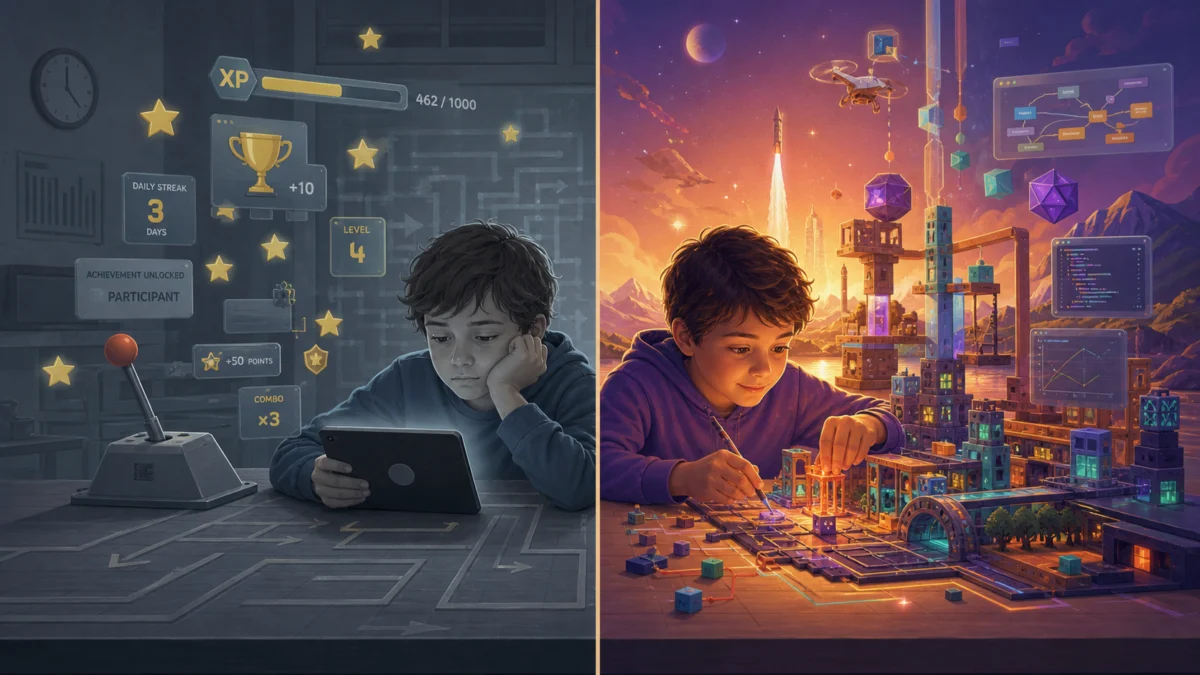
In the modern classroom and digital workspace, there is a prevailing obsession with "gamification"—the practice of applying game-design elements to non-game contexts. From language apps awarding digital badges to middle-school math platforms that offer "XP" for finished worksheets, the industry is convinced that progress bars and gold stars are the silver bullets for engagement.
However, a growing body of evidence suggests that for Gen Z and Gen Alpha—generations raised on the complex, high-agency ecosystems of Minecraft, Roblox, and Fortnite—this shallow implementation of gamification is not just ineffective; it is actively patronizing. The "game" is up, and the kids are the ones calling it out.
Main Facts: The Disconnect Between Design and Experience
The core of the issue lies in a fundamental misunderstanding of what makes a game compelling. Developers often equate "gamification" with "points and levels." They operate under the assumption that if they provide a superficial dopamine loop—a badge for a completed task—students will be incentivized to learn.
But the reality is starkly different. When a twelve-year-old student spends hours in Minecraft engineering complex redstone circuits or collaborating on massive sandbox builds, they are engaging in high-level problem-solving, social negotiation, and creative output. When they switch to an "educational game" that presents a digital worksheet with a progress bar, they immediately recognize the difference.
As one student bluntly noted: "It’s not a game. It’s just homework with points." This sentiment represents a crisis for EdTech. We are currently witnessing a massive, silent rejection of "fake gamification" by the very users these tools are meant to serve.
A Chronology of the Gamification Fallacy
To understand how we arrived at this impasse, one must look at the evolution of educational software over the last two decades.
- 2005–2010: The Digitization Era: Education software began shifting from physical textbooks to digital PDFs and basic web quizzes. Gamification was non-existent; the goal was merely to move content online.
- 2011–2015: The Rise of "Badges": Inspired by the early success of mobile gaming and social platforms, developers began adding "achievement" systems. This era saw the birth of the "Gold Star" digital economy.
- 2016–2020: The Peak of Superficiality: As mobile gaming exploded, EdTech companies doubled down on Skinner-box mechanics—XP bars, streaks, and leaderboards. These were designed to maximize time-on-app metrics rather than mastery of the subject matter.
- 2021–Present: The "Gen Alpha" Reckoning: A generation that has never known a world without immersive virtual environments is now encountering these legacy systems. They are finding that the "gamified" tools of their schools are significantly less sophisticated than the entertainment they consume in their free time.
Supporting Data and Psychological Underpinnings
Why do these systems fail? The answer lies in the psychology of play. True games provide what psychologists call "Intrinsic Motivation." According to Self-Determination Theory, people—including children—are motivated by three factors: Autonomy, Competence, and Relatedness.
- Autonomy: In Minecraft, the player chooses what to build and how to build it. In a "gamified" math app, the player is forced down a linear path of sequential questions. The user has no agency.
- Competence: In a well-designed game, the player masters a skill through trial and error. In fake gamification, the "challenge" is usually a low-effort hurdle designed to be cleared for a reward, rather than a genuine cognitive challenge.
- Relatedness: Modern gaming is social. Educational tools often isolate students, pitting them against each other in sterile leaderboards that do nothing to foster genuine collaboration.
When a student finishes a worksheet and receives a meaningless badge, their brain registers that this is not a reward for achievement, but a manipulative nudge. The reward is hollow, and because the student is a "digital native," they have developed a high-functioning "BS detector" for these types of behavioral economics.
Official Responses and Industry Skepticism
The industry is beginning to take note. UX designers in the gaming space have long criticized the "gamification" of education as a bastardization of game design principles.
"We are seeing a trend where educational developers are looking at the ‘shell’ of a game without understanding the ‘soul’ of the mechanics," says Dr. Elena Vance, a UX researcher specializing in educational software. "They see a leaderboard and think it creates competition, but for a student, it often just creates anxiety or indifference. When you take the mechanics of a casino—which is essentially what many of these apps do—and apply them to learning, you don’t create a student; you create a user who is trying to hack the system."
Several major school districts have begun to pivot, moving away from "gamified" subscription platforms and toward "game-based learning"—a fundamental shift where the process of learning is the game, rather than the reward system layered on top of it.
Implications: The Hard Truth for Developers
If you are an app developer or an instructional designer, the implication is clear: You are no longer competing with the textbook. You are competing with Roblox, Fortnite, and the entire catalog of high-quality, player-driven entertainment.
If your design would not hold the attention of a child who has spent three years playing Portal or The Legend of Zelda, then your design is failing.
The Path Forward: A New Framework
To fix this, developers must stop asking, "How do I add points to this?" and start asking, "What genre of game does this subject naturally inhabit?"
- Language Learning as an RPG: Think of it as a character-building journey. The "leveling up" shouldn’t be an arbitrary bar, but the unlocking of the ability to communicate in increasingly complex scenarios.
- Math as a Puzzle Genre: Math is essentially a series of elegant problems. Design it like Tetris or Portal—where the satisfaction comes from the "Aha!" moment of solving the logic, not from the badge that flashes afterward.
- Science as a Sandbox: Much like Minecraft, chemistry or physics education should be about experimentation and the freedom to "break" the rules to see what happens.
Conclusion: Respecting the Student
The fundamental error of the last decade has been the assumption that students are easily manipulated by digital trinkets. This is a patronizing view that fails to account for the intelligence and exposure of the modern child.
If your goal is to teach, you must respect the student’s time and intelligence. If you cannot make the learning material itself engaging, no amount of digital glitter will bridge the gap. We must stop trying to "trick" children into learning and start building environments where the act of learning is the primary source of fun.
The era of "homework with points" is coming to an end. It is time to treat our students like the players they are—capable, creative, and highly discerning consumers of experience. If you aren’t prepared to design a truly great game, perhaps you should be honest enough to just build a great tool. In the end, students will appreciate the honesty far more than the fake badges.
 Ammar Sabilarrohman
  Neng Nana
  Sagoh
Sagoh 