
 By Lina Hope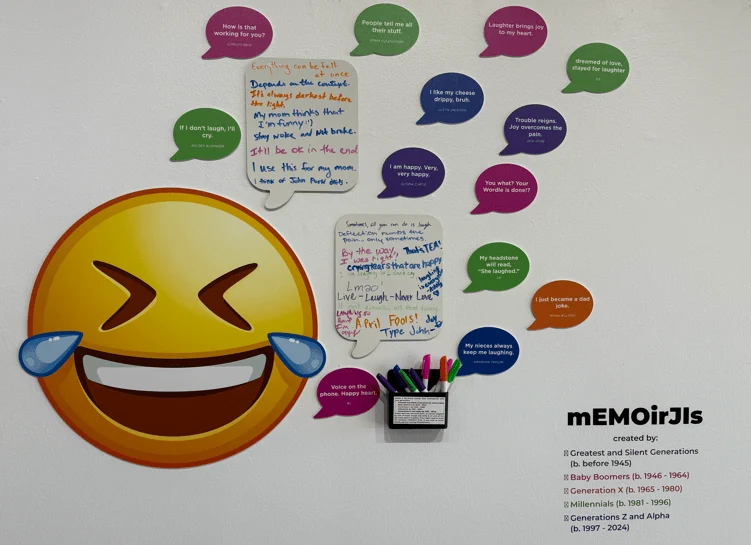
By Callie Dean
Director of Applied Research, Institute for Nonprofit Administration and Research, LSU Shreveport
Main Facts
Emojis have quietly evolved into one of the world’s most dominant visual languages, functioning as a universal shorthand across text messages, emails, and social media feeds. Yet, beneath their cheerful digital façades lies a labyrinth of ambiguity. Are these icons truly universal, or are they filtered through the subjective lenses of personal experience, regional slang, and generational divides?
This question served as the intellectual catalyst for “mEMOirJIs,” a creative data-art project launched in the fall of 2024. Centered in Shreveport, Louisiana, the project investigated the vast chasms in how different age groups interpret and utilize standard digital icons. By pairing six historically misunderstood emojis with the constraints of the six-word memoir format, the project transformed abstract digital miscommunication into a tangible, participatory art installation.
The resulting exhibition—displayed as part of the broader "Data is Poetry" showcase at Shreveport’s Artspace Gallery—revealed that while quantitative surveys can chart where emojis cause confusion, only qualitative, community-driven storytelling can capture why. Through color-coded PVC speech bubbles, generational writing workshops, and interactive dry-erase walls, "mEMOirJIs" proved that data is not merely confined to spreadsheets; it lives in our literature, our art, and our tears.
Chronology of a Project: From Viral Reports to Gallery Walls
The genesis of "mEMOirJIs" can be traced back to a series of linguistic and cultural reports that captured public attention in mid-2024.
Phase 1: Research and Inspiration (Summer 2024)
As digital communication reports surfaced across mainstream news feeds, clear patterns of intergenerational friction began to emerge. A comprehensive survey by Preply pinpointed the most confusing emojis across American states, ranking the unassuming Nail Polish emoji as the most confounding overall. Simultaneously, researchers at the University of Ottawa published findings indicating that older adults genuinely struggle to interpret and deploy specific emotive icons. To compound these findings, a widely cited CNN poll released around World Emoji Day reinforced a stark generation gap, highlighting Gen Z’s penchant for deploying emojis with thick layers of irony compared to older demographics.

Intrigued by these disconnects, project creator Callie Dean asked a foundational question: Could a data-art approach illustrate this linguistic friction in a novel, human-centric way?
Phase 2: Community Workshops (Fall 2024)
Planning commenced with the selection of six specific emojis frequently panned for their high miscommunication potential. Partnering with diverse community groups and local schools throughout Shreveport, Dean led a series of intimate writing workshops.
Participants were challenged to distill an authentic emotion or life experience into exactly six words—a micro-prose genre famously attributed to a legendary challenge faced by Ernest Hemingway ("For sale: baby shoes, never worn"). By utilizing the six-word constraint, the workshops lowered the barrier to entry, welcoming participants who might not otherwise identify as "real writers." The results were immediate, revealing a cascade of hilarious, poignant, and deeply contradictory responses.
Phase 3: Exhibition and Iteration (Late 2024 – Early 2025)
The culmination of the workshops materialized as "mEMOirJIs," integrated into the "Data is Poetry" installation at the Artspace Gallery. Designed to engage visitors on multiple levels—from passive observers to active contributors—the exhibit ran for two months, capturing thousands of visitor interactions and transforming how a Southern community viewed digital discourse.
Supporting Data and Insights: Decoding the Generational Gap
Quantitative surveys provide the skeleton of modern sociological research, but qualitative data brings it to life. While polls can establish that generations use emojis differently, "mEMOirJIs" mapped out the exact contours of those differences through localized prose.
The Melting Face: A Case Study in Multi-Generational Meaning
The Melting Face emoji—often deployed by younger users to signify existential dread, social awkwardness, or being overwhelmed by the heat of modern life—yielded vastly divergent interpretations across age brackets during the Shreveport workshops.

The Loudly Crying Face: Joy vs. Trauma
Perhaps no single emoji captures the intergenerational chasm quite like the Loudly Crying Face (😭). Traditionally designed to represent deep sorrow or grief, its modern usage has been completely subverted by digital natives.
- Gen Z Respondent: "I have never been so excited." (Reflecting its widespread use as an intensifier for positive emotions, laughter, or awe).
- Millennial Respondent: "Daycare dropoff: two sets of tears." (Reflecting the authentic, localized exhaustion of modern parenting).
- Gen X Respondent: "Coping with cataracts? See a doctor." (Reflecting a literal interpretation of physical ocular distress).
These stark juxtapositions demonstrated that quantitative data alone—such as frequency counts of emoji deployment—fails to register the radical shifts in semantic meaning occurring beneath the surface of everyday text exchanges.
Official Responses and Methodology
The execution of the "mEMOirJIs" installation required a meticulous blend of physical design and community trust.
To bridge the gap between digital screens and gallery walls, Dean collaborated with a local fabrication business to produce giant, oversized renderings of the chosen emojis printed onto 3 mm sheets of durable PVC (polyvinyl chloride). Spatial constraints and a commitment to representing balanced generational viewpoints led to the selection of four primary emojis for the physical installation, accompanied by 12 to 17 curated memoirs per icon.
To maintain analytical clarity within the art piece, memoirs were rigorously color-coded by generation and mounted on individual PVC speech bubbles positioned radially around each giant emoji. This visual arrangement created the clever illusion that the emojis themselves were "speaking" the crowdsourced memoirs.
Furthermore, the installation featured an interactive element: eight wall-mounted dry-erase speech bubbles accompanied by color-matched markers corresponding to each generation. Gallery guidelines instructed visitors to select their generational marker and contribute their own six-word memoirs to the living installation.

Implications: Technology, Connection, and the Future of Visual Language
As digital communication continues to outpace traditional linguistics, projects like "mEMOirJIs" carry profound implications for how we understand human connection in the digital age.
1. The Redefinition of Literacy
Traditional literacy once meant the ability to read and write standard text. Today, visual literacy encompasses the interpretation of complex iconographies, context clues, and algorithmic slang. The friction between generations highlights that emojis are not a neutral, globally understood alphabet; they are dynamic dialects shaped by age, culture, and subversion.
2. Technology as a Bridge and Barrier
Visitor feedback at the Artspace Gallery frequently touched upon a central paradox: while digital communication tools are designed to bring people closer together, their inherent ambiguities can just as easily foster misunderstanding and isolation. By juxtaposing emoji data with broader themes of screen time, information overload, artificial intelligence, and collective human experiences (such as the shared awe of a modern solar eclipse), the exhibition prompted deep self-reflection among attendees.
3. The Ubiquity of Data
Ultimately, "mEMOirJIs" challenges restrictive definitions of data science. Data is not merely cold, numerical output generated by algorithms or corporate tracking; it is embodied in our cultural artifacts, our poetry, our text threads, and our emotional expressions.
As we look toward an increasingly automated future where digital avatars and AI-generated text dominate our screens, projects like Callie Dean’s remind us that human nuance remains stubbornly creative. Whether expressed through a tear, a smile, or a melting face, our attempts to communicate across the generational divide remain one of our most deeply human endeavors.
 Lina Irawan
  Nana
Nana  Nila Kartika Wati