In the corporate boardrooms of Silicon Valley and Fortune 500 enterprises alike, a pervasive and largely unquestioned assumption dictates modern product development: everyone desperately craves more artificial intelligence.
Executives operate under the belief that infusing AI into every possible product, workflow, and customer touchpoint is a universally desired evolution. Yet, empirical evidence, low adoption rates, and escalating user friction tell an entirely different story.
The core thesis emerging from product design and UX research is striking: people do not want more AI. At least, they do not want the disruptive, uninvited, and inefficient implementations envisioned by tech leaders. Rather than serving as a magical value proposition, hastily bolted-on AI tools frequently fracture existing workflows, amplify organizational shortcomings, and introduce new layers of cognitive fatigue.
To achieve genuine utility, companies must pivot away from "AI-first" marketing hype. Instead, they need to embrace an "AI-second" approach—one where artificial intelligence functions quietly in the background to automate tedious, soul-sucking labor, leaving human creativity, connection, and critical thinking untouched.
Chronology of the AI Over-Saturation Boom
To understand how enterprises arrived at a juncture where users are actively resisting technological integration, it is necessary to examine the rapid escalation of the AI gold rush over recent years.
Phase 1: The Generative AI Explosion (2022–2023)
Following the public release of foundational large language models, the tech sector experienced a massive, speculative land grab. Companies rushed to rebrand existing software as "AI-powered" to satisfy investors and inflate market valuations. During this period, the prevailing philosophy was speed-to-market: ship first, figure out the use case later. UX best practices were frequently sidelined in favor of integrating chat interfaces and generative text boxes into every conceivable application.
Phase 2: The Enterprise Integration and Bolt-On Era (2024–2025)
Organizations mandated the adoption of internal AI tools, operating under the silent assumption that employees would naturally discard legacy habits in favor of automated workflows. Software suites added disjointed sidebars, autonomous agents, and predictive text generators. However, instead of boosting productivity, these additions often disrupted deep-focus work, forcing employees to constantly toggle between fragmented applications and manage the fallout of unvetted algorithmic outputs.
Phase 3: The Productivity Backlash and UX Reckoning (2026 and Beyond)
By 2026, enterprise studies began painting a stark picture of the true cost of uncritical AI adoption. Rather than reducing workloads, AI tools were shown to significantly increase administrative drag—spiking email volume, chat messages, and the time spent correcting machine errors. Users began pushing back against "AI slop" and uninvited automation, forcing product designers, UX researchers, and enterprise leaders to re-evaluate whether adding "smart" features actually solved human problems.
Supporting Data: The Hidden Costs of Forced AI Integration
The disconnect between corporate expectations and end-user reality is underscored by a growing body of workplace and consumer research.
1. The Productivity Paradox
Comprehensive corporate data compiled across various productivity studies reveals an alarming trend: AI does not reduce work; it intensifies it.
Communication Overload: Following the widespread introduction of generative tools, time spent managing email surged by 104%, while business chat and messaging applications saw a 145% increase.
Work-Life Erosion: Weekend labor climbed noticeably, with Saturday work hours increasing by 46% and Sunday work by 58%, as employees struggled to keep pace with the constant stream of AI-generated inputs and follow-up tasks.
Focus Deficit: Deep focus mode dropped by 9%, while costly workplace mistakes ticked upward by 39%, driven largely by the burden of sorting through "AI slop" (low-quality, unverified automated output).
2. The Illusion of Value
According to foundational product strategy insights—such as those illustrated by innovation expert David Bland—artificial intelligence does not belong in the "Value Propositions" section of a Business Model Canvas. Instead, AI belongs strictly in Key Activities and Key Resources.
When companies market "Powered by AI" as the primary value proposition, they make a fundamental strategic error. Customers do not care about the underlying algorithmic architecture; they care about predictable, reliable, and frictionless outcomes. If a traditional, deterministic software feature works flawlessly every time, while an AI-driven feature hallucinates or requires extensive error-checking, users will invariably choose reliability over novelty.
+-----------------------------------------------------------------+
|                    BUSINESS MODEL CANVAS                        |
|                                                                 |
|  [Key Activities]          [Value Propositions]                 |
|       * AI Goes Here           * NOT HERE (AI is a means)       |
|  [Key Resources]                                                |
|       * AI Goes Here                                            |
+-----------------------------------------------------------------+
3. Vulnerability and Job Exposure
Data from research institutions like GovAI and the Brookings Institution, highlighted by The Washington Post, maps out the sectors most exposed to AI automation. Roles heavily reliant on digital processing—such as software developers and public relations specialists—face high structural exposure. However, the data also highlights that jobs requiring physical intuition, interpersonal empathy, and complex human judgment (such as emergency responders) remain resilient. The challenge lies in ensuring that automation targets the tedious components of vulnerable jobs without eroding the core human satisfaction derived from creative problem-solving.
Official Responses and Expert Perspectives
As disillusionment with mandatory AI features grows, industry leaders, UX designers, and organizational thinkers are speaking out against the relentless push for ubiquitous artificial intelligence.
The Problem with "Bolt-On" UX
UX authorities and designers emphasize that AI tools frequently fail because they are treated as separate, standalone destinations rather than integrated elements of an existing mental model.
"AI is pretty good at amplifying shortcuts and shortcomings in organizations—from data quality to decision-making. It can’t magically fix years of accumulated quick patches, technical debt, broken culture and internal politics."
When companies introduce an AI tool as yet another disconnected system, they force employees to hop on and off various platforms, compounding administrative overhead rather than alleviating it.
The Human-Centric Perspective: Bo Young Lee
One of the most resonant voices on the limitations of consumer-facing artificial intelligence is corporate strategist Bo Young Lee, whose reflections captured a widespread cultural sentiment:
"I don’t want to read books written by AI. I don’t want to gaze upon paintings by AI. I don’t want AI to teach my children. I don’t want to have an AI therapist. I don’t want AI making my medical decisions. I want AI to do all the physical and mental labor that taxes me so I can read books written by humans and go to art galleries to engage with art made by humans. I want AI that makes my life easier rather than forces me to change myself."
This perspective cuts to the heart of the modern technological dilemma: humanity does not desire synthetic substitutes for genuine human connection, culture, and intellect. We desire competent, invisible assistance that grants us the time and headspace to engage more deeply with each other.
Implications for the Future of Product Design and Enterprise Strategy
The realization that users do not want "more AI" has profound implications for software developers, UX architects, and corporate decision-makers moving forward.
1. From "AI-First" to "AI-Second"
The most successful products of the coming decade will not be those built around a flashy, chat-based AI wrapper. They will be "AI-second" tools. These systems operate quietly, humbly, and ambiently in the background. They do not demand the user’s attention, nor do they force individuals to converse with a "magical box" to execute simple tasks. Instead, they seamlessly absorb administrative friction, clean up predictable data entry, and step out of the way.
2. Restoring the Joy of Craft
When software engineering and creative work are reduced to "vibe-coding" or prompt-engineering machines to generate mass content, the intrinsic reward of craftsmanship begins to evaporate. Employees and creators want to spend time thinking deeply, making nuanced decisions, and enjoying the process of creation. Automation should exist to eliminate the mind-numbing repetition that drains human energy—not to replace the acts of thinking, writing, designing, and feeling.
3. Redefining Success Metrics
Organizations must stop measuring success by the sheer volume of AI features deployed or the amount of buzzword-compliant marketing copy generated. Instead, product teams must evaluate features based on traditional, time-tested metrics:
Predictability: Does the feature behave the exact same way every single time?
Accessibility: Can users interact with it naturally within their established workflows?
Cognitive Relief: Does it genuinely reduce mental taxation, or does it shift the burden of error-checking onto the user?
Conclusion
The corporate infatuation with artificial intelligence has created an echo chamber where volume is mistaken for value, and disruption is confused with progress. However, as adoption data and workplace studies clearly demonstrate, people are experiencing fatigue, anxiety, and resistance toward uninvited, poorly integrated AI systems.
Ultimately, people do not yearn for a world saturated with synthetic art, autonomous financial agents, and chat boxes masquerading as companions. They want fast, reliable, accessible tools that shoulder the burden of boring, repetitive labor. By shifting focus from aggressive "AI-first" disruption to calm, supportive "AI-second" design, companies can build products that truly respect human time, human agency, and the irreplaceable value of human connection.

 By Asep Darmawan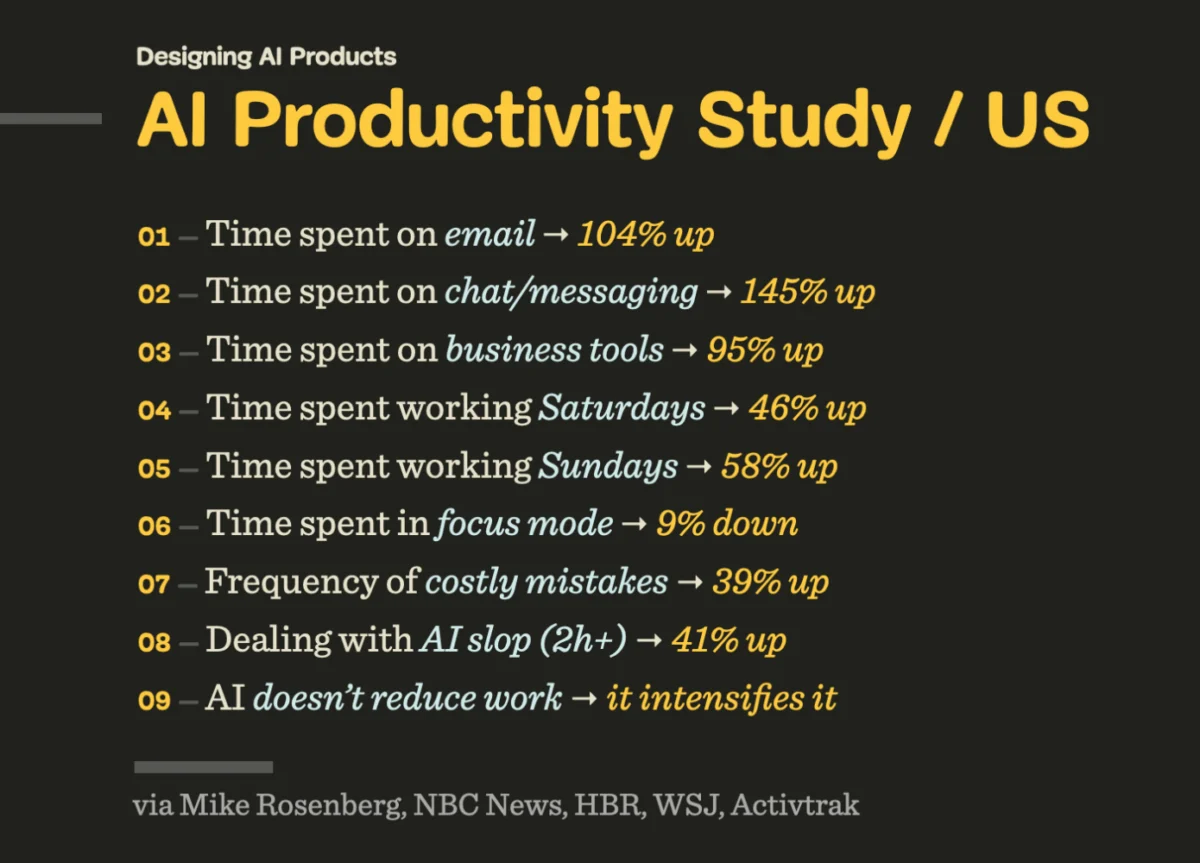


 Nana
Nana  Nana Wu
  Lina Irawan