
 By Ali Ikhwan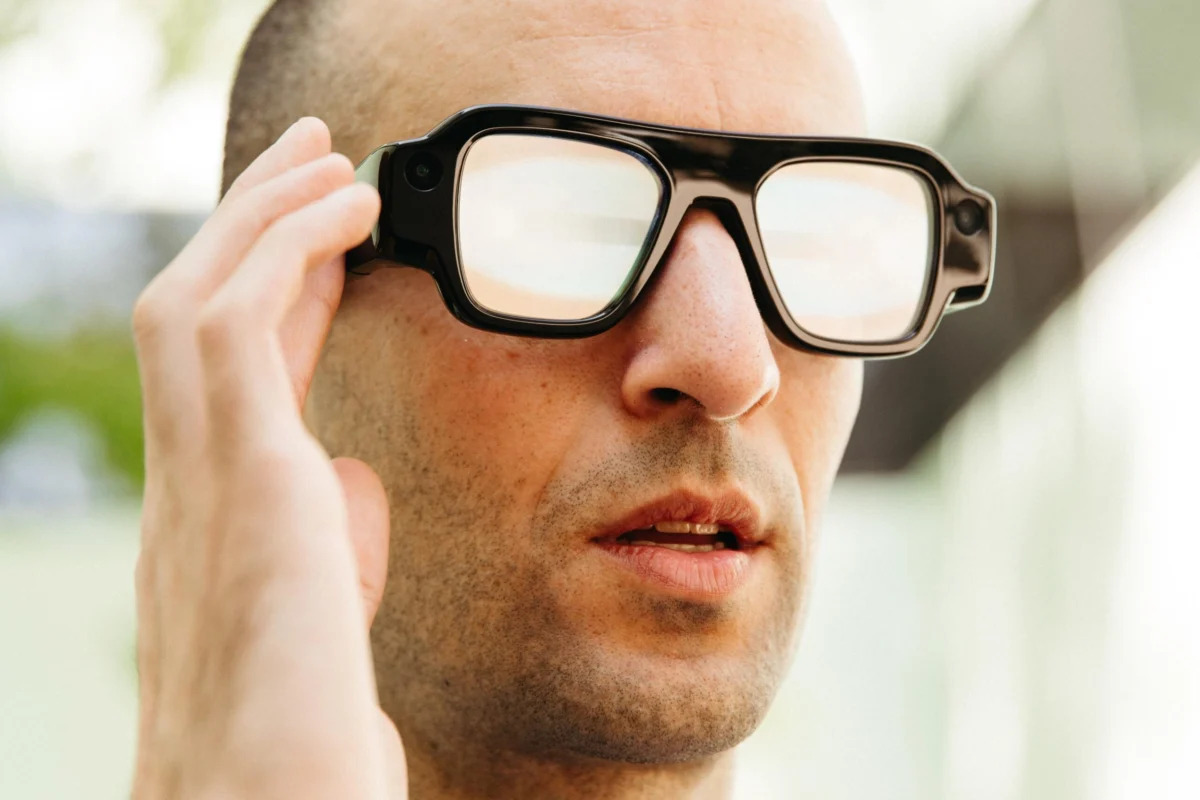
Main Facts
After more than half a decade of secretive research, limited developer-only iterations, and lofty ambitions to break free from the constraints of traditional app stores, Snap is preparing to take its biggest gamble yet. This fall, the company will launch its first consumer-facing augmented reality (AR) glasses, simply named Specs.
Priced at a hefty $2,195, the Specs represent a significant hardware milestone: unlike lightweight smart glasses that rely entirely on a paired smartphone or external compute puck, Snap’s new device functions as a fully standalone computer. Available in 47mm and 52mm lens sizes, the chunky, bold black frames house all necessary processing power, optical wave-guide displays, and tracking hardware directly on the user’s face.
The device aims to deliver a true stereoscopic augmented reality experience rather than simply projecting flat digital screens. By utilizing advanced hand-tracking technology, users can interact with virtual menus, resize floating application windows, and play shared digital games—such as virtual dominoes—that sit seamlessly on physical, real-world surfaces.
However, despite achieving what competitors like Meta have yet to ship commercially—dual-lens AR displays capable of rendering 16 million colors—early hands-on testing suggests that the hardware may still be struggling to balance visionary design with everyday usability. High price points, bulky aesthetics, tracking inconsistencies, a narrow field of view, and profound social friction indicate that the Specs might be arriving before the technology is fully ready for primetime.
Chronology
The Long Road to Consumer AR
- 2016–2020: Snap introduces its initial consumer-focused camera glasses under the name Spectacles. These early iterations are essentially glorified video-capture tools designed to feed content directly into the Snapchat app, lacking any visual display technology.
- 2021–2023: Snap shifts its developmental focus toward true augmented reality, releasing successive generations of Spectacles. However, these editions are strictly gatekept, shipped exclusively to a small, select group of software developers and creators to build out the underlying ecosystem.
- September 2024: In an interview with The Verge, Snap CEO Evan Spiegel outlines the company’s long-term philosophy, asserting that computing must evolve to "support the ways that humans have long interacted socially by looking at each other eye to eye with much more natural interaction."
- Late 2024–2025: Industry momentum accelerates as tech giants race toward wearable displays. Meta showcases its prototype Orion AR glasses, Apple signals intentions for future smart eyewear, and Google ramps up its Android XR software initiative.
- September 2026: Snap steps out from behind closed doors, providing media outlets with hands-on demonstrations of the finalized consumer Specs at its corporate offices ahead of a scheduled autumn market launch.
Supporting Data
- Pricing: The consumer-ready Specs carry a steep retail price tag of $2,195, positioning them closer to high-end enterprise headsets than mainstream consumer electronics.
- Hardware Configurations: The frames are manufactured in two distinct lens sizes—47mm and 52mm—to accommodate different facial structures, though both models feature the same bold, heavy aesthetic.
- Display Specifications: Snap utilizes advanced waveguide optics capable of rendering 16 million colors with high-resolution visual output, though the company has declined to publish exact pixel-per-inch (PPI) or resolution metrics.
- Field of View (FOV): The glasses feature a 51-degree field of view, a critical technical limitation that concentrates digital elements dead center in the user’s vision.
- Battery Life: The standalone units offer an estimated four-hour battery cycle under active use.
Official Responses and Corporate Vision
Snap’s official communications surrounding the launch emphasize a philosophical shift in how humanity interacts with digital interfaces. In its official product launch material, titled Making Computing More Human with Specs, the company argues that the device’s primary goal is to strip away the physical barriers of screens, keyboards, and handheld mobile devices.

"Our vision with Specs is to make computing more human," Snap states in its official release materials, echoing the sentiments expressed by executive leadership over the years.
The company envisions an ecosystem where technology recedes into the background of natural human interaction. By embedding hand-tracking—such as pinching to grab objects, snapping fingers to capture photographs, or holding up a palm to summon a Control Center-style menu—Snap wants to replace clunky touchscreens with intuitive, bodily gestures.
Yet, executive optimism contrasts sharply with early critical reception. While Snap representatives position the Specs as a breakthrough in untethered spatial computing, testers have noted that the heavy physical presence of the hardware and the isolation of private digital interfaces often achieve the exact opposite of "making computing more human."
Implications
The User Experience: Promise vs. Reality
During controlled demonstrations, the Specs flashed moments of genuine brilliance. Playing virtual dominoes across a real table with another person wearing identical glasses offered a glimpse into a genuinely shared digital-physical future—an experience largely absent from current virtual reality headsets.
Yet, the execution frequently faltered. The device’s 51-degree field of view proved to be a major architectural bottleneck. Because the AR graphics are constrained to a relatively narrow central window, digital elements routinely slip out of the user’s peripheral vision as they move their heads, shattering the illusion of spatial persistence. When testing a media browser in a moving car or playing table games, users reported having to unnaturally shrink windows or violently swivel their heads to keep up with the interface.

Furthermore, the physical control scheme remains finicky. Hand-tracking gestures—such as pinching items or executing two-part motion combinations to access home menus—frequently required multiple attempts to register accurately. Environmental factors also pose a severe challenge; under bright sunlight, the waveguide AR graphics wash out significantly, rendering them difficult to view.
The AI and Social Paradox
In step with the technological landscape of 2026, the Specs include an integrated AI assistant activated by a "Hey Specs" voice command. However, early testing revealed frustrating latency issues. Simple queries—such as asking the assistant to pull up funny cat videos on YouTube—frequently required repeating commands and resulted in a sluggish 15-second delay before rendering results.
More concerning than software lag, however, are the emergent social dilemmas. During media playback, audio is piped directly to the user via onboard spatial speakers. In tests where a user watched a video while maintaining an in-person conversation, observers standing inches away could hear nothing. This introduces a deeply unsettling paradigm: individuals can consume private digital media while staring someone straight in the eye, creating an unprecedented barrier to authentic communication.
Users reported feeling acutely distracted, caught in a bizarre hybrid state where their eyes and hands were consumed by arcane gestures and private screens while their bodies remained anchored in physical rooms. Rather than fostering presence, the glasses risk hyper-isolating the wearer.
Privacy Concerns and the "Pervert Glasses" Precedent
Like Meta’s competing smart glasses—which have recently battled severe backlash and earned a damaging reputation as "pervert glasses" due to unauthorized recording fears—Snap’s Specs feature integrated cameras for capturing photos and video.

To combat privacy violations, Snap has implemented a prominent indicator light. However, unlike Meta’s offset LED, Snap placed its privacy light directly in the center of the bridge of the glasses. Despite this highly visible design choice, industry analysts question whether any blinking light will suffice to soothe mounting public anxiety regarding non-consensual surveillance in public spaces.
The Broader Industry Landscape
Snap’s release of the Specs serves as the opening salvo in what is shaping up to be the next great platform war. With Meta actively developing advanced AR prototypes (such as Orion), Google investing heavily in Android XR smart glasses, Apple reportedly preparing a lightweight competitor for next year, and OpenAI exploring wearable audio-visual form factors, the tech industry has cast its collective die: the post-smartphone era will live on our faces.
As the first company to commercialize a dual-lens, standalone AR glass option at this scale, Snap is shouldering the burden of proving that consumer appetite for such devices actually exists. At $2,195, the Specs are undeniably a luxury product aimed at early adopters and enterprise developers. But as Snap barrels toward its fall release, the overarching question remains: even if the hardware is technically functional, are consumers ready for the profound social alienation and technical growing pains that come with wearing a computer on their face?
 Muslim
  Evan Lee Salim
  Azzam Bilal Chamdy