
 By Dwi Wanna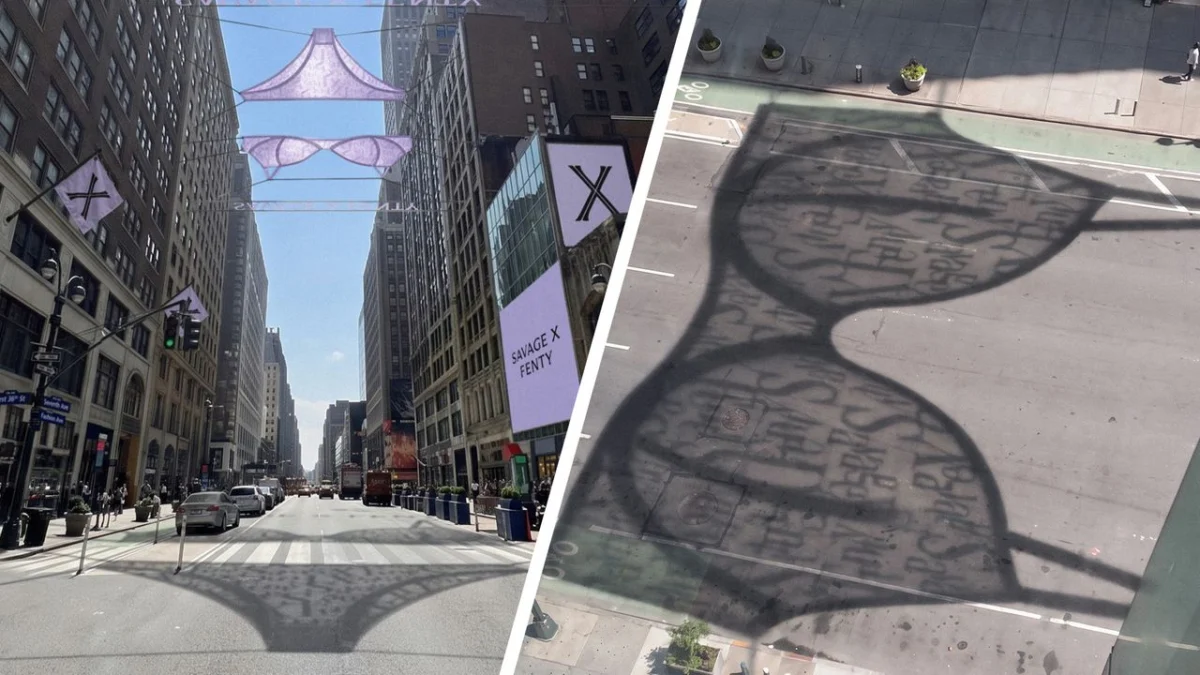
In the high-stakes theater of New York Fashion Week (NYFW), where brands spend millions on elaborate runway shows, exclusive after-parties, and influencer activations, Rihanna’s Savage X Fenty has opted for a different strategy. Rather than fighting for space on a crowded social media feed or competing for the attention of a limited front-row audience, the lingerie brand has taken to the literal skyline. By installing a massive, oversized lingerie set that looms over Seventh Avenue and Fashion Avenue, the brand has executed one of the most audacious pieces of experiential outdoor advertising in recent memory.
This campaign is not merely a billboard; it is a masterclass in scale, placement, and environmental branding. By utilizing the architecture of the city itself to create a "living" ad, Savage X Fenty has proven that in an era of digital saturation, sometimes the most disruptive technology is simply a physical object that demands you look up.
The Anatomy of the Installation: Facts and Execution
The centerpiece of the campaign is a gargantuan, three-dimensional representation of a Savage X Fenty lingerie set. Suspended strategically in the heart of New York’s Garment District, the structure is designed to interact with the environment in real-time.
When the sun hits the installation at the correct angle, the lingerie casts a distinct, unmistakable shadow across the pavement below. The designers behind the project displayed a keen eye for urban choreography, aligning the installation so that the shadow bisects a major crosswalk. As pedestrians walk through the intersection, they are literally enveloped by the brand’s silhouette.
The branding is subtle yet assertive. The fabric of the oversized garment features the iconic "Savage" wordmark rendered in a sleek, modern serif font, while the perimeter of the installation is framed by the full Savage X Fenty logo. This creates a visual hierarchy that informs the viewer exactly what they are looking at without the need for aggressive, text-heavy copy. It is a minimalist approach to maximum impact, relying on the sheer novelty of the object to do the heavy lifting.
A Chronology of Disruption
The timing of this installation was no coincidence. By launching during New York Fashion Week, Savage X Fenty effectively hijacked the conversation of the industry’s biggest week.
- Pre-Launch Phase: In the days leading up to NYFW, the Garment District saw the quiet assembly of rigging and structures. While standard construction is common in NYC, the peculiar shape of the materials began to circulate on social media, sparking speculation among locals and fashion enthusiasts.
- The Reveal: As the installation was unveiled on the eve of the week’s festivities, it became an immediate "photo op" destination. Fashion editors, street-style photographers, and influencers diverted their paths to document the sight.
- The Peak: Throughout the height of the week, as the industry converged on Manhattan, the installation became a constant backdrop for the city’s discourse. Its presence turned a standard urban commute into a brand experience.
- The Aftermath: Even as the week concludes, the imagery of the floating lingerie remains a viral touchstone, proving that the shelf life of a physical installation often outlasts the 24-hour cycle of a social media post.
The Economics of Experiential Advertising
To understand why Savage X Fenty would choose such a bold path, one must look at the current state of the advertising landscape. Traditional billboard advertising is currently facing a "banner blindness" crisis. As consumers, we are conditioned to ignore flat, two-dimensional surfaces that clutter our peripheral vision.
According to recent industry data, experiential advertising—campaigns that engage the consumer in a physical or interactive way—can yield up to three times the engagement of traditional digital ads. When a brand steps out of the screen and into the physical space, it changes the relationship between the consumer and the product. It ceases to be an interruption and becomes an event.
Furthermore, the "Instagrammability" of the installation provides a massive return on investment. By creating a structure that is inherently shareable, Savage X Fenty effectively turned every passerby into a brand ambassador. Each photo taken of the shadow on the crosswalk and shared on Instagram or TikTok represents free, organic reach that no paid digital campaign could easily replicate.
Official Responses and Industry Reception
While the brand has kept its direct commentary on the project brief, letting the art speak for itself, the industry response has been overwhelmingly positive. Design critics have lauded the project for its "tactile" approach, contrasting it with the increasingly sterile world of programmatic advertising.
"What Rihanna’s team has done here is a perfect example of context-aware design," says marketing consultant Elena Rossi. "They aren’t just placing an ad in New York; they are using the geometry of New York to complete the ad. The way the crosswalk aligns with the shadow isn’t a mistake—it’s an invitation to participate."
Competitors, while quiet, are undoubtedly taking notes. In a market where high-end fashion brands are struggling to maintain relevance among younger, "ad-averse" demographics, the success of this installation serves as a blueprint for future campaigns. It suggests that the future of luxury marketing is not found in more digital spend, but in the creative reclamation of the physical world.
The Implications for Future Brand Campaigns
The success of the Savage X Fenty installation signals a broader shift in the marketing zeitgeist. We are seeing a "return to the real." As the digital space becomes increasingly fragmented and dominated by AI-generated content, the physical, tangible world is becoming a premium commodity.
1. The Death of the Passive Ad
Consumers are no longer satisfied with being spoken to; they want to be part of the story. Future campaigns will likely mirror this trend by prioritizing interactivity. Whether through augmented reality that anchors to physical landmarks or, as in this case, physical structures that manipulate light and shadow, the future of advertising is immersive.
2. Hyper-Local Contextualism
The genius of this campaign lies in its specific location. It doesn’t work anywhere; it works specifically on Seventh Avenue because it is the heart of the fashion industry. Brands will need to move away from "one-size-fits-all" billboard designs and toward location-specific activations that respect and leverage the local geography.
3. Sustainability and "Subvertising"
There is a growing movement of "subvertising"—a critical take on the traditional advertising model that holds a mirror up to consumer culture. By making the ad itself an art installation, Savage X Fenty has successfully skirted the line between consumerist propaganda and public art. This blurred boundary makes it much harder for consumers to reject the brand, as they are essentially viewing a piece of temporary city art rather than a standard sales pitch.
A New Benchmark for Fashion Week
As New York Fashion Week continues to evolve, the definition of what constitutes a "show" is changing. When the clothes on the runway are only half the story, and the real impact happens in the streets, brands must be prepared to innovate.
Savage X Fenty’s sky-high lingerie set is a testament to the power of bold, unconventional thinking. It serves as a reminder that the most effective marketing doesn’t always come from the most expensive agency; sometimes, it comes from the willingness to look up, see the sky as a canvas, and dare to cast a shadow on the status quo.
In the coming years, we can expect to see more brands following this lead—transforming our cityscapes into playgrounds of branding, ensuring that even if we try to look away from our screens, we cannot look away from the world around us. Rihanna’s brand has not just sold lingerie; it has sold an experience, a moment, and an indelible image that will define the aesthetic of this year’s fashion cycle for years to come.
 Asep Darmawan
  Asro
Asro  Azzam Bilal Chamdy