
 By Evan Lee Salim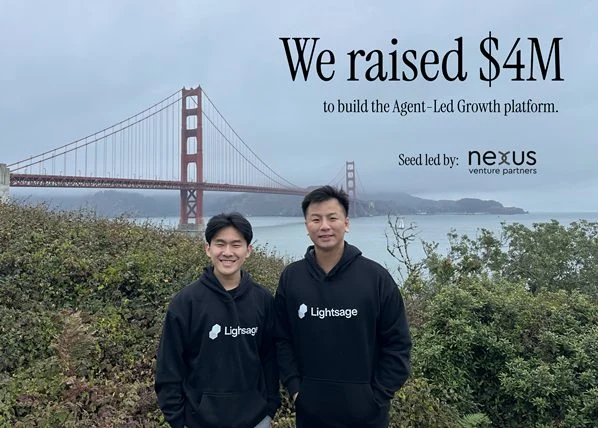
In the traditional software sales funnel, the path to revenue is well-trodden: a human prospect searches Google, clicks a link, peruses a landing page, signs up for a demo, and eventually swipes a credit card. But what happens when the buyer is no longer a human, but an autonomous AI agent?
As coding agents like Claude Code, Cursor, and GitHub Copilot become increasingly sophisticated, they are beginning to bypass the human "front door" of the internet entirely. These agents can autonomously discover libraries, install SDKs, authenticate APIs, and execute complex workflows without a human ever visiting a vendor’s website.
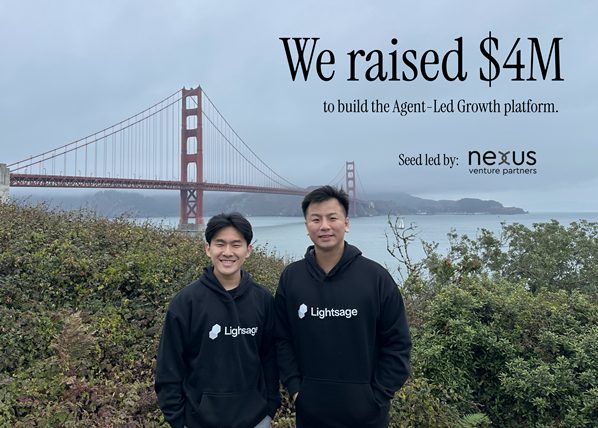
Recognizing this paradigm shift, San Francisco-based startup Lightsage today announced a $4 million funding round led by Nexus Venture Partners. The startup is building the infrastructure for "Agent-Led Growth" (ALG)—a new category of business intelligence designed to help software companies optimize their products for machine consumption.
The New Frontier: From Product-Led to Agent-Led Growth
For decades, the tech industry has optimized for Product-Led Growth (PLG), where the product itself serves as the primary driver of customer acquisition. However, the emergence of autonomous agents is forcing a rethink of how software is marketed and sold.
"We are moving from an internet where AI tells people which software to use to one where AI increasingly uses the software itself," says Jun Liang Lee, CEO and Co-Founder of Lightsage. "That changes what growth means. Visibility still matters, but the real test is whether an agent can understand your product and get to a successful outcome. We think every software company will eventually need to optimize for that journey to unlock Agent-Led Growth."
The core problem is one of "machine friction." If a coding agent attempts to integrate a database or authentication provider and encounters a confusing documentation structure, a broken API endpoint, or an incompatible SDK, it may simply abandon that vendor in favor of a competitor. Traditional SEO and Generative Engine Optimization (GEO) focus on visibility—getting the agent to "see" the product—but they fail to address the "last mile" problem: ensuring the agent can actually use the tool successfully.
Chronology of an Industry Shift
The development of Lightsage arrives at a pivotal moment in the evolution of the software development lifecycle:
- The Rise of Coding Agents (2023–2024): The launch of tools like Cursor and the integration of advanced LLMs into IDEs transformed the developer workflow. Suddenly, "coding" shifted from manual typing to natural language prompting.
- The Discovery Gap: Software vendors realized that agents were surfacing specific tools, yet there was zero visibility into why an agent chose one library over another.
- The Documentation Crisis: Developers began noticing that even if their product was superior, agents were defaulting to competitors because the competitor’s documentation was more "agent-readable."
- Lightsage’s Inception: Founded by Jun Liang Lee and CTO Sean Er, the startup began building a platform to simulate agent behavior, creating a sandbox where companies could observe their products through the "eyes" of an AI.
- The Funding Milestone (2025): With $4 million in backing, Lightsage is moving from stealth to a full-scale rollout, securing support from some of the most influential names in the developer tools ecosystem.
How Lightsage Bridges the Gap
Lightsage functions as a diagnostic layer between a software vendor and the AI agent ecosystem. The platform enables companies to see how their products perform in real-world scenarios across various coding agents and answer engines.
1. Large-Scale Simulations
Lightsage runs automated simulations where agents are tasked with specific workflows—such as installing an SDK or connecting an API. By testing these tasks across different agent models, Lightsage can pinpoint exactly where the process breaks. Does the agent fail because of a missing dependency? Is the documentation too ambiguous? Does the authentication handshake fail?
2. The "Agent-Readability" Metric
Just as companies once optimized for humans (UI/UX) and then for search engines (SEO), they must now optimize for agents. Lightsage provides feedback on whether a product’s CLI, SDK, or MCP (Model Context Protocol) server is "agent-readable." If an agent struggles with a specific documentation page, Lightsage flags it for the developer team to rewrite for higher machine-clarity.
3. Real-Time Agent Analytics
The platform doesn’t just stop at simulations. It tracks live agent traffic, providing analytics on which agents are visiting a site, what they are interacting with, and whether those interactions lead to successful integration. This creates a feedback loop that allows companies to iteratively improve their "Agent Experience" (AX).
Supporting Data and Early Traction
The necessity of the platform is reflected in its early adoption. Despite being in the early stages, Lightsage has already gained traction with developer-first companies including Firecrawl, Reducto, Daytona, Rime, and Tinyfish.
These early adopters are using the platform to solve tangible growth problems. For example, in a scenario where a coding agent consistently recommends a competitor, Lightsage allows the vendor to conduct a "side-by-side" simulation. By stripping away the variables, companies can isolate whether the loss of business is due to a lack of visibility in search results, a failure in documentation clarity, or an actual defect in the API implementation.
Official Responses: The Investor Perspective
The funding round, led by Nexus Venture Partners, includes an impressive roster of individual investors who represent the "who’s who" of the developer and AI software space. The list includes former Salesforce CTO Steven Tamm, Postman CEO Abhinav Asthana, Apollo CEO Matt Curl, and DocuSign President Robert Chatwani, among others.
Abhishek Sharma, a partner at Nexus, emphasizes that the shift toward Agent-Led Growth is as significant as the transition to the mobile-first web.
"The internet brought the economy online, with humans discovering, choosing, and transacting through digital channels," says Sharma. "AI is now shifting that agency from humans to agents, which can discover, evaluate, and act on a customer’s behalf. Lightsage is building the intelligence infrastructure for this new era of autonomous browsing, helping companies optimize for agent conversion, not just awareness."
The participation of executives from companies like Postman and Apollo is particularly telling. These companies are the backbone of the API economy; their involvement signals a broad industry consensus that the way developers interact with APIs is fundamentally changing.
Implications for the Future of B2B Software
The implications of the Agent-Led Growth movement are vast and extend far beyond the developer tools sector.
The Decline of the Traditional Homepage?
If agents are doing the research and execution, the "marketing homepage" may become secondary to the "agent-facing interface." Companies may need to prioritize the creation of machine-readable artifacts—such as high-quality MCP servers—over slick, human-centric design.
New Metrics for Growth
In the age of ALG, "Click-Through Rate" (CTR) and "Time on Site" may lose their predictive power. Instead, companies will likely focus on "Agent Success Rate," "Integration Latency," and "Agent-Driven Conversion." Attribution will also become more complex; if an agent discovers a product on GitHub, evaluates it via a coding agent, and executes the implementation via an API, the traditional marketing attribution model breaks down.
A New Discipline: Agent Experience (AX)
Just as "Developer Experience" (DX) became a competitive differentiator for companies like Stripe and Twilio in the 2010s, "Agent Experience" (AX) is set to become the defining trait of the 2020s. Companies that prioritize making their products easy for machines to understand, authenticate, and pay for will likely dominate their markets.
What’s Next for Lightsage
The $4 million injection of capital will be used to scale the team and broaden the scope of the platform. While the current focus is on developer tools and coding agents, the roadmap suggests an eventual expansion into the wider B2B software landscape.
As agents begin to act directly across infrastructure, payments, and enterprise SaaS, Lightsage aims to become the standard infrastructure for understanding this machine-driven commerce. For developers and commercial leads, the message is clear: the machines are shopping, and if you aren’t optimizing for them, you are effectively invisible.
As Lightsage expands its technical and commercial teams, it is positioning itself not just as a tool, but as the foundational layer for the next iteration of the internet economy—an economy where the most important customer is the one that never sleeps, never complains, and never visits your homepage.
 Layla Zulfa
  Neng Nana
  Asep Darmawan