
 By Ammar Sabilarrohman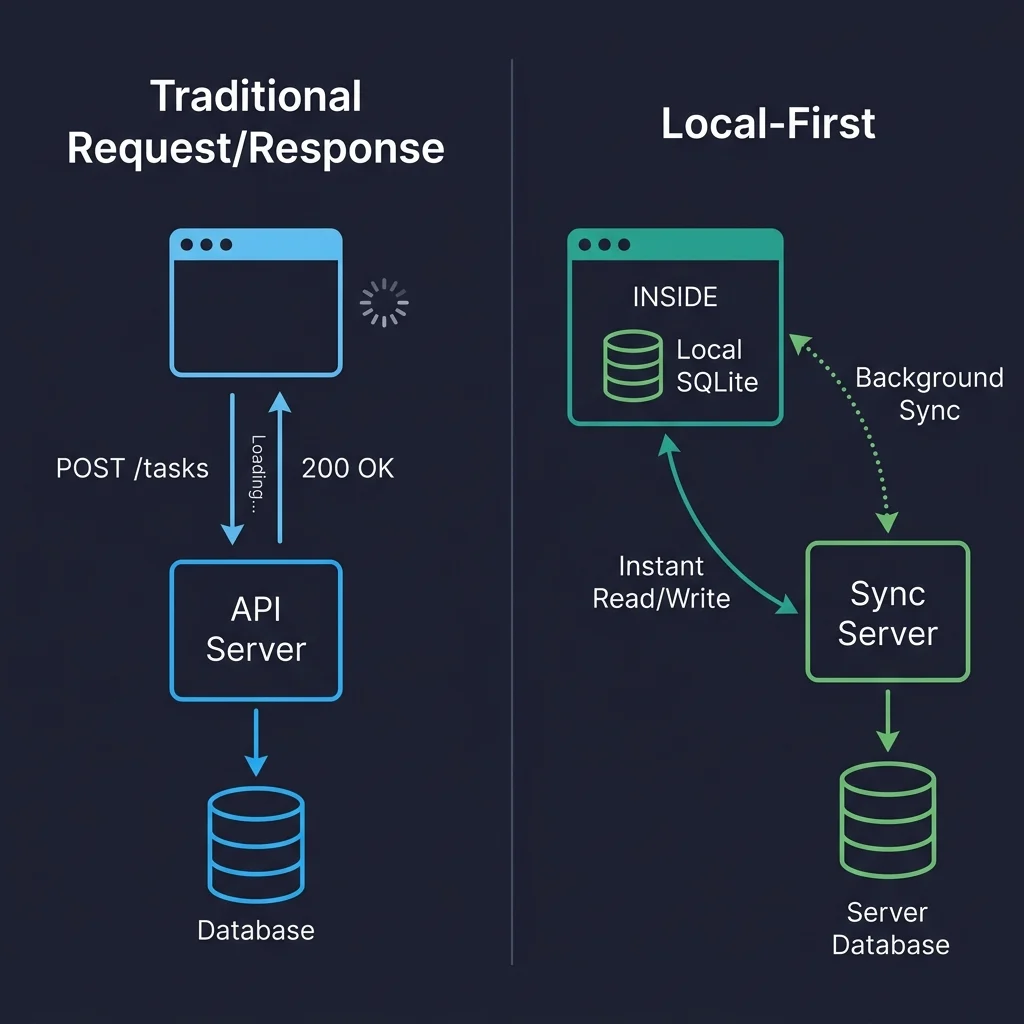
Main Facts
The software development landscape has reached an inflection point regarding how client applications interact with persistent data. For years, the default paradigm has centered on a centralized, request-response architecture: a frontend framework (such as React) communicates with a backend server, which queries a remote database, returning states after a round-trip latency penalty.
However, the industry’s embrace of local-first software architecture has shifted from academic theory to production reality. Defined by its ability to store primary data directly on the user’s device while syncing asynchronously in the background, local-first computing prioritizes performance, multi-device accessibility, resilience during network failures, and absolute user data ownership. Driven by advanced WebAssembly (WASM) implementations of relational databases like SQLite and robust synchronization protocols, developers are increasingly rejecting the notion that the client must act as a mere "thin view" waiting on server authorization.
Chronology: From Academic Curiosity to Production Standard
2019: The Ink & Switch Manifesto
The foundational philosophy of local-first software was formally articulated in 2019 by research lab Ink & Switch. Their landmark white paper outlined seven core ideals: speed, multi-device support, offline capability, collaboration, data longevity, privacy, and true user ownership. At the time, the software engineering community largely dismissed these principles as an impractical wish list. The necessary client-side tooling—ranging from performant local SQL engines to decentralized synchronization primitives—was simply immature, prompting most developers to default to traditional cloud-backed CRUD designs.
2021–2024: The Tooling Awakening
During this interim period, the web ecosystem began laying the technical groundwork for client-side autonomy. The widespread adoption of the Origin Private File System (OPFS) provided web applications with high-performance, sandboxed local file systems. Concurrently, libraries utilizing Conflict-Free Replicated Data Types (CRDTs), such as Yjs and Automerge, proved that real-time collaborative text editing without a centralized locking server was mathematically possible and practically viable.
2025–2026: The Maturity of WASM SQLite and Sync Engines
By 2026, local-first transitioned from an experimental niche to an enterprise-grade pattern. The release of wa-sqlite and standardized OPFS access enabled full relational databases to run directly inside browser web workers. Dedicated sync engines like PowerSync emerged to bridge client-side SQLite instances seamlessly with traditional backend servers like PostgreSQL. Developers who had initially dismissed local-first as over-engineering began successfully shipping production-grade applications that operated instantly, entirely independent of fluctuating network conditions.

Supporting Data: Architectural Shifts and Performance Metrics
The transition from a request-response model to a distributed replica model alters baseline performance indicators across every layer of the software stack:
- Read Latency: Traditional request-response architectures incur a round-trip network delay, often ranging from 50ms to over 300ms depending on geographic distance and server load. In contrast, querying a local SQLite database for a dataset of 500 records takes under two milliseconds on modern hardware and approximately eight milliseconds on mid-range mobile devices.
- Initial Sync Costs: Bootstrapping a local replica on a fresh installation requires downloading payload data. For a workspace containing 5,000 tasks and related project assets, initial synchronization takes roughly 1.2 seconds over a standard broadband connection, and between 3.5 to 5 seconds over simulated 3G networks. Subsequent incremental updates remain negligible.
- Bundle Overhead: Compiling SQLite to WASM adds approximately 400KB (gzipped) to the overall JavaScript bundle. To mitigate initial load time penalties, production architectures must employ dynamic imports to lazy-load database modules.
- Conflict Resolution Efficiency: Field-level last-write-wins (LWW) algorithms successfully resolve roughly 95% of standard multi-device data conflicts automatically, minimizing the need for manual user intervention during synchronization.
Official Perspectives and Industry Trade-Offs
While the benefits of local-first design—such as instantaneous user interfaces and offline resilience—are widely praised, senior engineers and systems architects emphasize the importance of matching the architecture to the specific domain.
When Local-First Excels
Local-first principles thrive in environments dominated by user-generated content and real-time collaboration. Document editors, note-taking apps, task boards, and field-data collection tools benefit immensely from local persistence. Because the client holds the primary database, users experience zero latency on mutations, and applications remain fully functional during total network outages.
When Local-First Fails
Conversely, industry veterans caution against forcing local-first patterns onto inherently server-bound domains:
- Server-Generated Data: Analytics dashboards, aggregate feeds, and search engines produce data natively on the server; replicating these datasets to a client offers zero structural advantage.
- Strict ACID Consistency: Domains requiring immediate, globally consistent transactional validation—such as banking, high-frequency payment processing, and single-item inventory management—cannot rely on eventual consistency. A centralized, authoritative database remains mandatory to prevent catastrophic double-allocations.
- Massive Datasets: Applications scaling into gigabytes of relational data will quickly overwhelm the storage quotas and memory limits of standard client devices, making full local replication physically impractical.
Implications for the Future of Web Development
The widespread adoption of local-first architectures introduces profound systemic changes to how developers approach security, state management, and testing.

Security and Authorization Shifts
In a traditional client-server relationship, the server acts as the primary trust boundary. In a local-first ecosystem, because data resides directly on the user’s device, the client cannot be trusted. Authorization must be rigorously enforced at the synchronization boundary. Server-side sync rules must filter outbound payloads strictly based on user permissions, ensuring unauthorized data never reaches the client’s local database. Furthermore, payloads can be encrypted at rest, paving the way for native end-to-end encryption (E2EE) models where cloud servers act merely as blind relays.
The Complexity Budget
The primary tax of local-first development is architectural complexity. Teams must manage client-side schema migrations across thousands of disparate user devices running various versions of an application. They must also implement robust background synchronization logic, handle semantic edge cases (such as scheduling double-bookings), and debug distributed state inconsistencies.
Despite these challenges, the prevailing sentiment among engineers who have navigated the transition is clear: local-first development represents a fundamental correction in web design. By treating the client not as a fragile rendering engine, but as an empowered node in a distributed system, developers can build applications that respect user time, network fragility, and data sovereignty.
 Nana Muazin
  Nana Wu
  Iffa Jayyana