
 By Raul Delapena Setiawan
By Smashing Editorial
Executive Summary & Main Facts
In the boardrooms of Silicon Valley and across enterprise corporate structures worldwide, a pervasive assumption reigns supreme: everyone is desperate for more artificial intelligence. Leadership teams operate under the guiding light that humanity is collectively craving an influx of AI features, generative algorithms, autonomous workflows, and automated interactions designed to completely uproot legacy workflows.
Yet, empirical reality tells a starkly different story. Data from recent industry studies—such as IBM’s 2026 adoption metrics—reveal that a high volume of rushed AI features suffer from notoriously low adoption rates and poor retention, despite costing astronomical sums to deliver. Rather than experiencing widespread technological euphoria, everyday workers and consumers are increasingly pushing back.
The core issue is not necessarily the underlying technology itself, but the dogmatic application of "AI-first" thinking. Users do not want disjointed chatbots, uninvited automation agents managing their bank accounts, or synthetic art museums. Instead, they want reliable, predictable tools that quietly eliminate mundane labor, allowing humans to spend more time doing what they actually love: engaging with other humans.
Chronology of the "AI-First" Rush
The Initial Wave of Generative Hype (2022–2023)
Following the explosive public release of foundational large language models, tech companies rushed to capitalize on the zeitgeist. The prevailing strategy across the software industry mirrored a gold rush mentality: integrate generative AI capabilities into every conceivable product as fast as humanly possible. During this period, "Powered by AI" was mistakenly treated as a universal value proposition rather than an architectural mechanism.
The Integration Backlash and Productivity Illusion (2024–2025)
As enterprises rushed to deploy standalone AI bolt-ons, cracks began to show in the corporate facade. Employees found themselves bouncing between an even greater number of fragmented systems. Rather than driving efficiency, studies tracking workplace habits began to record a startling reality: AI was not reducing work; it was intensifying it. Email volume, messaging pings, and the administrative overhead of cleaning up "AI slop" began to crowd out deep, focused work. Weekend hours expanded as workers labored to double-check AI-generated outputs for hallucinations and inconsistencies.
The Realignment Toward "AI-Second" Utility (2026 and Beyond)
Today, the conversation has shifted from reckless expansion to sober reflection. Organizations are beginning to reckon with the hidden costs of AI adoption, including technical debt, eroded team morale, and heightened security liabilities. Thought leaders, UX designers, and enterprise architects are now asking a radical question: What if the best AI is the one you barely notice?
Supporting Data & Empirical Findings
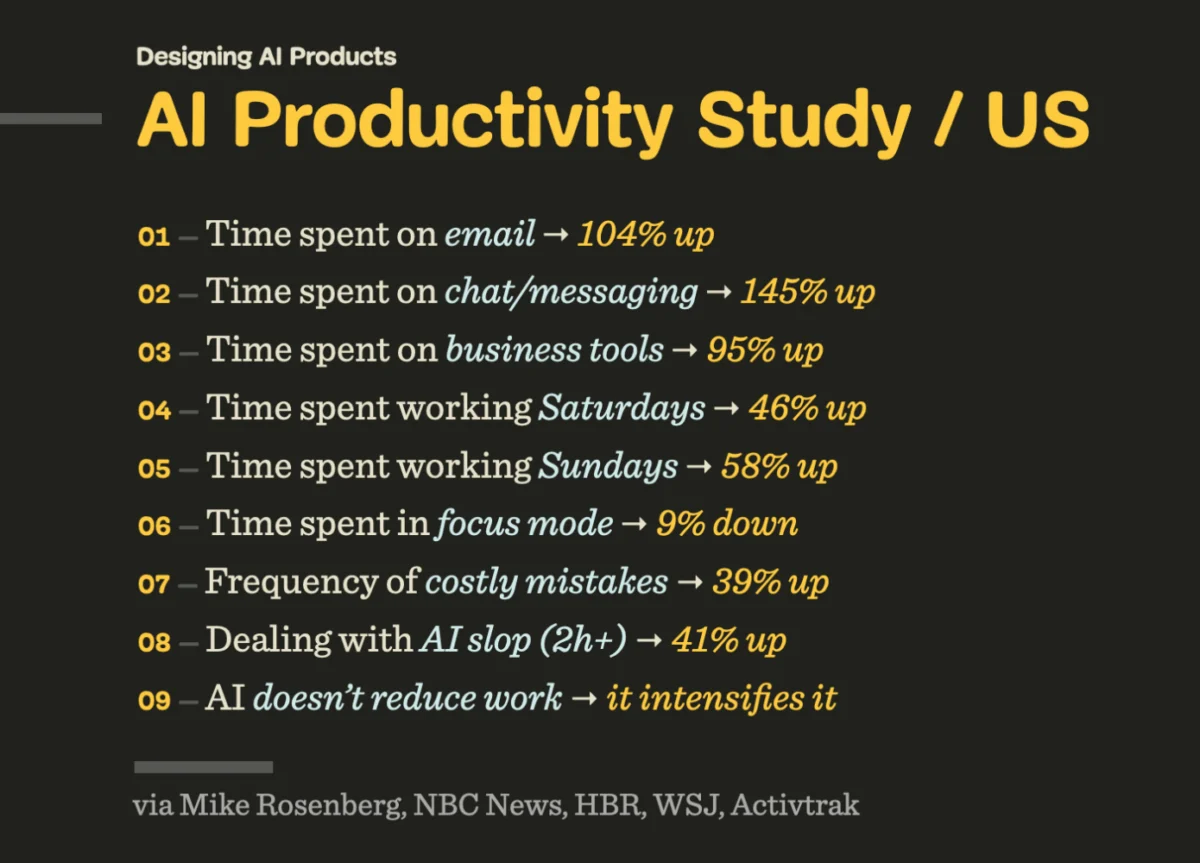
The friction between corporate expectations and end-user reality is substantiated by mounting workplace and consumer data. According to comprehensive productivity metrics aggregated by platforms like ActivTrak, NBC News, Harvard Business Review, and the Wall Street Journal, the widespread injection of unrefined AI tools into daily operations has yielded unintended consequences:

- Communication Overload: Time spent managing emails has surged by 104%, while time dedicated to workplace chat and messaging platforms has increased by 145%.
- Expansion of Business Tooling: Reliance on fragmented business tools has risen by 95%, contributing to digital fatigue.
- Encroachment on Personal Time: Working hours on Saturdays have increased by 46%, and Sunday work has climbed by 58% as employees scramble to keep pace with administrative demands.
- Erosion of Focus: Dedicated "focus mode" time blocks have dropped by 9%.
- The Cost of Errors: Costly operational mistakes linked to rushed automated workflows have jumped by 39%.
- The Burden of "AI Slop": Dealing with low-quality, AI-generated content and artifacts has wasted 41% of administrative evaluation time.
Furthermore, vulnerability mappings released by the Brookings Institution and GovAI via The Washington Post indicate that while knowledge-heavy professions—such as software engineering and public relations—face the highest exposure to automation, true productivity gains only materialize when technology respects existing human mental models and taste.
Official Responses and Expert Perspectives
The pushback against hyper-aggressive AI integration has found voice among industry analysts, UX researchers, and enterprise strategists who argue that technology must serve human intent rather than corporate metrics.
UX design educators, such as Vitaly Friedman—creator of the specialized video course Design Patterns For AI Interfaces—have consistently emphasized that user interfaces must stop forcing conversational chat boxes into domains where they do not belong. "People don’t compare software with other people; they compare features with features," Friedman notes. "If one feature in one product is unreliable while a similar feature works flawlessly in another, they choose the latter. It’s not about AI or not AI, but rather what works consistently and reliably."
This sentiment is echoed powerfully by corporate leaders like Bo Young Lee, whose reflections on the boundaries of automation have resonated deeply across professional networks:

"I don’t want to read books written by AI. I don’t want to gaze upon paintings by AI. I don’t want AI to teach my children. I don’t want to have an AI therapist. I don’t want AI making my medical decisions. I want AI to do all the physical and mental labor that taxes me so I can read books written by humans and go to art galleries to engage with art made by humans. I want AI that makes my life easier rather than forces me to change myself."
From a business model perspective, innovation strategist David Bland has famously mapped out where artificial intelligence genuinely belongs within an organization. On a standard Business Model Canvas, AI rightfully sits under Key Activities and Key Resources—the operational engine room—rather than being mistakenly thrust into the Value Propositions column, where customers evaluate actual utility and emotional resonance.
Implications for Business, UX, and Society
1. The Death of "Powered by AI" as a Marketing Hook
For years, appending "AI-powered" to a product description was enough to excite investors and secure short-term bumps in valuation. That era is rapidly drawing to a close. Consumers and enterprise buyers have grown weary of novelty features that break workflows, hallucinate data, and introduce unpredictable risks. Future success will belong to products that solve specific problems invisibly, without demanding that users relearn how to interact with software.
2. Shifting from "AI-First" to "AI-Second" Design
True innovation in user experience design requires adopting an "AI-second" mindset. Instead of building products centered around a generative chat window, designers should focus on ambient, calm, and supportive background automation. When AI operates quietly to strip away tedious, repetitive tasks—without disrupting human autonomy or creative intuition—its value proposition becomes self-evident.

3. The Cultural Cost of Technical Debt and Organizational Shortcuts
AI cannot serve as a digital band-aid for institutional dysfunction. Organizations suffering from poor internal communication, fractured data pipelines, and misaligned strategic priorities will find that artificial intelligence merely amplifies these shortcomings. When broken workflows are automated, the resulting inconsistencies are handed directly to the end user to untangle, destroying trust and depleting workplace morale.
4. Reclaiming Human Agency
Ultimately, the broader societal implication of the current AI fatigue is a renewed appreciation for human-centric experiences. People do not dream of a world mediated entirely by synthetic interactions. They crave predictability, deep focus, and meaningful human connection. By offloading mechanical, soul-crushing labor to algorithms—while fiercely protecting the creative, emotional, and intuitive parts of work and life—society can chart a healthier, more sustainable technological future.
For those looking to navigate these complex UX challenges thoughtfully, educational resources like Vitaly’s Design Patterns For AI Interfaces offer practical, real-world frameworks to help designers build interfaces that respect human cognition and elevate digital experiences.
 Iffa Jayyana
 Azzam Bilal Chamdy
 Nila Kartika Wati
