
 By Sagoh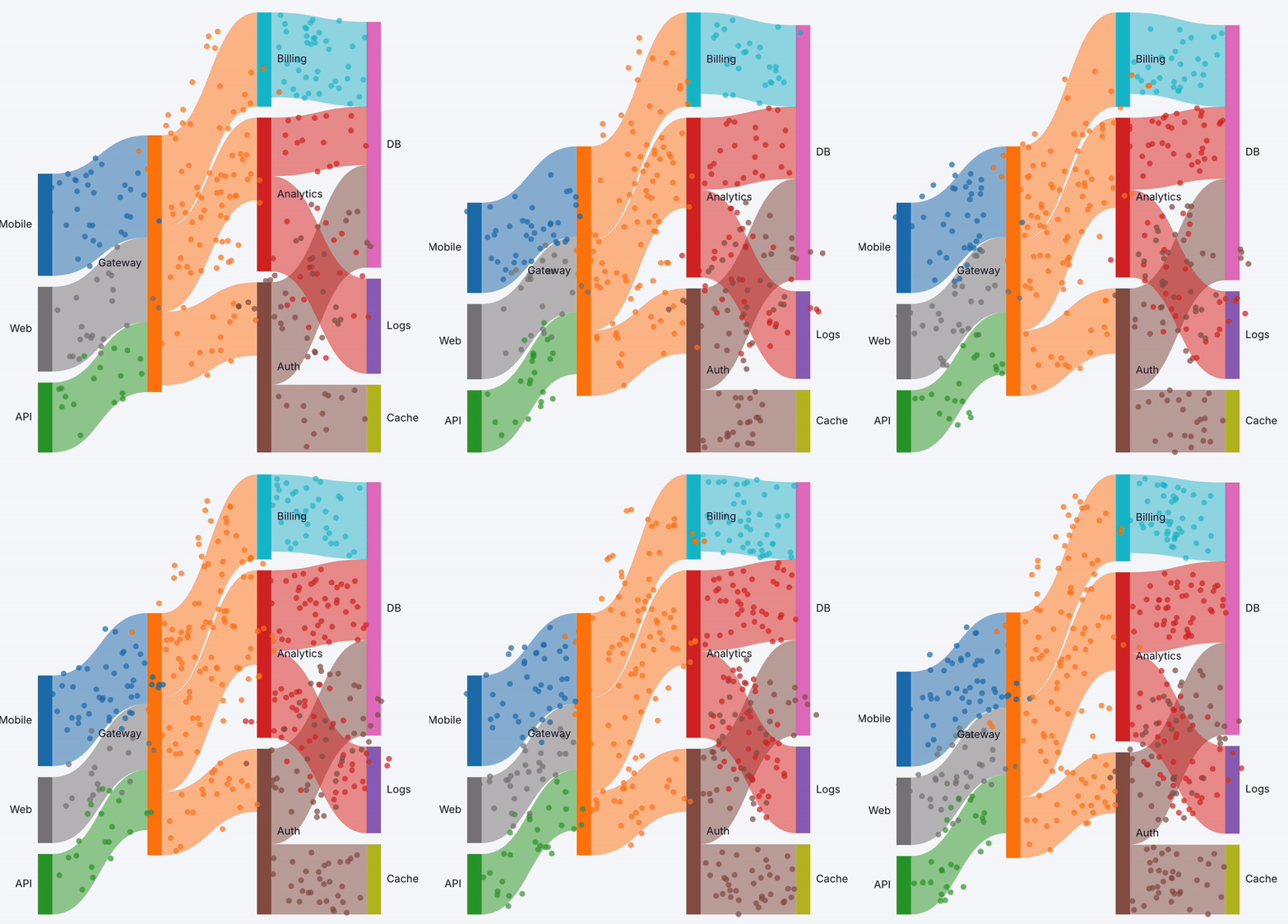
In the fast-evolving world of software engineering, few projects have undergone as radical a transformation as Semiotic. Originally birthed as an internal tool at Netflix, the data visualization library has long been a labor of love for its creator, Elijah Meeks. Today, with the launch of Semiotic 3, the project enters a new epoch. By embracing artificial intelligence as a collaborative engine rather than a replacement for human ingenuity, Meeks has effectively "hired" an army of invisible, high-level engineers to modernize a platform that was once constrained by the limitations of a single developer’s bandwidth.
The Evolution of Semiotic: A Chronology of Collaboration
To understand the gravity of Semiotic 3, one must look at the library’s lineage. Its origins trace back to the "Abacus Viz Framework" at Netflix—a suite of tools designed to streamline reporting and A/B testing. Even in its infancy, the project was a testament to the power of community. It relied on the architectural foresight of James Womack and the design-centric annotations of Susie Lu to transform what might have remained a dry technical prototype into a functional reality.
Over the years, the project saw contributions from industry luminaries like Tom MacWright, who refined its build systems, and Oleksii Raspopov, whose performance optimizations allowed the library to power data-intensive environments like Noteable’s Data Prism. Despite this collaborative history, the library suffered from a classic pitfall: it became an extension of Meeks’ own idiosyncratic obsessions. While it earned over 2,000 stars on GitHub, its adoption was hampered by a steep learning curve and a structural complexity that favored deep-level customization over "plug-and-play" simplicity.
As Meeks transitioned into his role as a Principal Engineer at Confluent, the library sat in a state of stasis. The innovations he envisioned—particularly those surrounding real-time streaming data—required a specialized engineering team that he simply didn’t have access to. The project became a personal ecosystem, efficient for his specific workflows but inaccessible to the broader developer community.
Bridging the Gap: AI as the Missing Team
The catalyst for Semiotic 3 was the rapid maturation of generative AI models. Meeks recognized a unique opportunity: he could use AI not to automate the "what" or the "why" of the project—areas where he held a decade of domain expertise—but to execute the "how."
"I knew where the bottlenecks were, I knew which abstractions were load-bearing and which ones were vanity," Meeks explains. "What I didn’t have was the ability to execute on all of it myself at the level of quality it deserved."
By acting as the architect, Meeks provided the specific technical directives—such as implementing server-side rendering, optimizing data pipelines for rolling windows, and writing comprehensive test suites—while AI models handled the granular implementation. In this paradigm, AI did not replace the "best programmers" he had worked with in the past; rather, it filled the roles of the specialized engineers he could not afford to recruit. This effectively bypassed the limitations imposed by Conway’s Law, which suggests that organizations (or in this case, solo-developer projects) are constrained by their own structural designs.
Technical Implications: Real-Time as a First-Class Citizen
The most significant shift in Semiotic 3 is its pivot to being a "real-time-first" library. Drawing inspiration from Apache Flink—which treats streaming data as a superset of static batch data—Meeks has rebuilt the library to accommodate the constant flux of modern data architectures.
Key Technical Improvements:
- Streaming-First Architecture: Nearly every chart type now includes a dedicated streaming mode, allowing for dynamic updates without the performance degradation that plagued earlier versions.
- Server-Side Rendering (SSR): By implementing robust SSR, the library is now more accessible and performant for web applications requiring rapid initial paint times.
- Test Coverage: A primary critique of the previous versions was the lack of automated testing. Semiotic 3 arrives with comprehensive test suites that ensure stability across complex visualizations.
- Higher-Order Components: The library has been restructured to offer better abstractions, making it significantly more intuitive for developers who are not experts in the underlying D3.js engine.
Furthermore, the library now acknowledges the rise of "vibe coders"—developers who use AI assistants to generate code—by treating them as first-class citizens. The API is designed to be readable and logical, allowing AI models to effectively suggest modifications and enhancements without requiring deep manual intervention from the human developer.
The "Goldilocks Zone" of AI-Assisted Development
A critical takeaway from the development of Semiotic 3 is the identification of what Meeks calls the "Goldilocks Zone" of AI usage. The project serves as a rebuttal to the common narrative that AI will inevitably make human developers obsolete.

Instead, the library demonstrates that AI excels when it is directed by a domain expert. When the human provides a specific, high-level directive—"this component needs to handle streaming updates by diffing incoming data against a rolling window"—the AI can land the technical implementation with precision. Conversely, when AI is asked to define the vision for a product it doesn’t fully understand, it often falters. This "architect-as-pilot" approach allowed Meeks to maintain the library’s unique identity while offloading the heavy lifting of performance optimization and testing.
Future Outlook: Communication Through Data
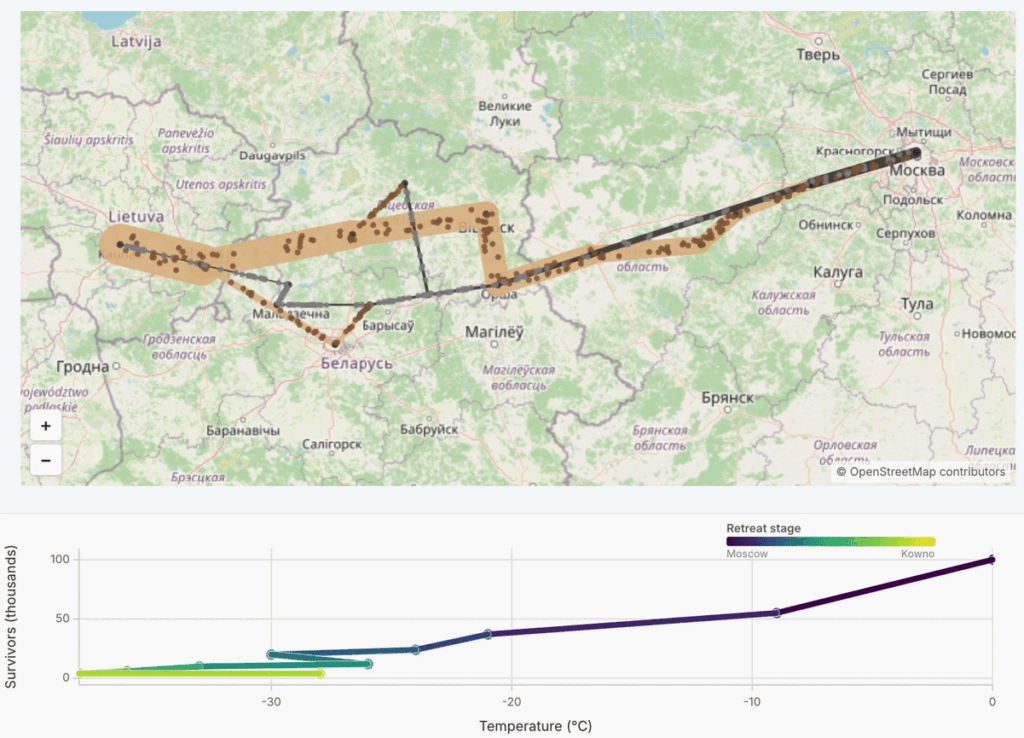
The release of Semiotic 3 is not just a technical update; it is an invitation for the community to experiment with novel modes of data communication. Meeks has long championed the idea that data visualization should be a flexible medium. From radial violin plots to particle-enhanced Sankey diagrams, the library provides the tools for users to push the boundaries of visual expression.
For Confluent and the broader streaming data community, this update offers immediate utility. It empowers stakeholders to move beyond static, historical reporting and toward dynamic UIs that visualize streaming data in real-time.
"I remember during a Reddit AMA at its release, someone asked me, ‘Is this really ready for prime time?’" Meeks recalls. With the modular, performant, and battle-tested architecture of version 3, that question has been answered with a resounding affirmation.
As we look toward the future of open-source development, Semiotic 3 stands as a case study in how the integration of AI can preserve the legacy of a project while accelerating its evolution. By delegating the execution to AI, Meeks has allowed the "best version" of his library to finally emerge, proving that the most effective teams of the future may well be those that blend human vision with machine-learned efficiency. Whether for enterprise streaming dashboards or experimental data art, Semiotic 3 is poised to change how we interact with the invisible, streaming pulse of the modern digital world.
 Lina Irawan
  Nana
Nana 