
 By Nila Kartika Wati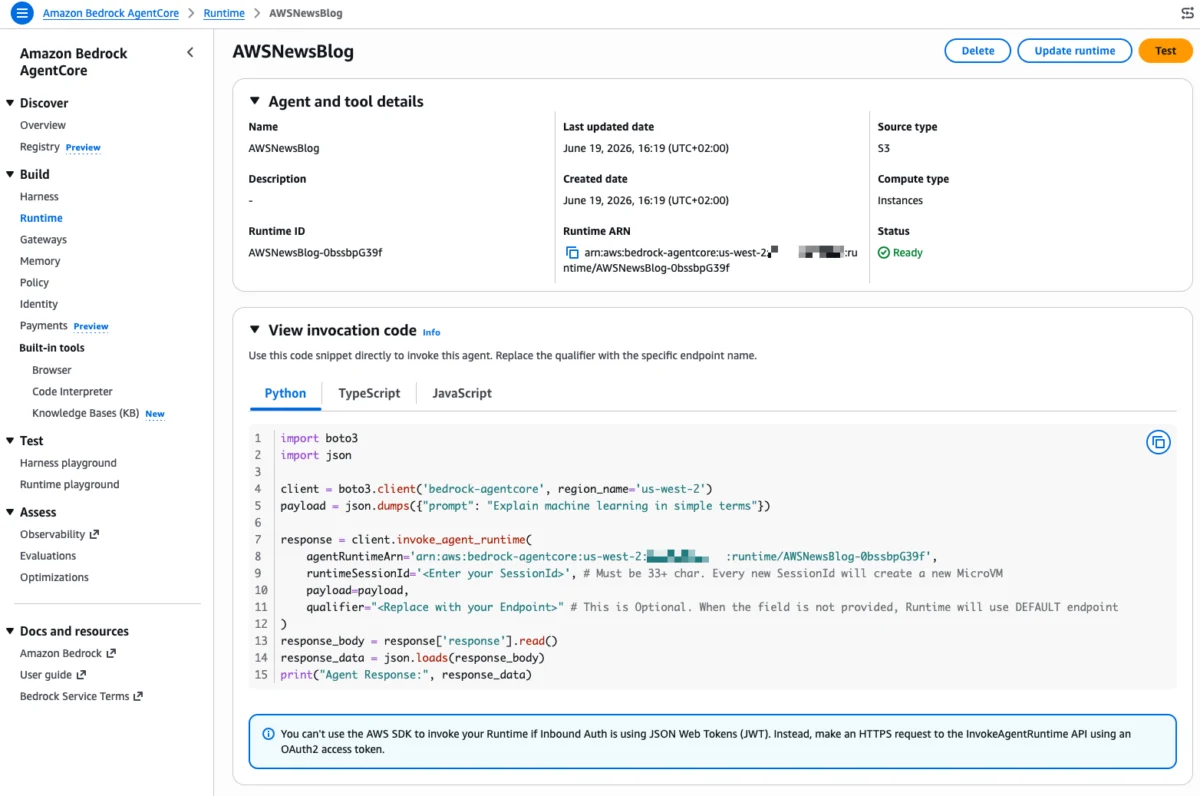
SEATTLE — As artificial intelligence transitions decisively from experimental prototypes to mission-critical enterprise production, infrastructure demands have evolved exponentially. Organizations moving beyond simple chat interfaces are discovering that advanced, multi-step AI agents require robust, enduring compute environments. They need to maintain operational state across complex workflows running for hours or days, coordinate fluidly with peer agents, share contextual memory, and occasionally tap into specialized hardware accelerators like Graphics Processing Units (GPUs) for intensive computing tasks.
Addressing these enterprise scaling hurdles head-on, Amazon Web Services (AWS) has officially announced the launch of runtime instances—a major, complementary compute option within the Amazon Bedrock AgentCore Runtime portfolio. Purpose-built to handle complex, long-running agent workloads, this new capability provides development teams with persistent, fully managed AWS infrastructure designed to seamlessly bridge the gap between ephemeral AI execution and robust enterprise applications.
Main Facts: The Architecture of Agentic Persistence
Until now, scaling AI agents past short-lived API requests meant shouldering a heavy operational burden. Developers wanting to keep agents active for multiple days, grant them GPU access, or orchestrate multi-agent environments had to provision and maintain their own infrastructure from scratch. This manual orchestration required spinning up Amazon Elastic Compute Cloud (EC2) instances, configuring complex networking topologies, building custom session management layers, engineering scaling logic, and stitching together disparate observability platforms.
Amazon Bedrock AgentCore Runtime instances change this paradigm entirely by delivering AWS-managed EC2 infrastructure specifically tailored for autonomous applications.

Core Capabilities and Features
- Multi-Agent Host Sharing: Organizations can deploy multiple distinct agents onto a single runtime instance. Each agent retains its own distinct dependencies, configuration, and artifact types while collaborating on the same underlying host.
- Extended Session Lifespans: Shared operational sessions can persist securely for up to 14 days, accommodating sprawling, multi-day reasoning tasks.
- Hardware Acceleration: Full support for GPU acceleration empowers compute-intensive tasks such as large-scale code compilation, static security scanning, deep machine learning inference, and complex Graphical User Interface (GUI) automation.
- Cost-Effective Lifecycle Management: Built-in session stop-and-restart capabilities allow teams to effectively hibernate workflows—such as shutting down operations on a Friday night—and resume them seamlessly on Monday morning with zero data loss.
- Enterprise-Grade Storage Integration: Runtime instances pair naturally with Amazon Elastic Block Store (Amazon EBS) and AgentCore Memory, ensuring that critical knowledge survives far beyond individual session lifecycles to offer long-term recall across environments.
Crucially, runtime instances integrate seamlessly with the identical AgentCore APIs, granular identity controls, and deep observability tooling that developers already utilize with existing AgentCore Runtime microVMs.
Chronology: The Evolution of Agentic Compute on AWS
The release of runtime instances represents the latest milestone in AWS’s systematic rollout of enterprise-grade tooling designed for autonomous generative AI systems.
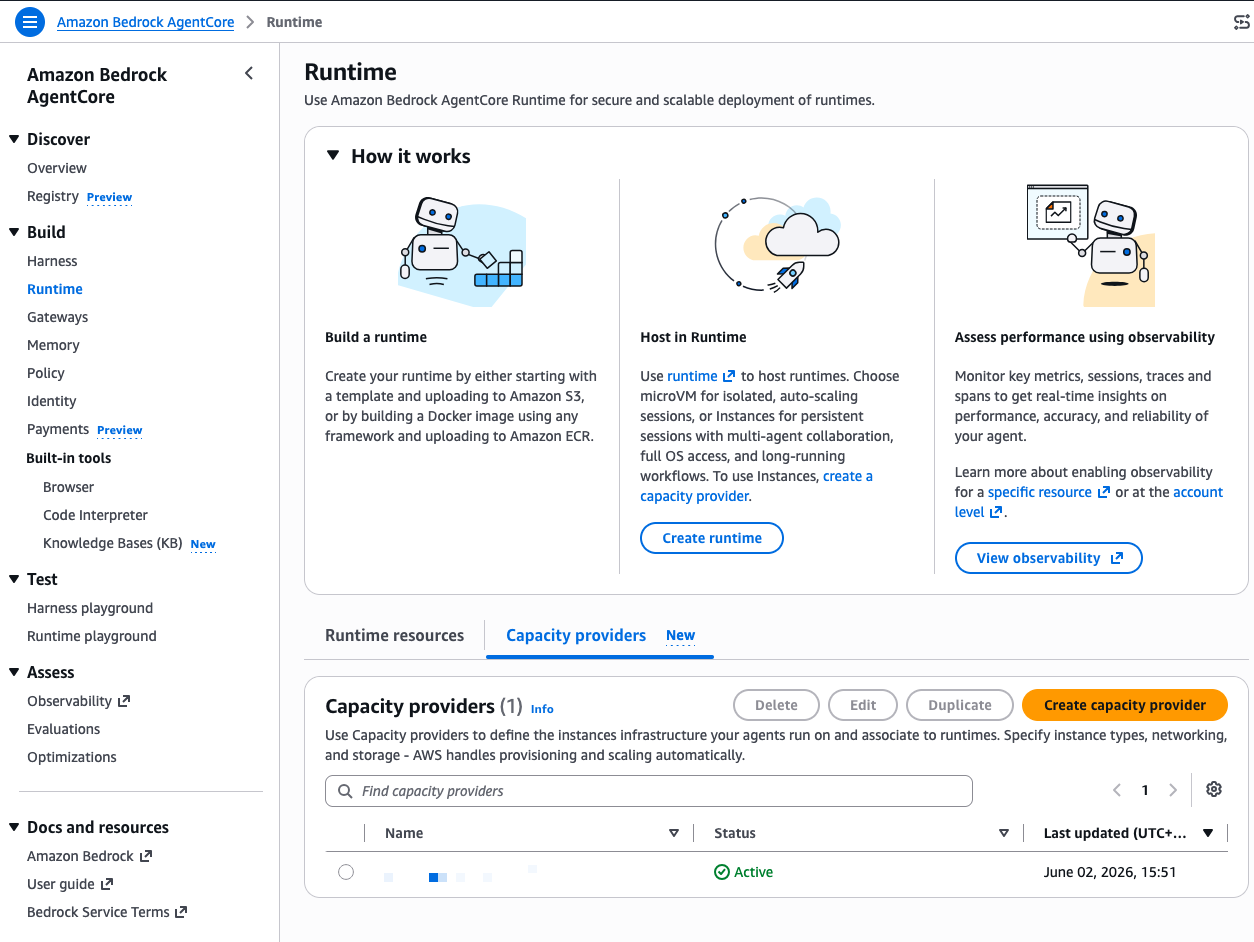
- The MicroVM Foundation: AWS initially introduced Amazon Bedrock AgentCore Runtime microVMs to provide a lightweight, fully managed environment capable of handling invocations running for up to 8 hours. While highly effective for stateless or short-term stateful workflows utilizing managed session storage, microVMs were constrained when faced with continuous, multi-day execution or specialized hardware requirements.
- Identifying the Enterprise Gap: As early adopters pushed AI agents into complex software engineering, financial modeling, and supply-chain logistics, engineers repeatedly hit infrastructure ceilings. Multi-day workflows, direct operating system access, and multi-agent coordination frameworks demanded dedicated, larger-capacity hosting environments.
- The Launch of Runtime Instances: AWS developed runtime instances to solve these heavy-duty infrastructure challenges. By providing managed EC2 compute options that support persistent file systems and multi-agent collaboration on shared hosts, AWS has bridged the divide between rapid serverless scaling and persistent infrastructure control.
Supporting Data: Complementary Compute Options in Action
To understand how runtime instances fit into modern cloud architecture, developers must view them alongside existing runtime microVMs. Rather than replacing microVMs, runtime instances are designed to operate as a complementary compute tier.
Dual-Tier Architecture: MicroVMs Meet Instances
Modern enterprise deployments can combine both compute paradigms through unified AgentCore runtime APIs:
- The Orchestrator Layer (Runtime MicroVMs): A lightweight orchestrator agent running on a fast-scaling microVM handles incoming API calls, dynamic task routing, and final result aggregation.
- The Worker Layer (Runtime Instances): Specialized worker agents running on dedicated runtime instances perform heavy, compute-intensive tasks that demand persistent state, direct OS access, and long-term file system sharing.
A Practical Demonstration: Autonomous Code Collaboration
To demonstrate the power of shared-host runtime instances, developers can construct a collaborative multi-agent pipeline consisting of a Code Writer Agent and a Code Reviewer Agent.
Both agents operate on a shared file system provisioned within the session directory (/tmp/agentcore-session/session_id/), allowing them to exchange complex artifacts without network overhead or explicit API calls between models.
The Code Writer Agent Implementation
Powered by Anthropic’s Claude Sonnet via the Strands Agents framework, the writer agent takes natural language prompts and outputs pristine Python code directly to the shared session storage:
from strands import Agent, app
from pathlib import Path

SHARED_DIR = Path("/tmp/agentcore-session")

writer = Agent(
    model="us.anthropic.claude-sonnet-4-5-20250929-v1:0",
    system_prompt=(
        "You are a senior Python engineer. "
        "Given a task, return ONLY a single Python code block — no prose."
    ),
)

@app.entrypoint
def handler(event, context):
    task = event.get("task") or event.get("prompt")
    session_id = getattr(context, "session_id", None) or event.get("session_id")
    session_dir = SHARED_DIR / session_id
    session_dir.mkdir(parents=True, exist_ok=True)

    code = str(writer(task))
    (session_dir / "code.py").write_text(code)

    return "agent": "writer", "wrote": str(session_dir / "code.py"), "code": code
The Code Reviewer Agent Implementation
Operating on the exact same host and referencing the identical session_id, the reviewer agent immediately reads the generated file, analyzes it for security flaws and style improvements, and returns a structured breakdown:
from strands import Agent, app
from pathlib import Path

SHARED_DIR = Path("/tmp/agentcore-session")

reviewer = Agent(
    model="us.anthropic.claude-sonnet-4-5-20250929-v1:0",
    system_prompt=(
        "You are a strict Python code reviewer. "
        "Given code, return 3 bullet points: bugs, style, suggestions."
    ),
)

@app.entrypoint
def handler(event, context):
    session_id = getattr(context, "session_id", None) or event.get("session_id")
    code_path = SHARED_DIR / session_id / "code.py"
    code = code_path.read_text()
    review = str(reviewer(f"Review this code:nncode"))

    return "agent": "reviewer", "read": str(code_path), "review": review
Step-by-Step Deployment Workflow via AWS Management Console
Deploying this multi-agent collaborative environment involves three straightforward phases:
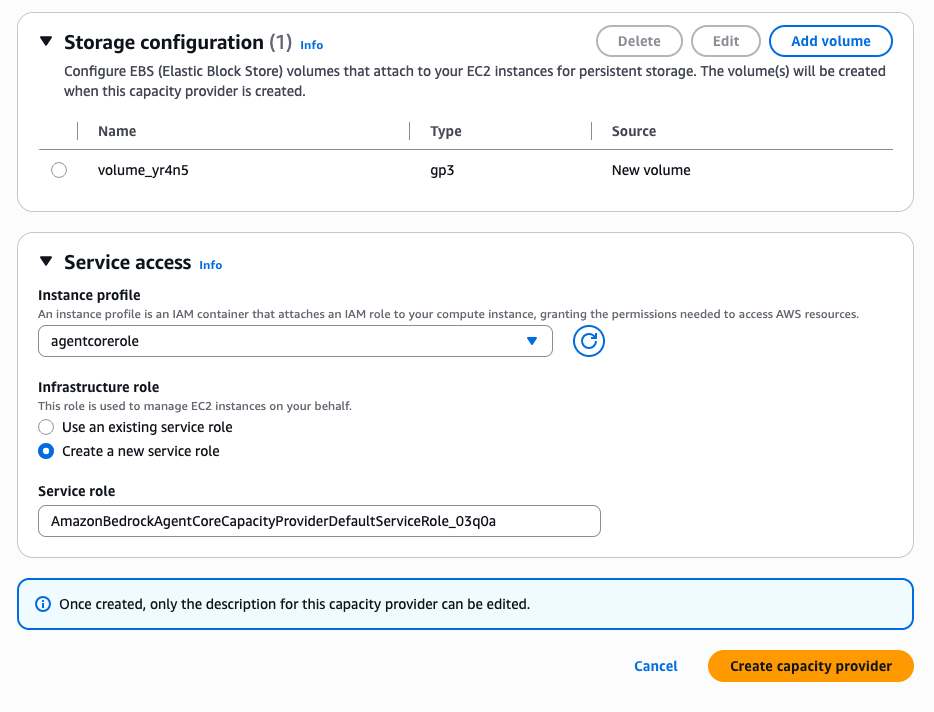
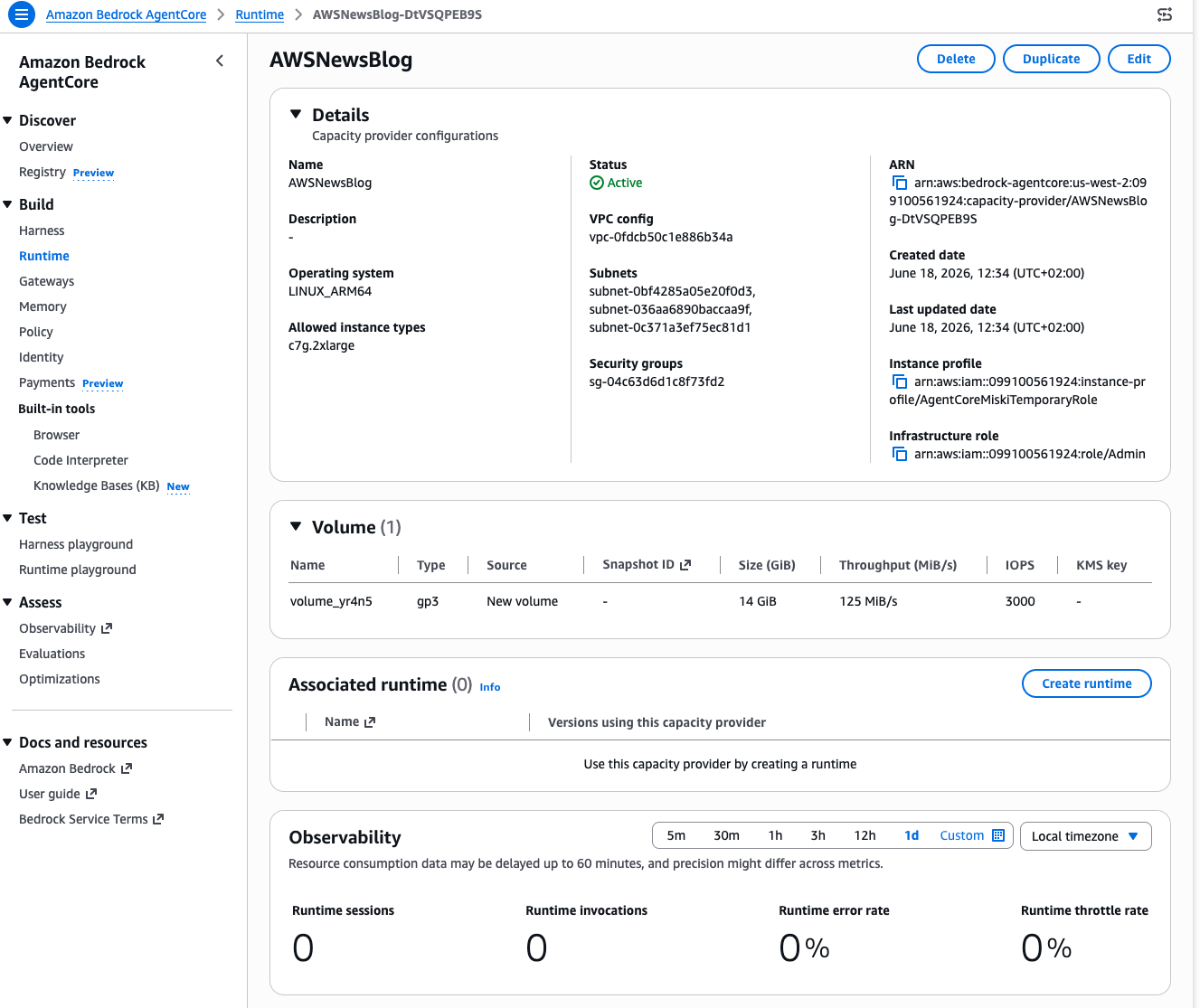
- Creating a Capacity Provider:
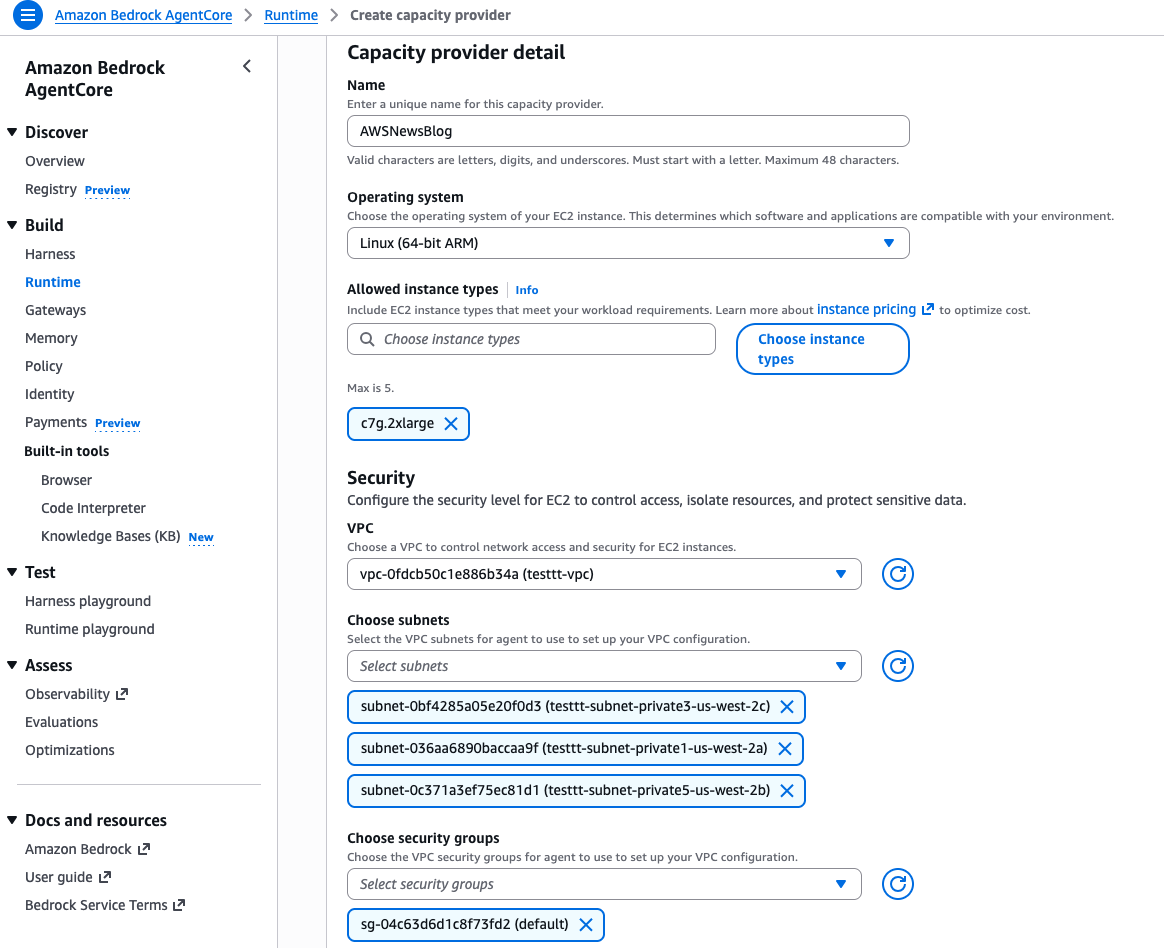
In the Amazon Bedrock console under the Runtime navigation menu, developers create a capacity provider. Selecting Linux (64-bit ARM) with anc7g.2xlargeinstance type provides 8 vCPUs and 16 GiB of memory—plenty of headroom to run both agents concurrently. Developers configure VPC subnets, security groups, and allow AWS to provision the underlying service role automatically. - Deploying the Runtimes:
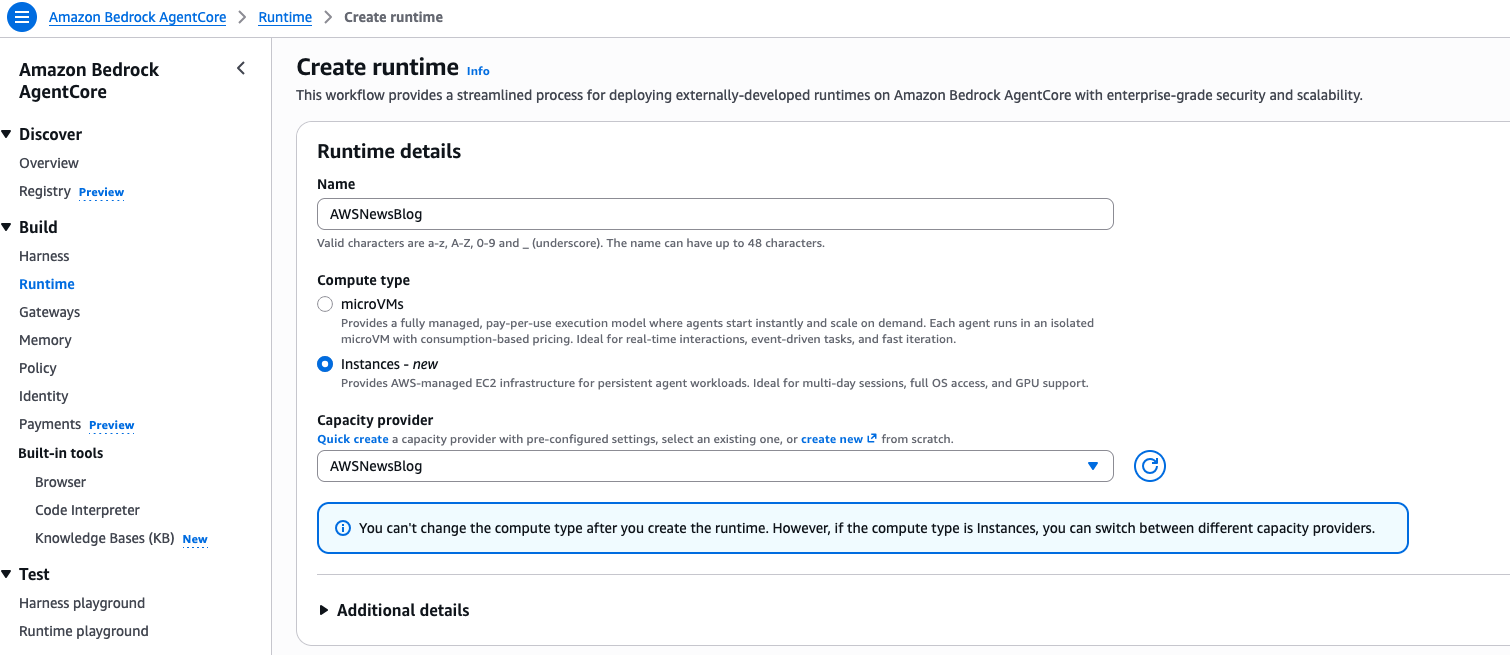
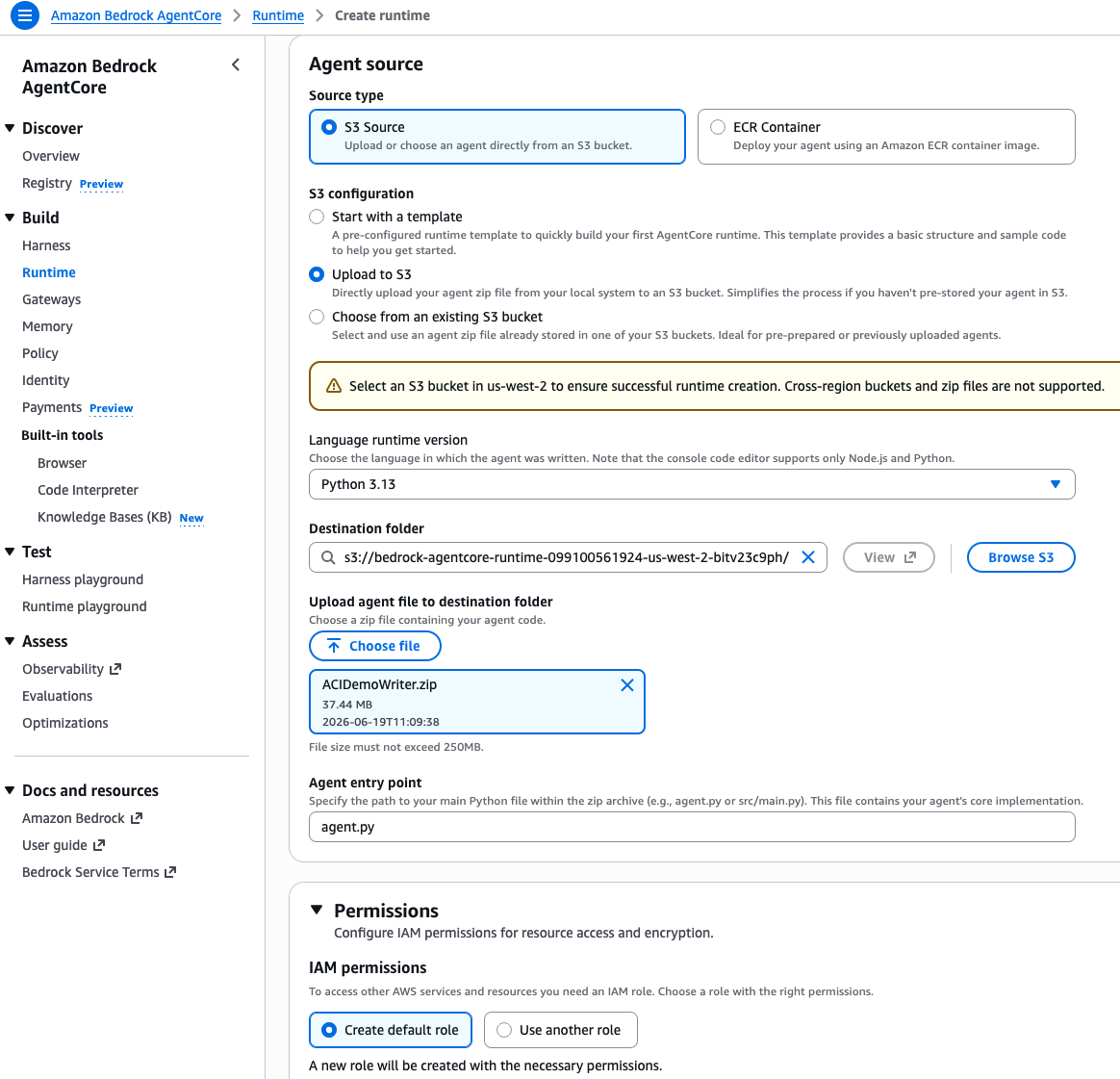
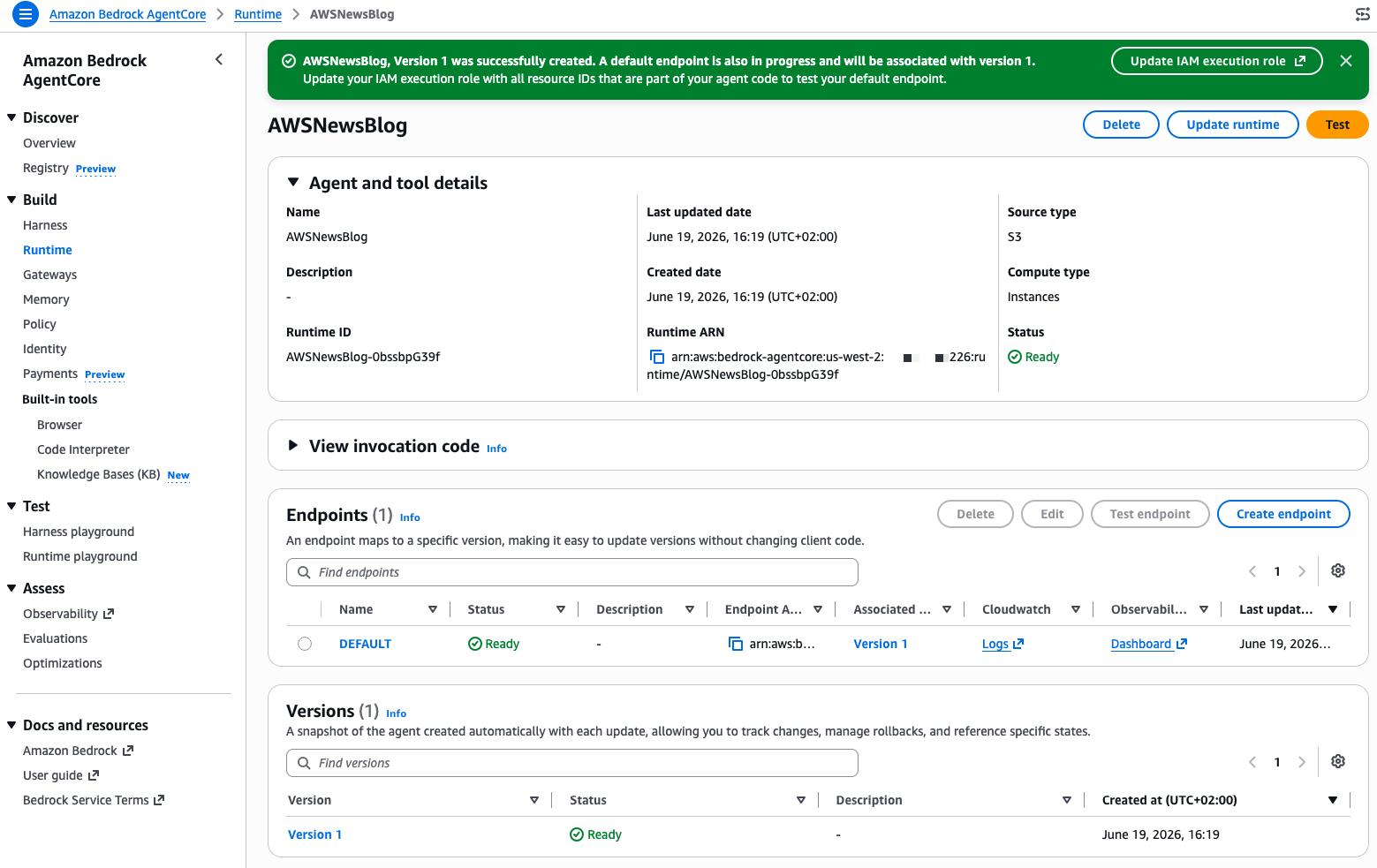
Next, developers create individual runtimes linked to the newly minted capacity provider. By uploading zipped agent packages (e.g.,ACIDemoWriter.zipandACIDemoReviewer.zip), specifying Python 3.13, and designating entry point scripts featuring the@app.entrypointdecorator, both agents are mapped to the shared underlying EC2 infrastructure. - Executing and Observing Collaboration:
Using the built-in Runtime Playground, engineers send a prompt such as"prompt": "write a fibonacci suite"to the writer agent. The agent generates the code inside the session directory. By switching the active runtime agent dropdown to the reviewer while maintaining the exact same Session ID, the reviewer agent instantly accesses the file, validates the code, and delivers expert feedback without manual data transfers.
Official Responses: Empowering Agent Developers
The introduction of runtime instances has drawn immense enthusiasm from the broader artificial intelligence and cloud development communities. By removing the infrastructure friction traditionally associated with multi-agent orchestration, AWS enables developers to focus entirely on agent logic, prompt engineering, and business logic rather than low-level systems administration.
Industry analysts note that flexibility is a primary differentiator for the new service. Because Amazon Bedrock AgentCore Runtime instances are model-agnostic and framework-agnostic—fully supporting popular open-source frameworks like CrewAI, LangGraph, LlamaIndex, and Strands alongside any foundational model—engineering teams are not locked into proprietary software stacks.
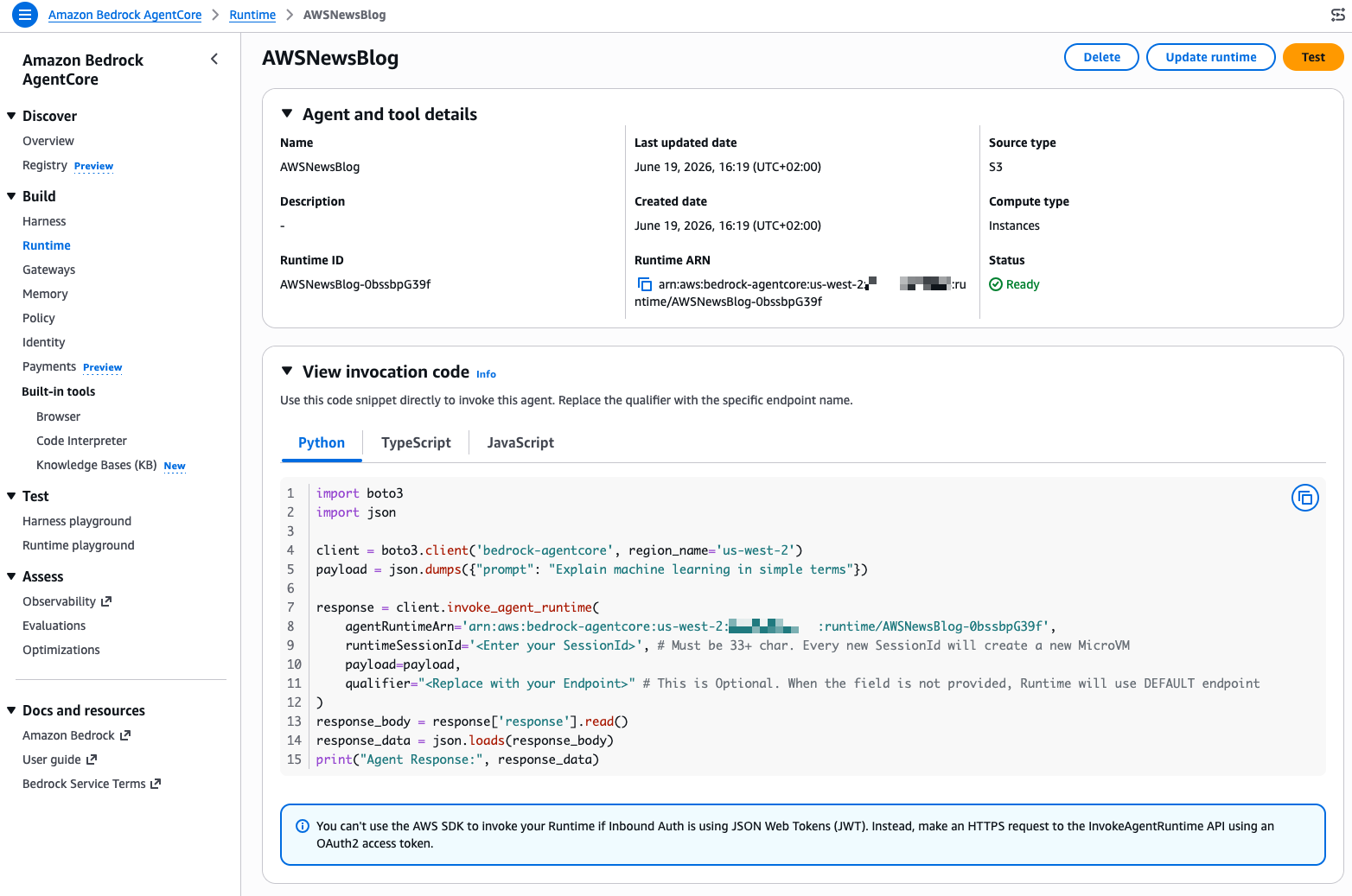
Furthermore, packaging overhead has been reduced to an absolute minimum: a simple @app.entrypoint decorator combined with a standard zip file or container image is all that is required to ship production-grade agent code.
Implications: What This Means for Enterprise AI
The launch of Amazon Bedrock AgentCore Runtime instances signals a mature turning point for enterprise artificial intelligence adoption. Several key implications emerge for CTOs, cloud architects, and software engineering leaders:
1. Democratization of Complex Multi-Agent Systems
Complex software engineering pipelines—where squads of specialized agents collaborate on testing, security auditing, code generation, and documentation generation—are no longer restricted to tech giants with dedicated platform engineering teams. AWS-managed capacity providers abstract away the grueling mechanics of cluster scaling and networking.
2. Radical Cost Optimization for Long-Running Tasks
Because enterprise AI workflows frequently involve human-in-the-loop validation, legal reviews, or overnight data processing, keeping clusters fully powered 24/7 has traditionally inflated cloud budgets. The ability to cleanly hibernate sessions—shutting down compute instances overnight or over weekends and resuming them with preserved state—drastically lowers the total cost of ownership (TCO) for autonomous applications.
3. Deepening the AWS Bedrock Ecosystem
By tightly binding Amazon EBS storage, IAM identity controls, and AgentCore Memory directly to runtime instances, AWS has created a cohesive, secure ecosystem. Enterprises hesitant to deploy autonomous agents due to compliance, data governance, and security concerns now have a governed framework backed by enterprise-grade cloud security controls.
Looking Ahead
As organizations continue to push the boundaries of what generative artificial intelligence can accomplish autonomously, the infrastructure supporting these systems must be equally dynamic and resilient. With runtime instances, Amazon Web Services has delivered a powerful foundational layer that ensures AI agents can move smoothly from experimental sandboxes into the demanding realities of production enterprise environments.
To get started with runtime instances, explore the official Amazon Bedrock AgentCore documentation and configure your first capacity provider today.
 Suro Senen
  Lina Hope
  Asep Darmawan