By Alexey Pomigalov, PhD in history and curator of the DataArt IT Museum Published: April 2026 Based on research prepared for the online project Retrospect.
Main Facts
Data processing did not begin with Silicon Valley, punch-card mainframes, or even the invention of coin-based commerce and warfare. According to modern archaeological and anthropological revisions, the genesis of data-driven culture is rooted deep in biology, cyclical observation, and survival.
For decades, popular historical narratives framed early human innovation through the restrictive lens of "Man the Hunter, Woman the Gatherer." However, modern bioarchaeology, DNA analysis, and forensic science have shattered this dichotomy, revealing deep and active female participation across all prehistoric domains. Crucially, it was prehistoric women who first tracked biological rhythms, mapped the lunar cycle, and externalized human memory onto bone.
From 29-notch baboon fibulas in Stone Age caves to proto-cuneiform accounting ledgers for ancient Sumerian breweries, data visualization has always been an instrument of survival. Over millennia, humanity transformed these crude physical notches into structured spreadsheets, standardized library catalogs (pinakes), and the programmable logic of industrial textile looms. Today, modern relational databases are being deployed to decode these very same ancient artifacts, closing a loop that spans tens of thousands of years.
Chronology: The Milestones of Data Civilization
[c. 35,000 BCE] ── Stone Age lunar tallying & early geometric sign usage
      │
[c. 3300 BCE]  ── Uruk proto-cuneiform brewery accounting tablets (First Spreadsheets)
      │
[c. 305–30 BCE]── Callimachus compiles the 'Pinakes' at the Library of Alexandria
      │
[1725 CE]      ── Basile Bouchon introduces perforated paper tape to textile looms
      │
[1804 CE]      ── Joseph-Marie Jacquard automates the loom using binary punch cards
      │
[1890 CE]      ── Herman Hollerith applies punched-card data processing to the U.S. Census
      │
[2010 CE]      ── Genevieve von Petzinger applies relational databases to Paleolithic cave art
1. The Stone Age (c. 35,000 BCE): The First "Human Computers"
Picture a woman from a Stone Age tribe in southeastern Africa sitting quietly on a rock, stargazing. Night after night, she watches the large white circle of the moon shift, wane, and grow. Driven by an innate sense of pattern recognition and precognition—knowing that the circle will eventually become full again—she decides to count. To ensure she does not forget, she records each night with a notch carved into a discarded bone.
For decades, artifacts like the Lebombo Bone—a baboon fibula featuring 29 distinct notches—were casually categorized by researchers as tools for male hunters. Modern anthropology refutes this. The bone is now understood to be an ancient lunar calendar, conceived and maintained by women tracking natural cycles. This discovery flips conventional economic history on its head: data did not originate to service commerce or war; it originated from biology, reproduction, and the imperative to track the life-sustaining rhythms of the natural world.
2. Ancient Sumeria (c. 3300–3200 BCE): The Birth of the Spreadsheet
As human settlements expanded into urban centers, the volume of resources required structured administration. Enter the world’s earliest known spreadsheet: a small clay tablet inscribed with proto-cuneiform writing, discovered in the ancient Sumerian city of Uruk (modern-day Iraq) and now housed in the Louvre.
Deciphered by archaeologist Robert K. Englund, the tablet is an accounting document recording the delivery of barley groats and malt from two individuals for use in a local brewery. By organizing data into distinct rows and columns, the ancient scribe invented a visual architecture for information. This structured layout allowed humans—and eventually machines—to analyze correlations instantly. It was a cognitive breakthrough as revolutionary for civilization as the invention of the wheel.
3. Ptolemaic Egypt (305–30 BCE): Indexing the Great Library of Alexandria
As libraries swelled to hold hundreds of thousands of scrolls, recording data was no longer enough; retrieval became the ultimate challenge. In the Great Library of Alexandria, the Hellenistic poet, scholar, and bibliographer Callimachus of Cyrene solved this by inventing physical indexing.
Callimachus compiled 120 tablets known as pinakes (singular pinax). Hung near the containers holding over half a million papyri, these tablets listed titles, authors, places of birth, educational backgrounds, and brief bibliographical summaries. Each unit of information was assigned an exact physical "address," establishing a navigational map of human knowledge. This foundational principle of physical indexing laid the conceptual groundwork for modern digital database architecture.
4. The Industrial Revolution (1705–1890): Coding Reality
The realization that physical reality operates on repeatable, mathematical rules led inventors to build mechanical automata and cathedral clocks—performative displays of human control over time and space. Soon, this performative logic evolved into industrial production infrastructure.
1725: Lyon textile worker Basile Bouchon used perforated paper tape, inspired by pinned musical automata, to control weaving patterns.
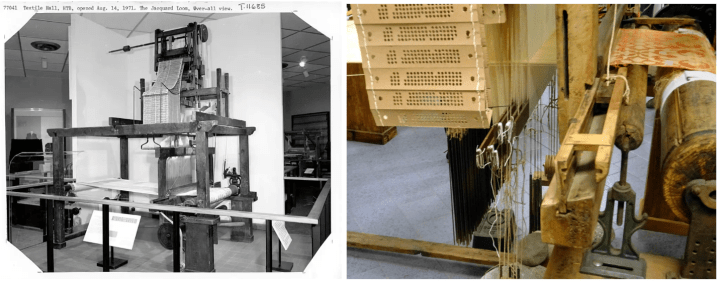
1804: Joseph-Marie Jacquard refined this innovation into the automated Jacquard loom, using a chain of binary punched cards to dictate which warp threads lifted. This marked the historical moment when instructions were decoupled from physical mechanics and treated as independent, reusable code—a direct conceptual ancestor to Charles Babbage’s Analytical Engine.
1890: Young engineer Herman Hollerith applied punch-card data processing to the U.S. Census. What would have taken decades of manual labor was completed in just three years, proving that automated data processing could manage the scale of modern nation-states.
5. The Modern Era (2010): Decoding the Paleolithic
In 2010, paleoanthropologist Genevieve von Petzinger revolutionized the study of prehistoric art by applying modern relational database software to Stone Age artifacts. Rather than focusing solely on animal and human figures in French rock art (dating from 35,000 to 10,000 BCE), she cataloged the non-figurative geometric symbols painted alongside them across 146 cave sites.
By running these variables through a relational database, she identified 32 distinct, recurring geometric signs used consistently across millennia. Her work demonstrated that art and data processing emerged simultaneously; these abstract markings were an early, structured transmission of data across generations.
Supporting Data: Evolution of Externalized Memory
Era / Period
Primary Storage Medium
Form of Data Organization
Core Purpose
Upper Paleolithic
Bone, Stone, Cave Walls
Notches, 32 Geometric Signs
Tracking lunar cycles, natural rhythms, ritual communication
Bronze Age Sumeria
Clay Tablets
Proto-Cuneiform Rows and Columns
Inventory control, resource distribution (grain, beer)
Hellenistic Period
Papyrus & Stone Tablets (Pinakes)
Metadata mapping (Author, Title, Bio)
Knowledge navigation and library asset management
Industrial Era
Perforated Paper & Punched Cards
Binary sequences / mechanical logic
Automating textile manufacturing and national censuses
Reflecting on the evolution of data-driven culture, historians and curators emphasize that the human impulse to externalize memory is fundamentally tied to our survival strategy.
According to museum curators and media archaeologists studying the deep history of computation, mainstream narratives have long suffered from tunnel vision, focusing excessively on twentieth-century electronic machines while ignoring the millennia of cognitive engineering that made them possible.
"Data is what we invented and encoded to transmit through millennia without even knowing the recipient," notes Alexey Pomigalov, curator of the DataArt IT Museum.
Scholars emphasize that the transition from physical bone tallies to clay spreadsheets and digital relational databases represents a continuous unbroken thread. Whether a Stone Age woman marking a baboon fibula or a twenty-first-century researcher querying a multi-site database, the underlying intent remains identical: to observe, record, sort, and figure out the environment in order to endure.
Implications: The Convergence of Humanities and Data Science
The integration of advanced data models into historical and archaeological research has profound implications for modern academia. For centuries, a rigid wall separated the quantitative sciences from the qualitative humanities. The success of modern data tools in decoding ancient artifacts—such as von Petzinger’s analysis of Paleolithic cave symbols or Englund’s translation of Uruk trade tablets—proves that quantitative methodologies can breathe new life into historical study.
Furthermore, this deep-time perspective reframes our relationship with modern technology. Algorithms, spreadsheets, and databases are not alien inventions of the digital age; they are the polished, accelerated descendants of ancient survival mechanisms. As humanity generates more data than ever before, looking back at the first "human computers"—the women of the Stone Age marking the phases of the moon—serves as a humbling reminder of our origins. We are, and always have been, a data civilization.

 By Jia Lissa




 Azzam Bilal Chamdy
 Asep Darmawan
 Suro Senen
