
 By Raul Delapena Setiawan
If you are currently drafting a business plan for an ecommerce startup, your first instinct is likely to gravitate toward dedicated storefront engines—Shopify, BigCommerce, or WooCommerce. These platforms are the industry standard for hosting product catalogs and processing transactions. However, there is a recurring narrative among successful digital retailers: the storefront is only half the battle. The other half, the one that dictates long-term survival, is customer relationship management (CRM).
While many entrepreneurs discover HubSpot only after they have reached a point of administrative complexity, industry experts are increasingly arguing that integrating HubSpot early—or even at the foundational stage—can fundamentally change the trajectory of an ecommerce business. It is the "operating system" for the customer journey, providing a level of visibility that traditional storefront tools simply cannot match.
The Evolution of the Ecommerce Stack
For years, the standard ecommerce tech stack has been a fragmented collection of "plug-and-play" apps. You have a tool for email marketing, another for customer support, a separate dashboard for order management, and perhaps a third-party plugin to handle abandoned cart recovery. This "duct-tape" approach creates data silos, where the marketing team has no idea what the support team is saying to a customer, and the sales team is blind to the customer’s browsing history.
HubSpot challenges this by centralizing the customer experience. When a customer interacts with your brand, every touchpoint—from their first click on a blog post to their final checkout—is logged in a unified, chronological timeline. This is not merely an administrative luxury; it is a tactical advantage. By connecting chat conversations to actual revenue and tying email engagement to purchase behavior, HubSpot transforms raw data into a narrative of the buyer’s journey.
Chronology of a Customer: From Anonymous Visitor to Brand Advocate
To understand the power of the HubSpot ecosystem, one must look at the lifecycle of a shopper. In a typical fragmented system, the transition from "anonymous browser" to "loyal customer" is invisible. With HubSpot, the progression is tracked with surgical precision:
- The Discovery Phase: A prospective buyer arrives at your site, likely driven by an inbound marketing campaign. HubSpot’s CMS tools track which pages they visit and how long they linger.
- The Engagement Phase: If the user abandons their cart, the system doesn’t just trigger a generic email. It initiates a personalized automation flow based on their specific behavior, potentially offering a discount or a link to an FAQ page that addresses their specific hesitation.
- The Conversion Phase: Using HubSpot Payments or a deep integration with your storefront, the sale is recorded, and the CRM automatically updates the customer’s profile, triggers a welcome email sequence, and assigns any necessary follow-up tasks to your team.
- The Retention Phase: Post-purchase, the system monitors the customer’s interaction with future content. If they return to the site to research a different product, the sales team receives a notification, allowing for a timely, personalized outreach.
Supporting Data: The Case for Integration
The efficacy of this centralized approach is not merely anecdotal. Consider the case of CODE41, a brand that leveraged HubSpot’s ecosystem to drive explosive growth. By integrating their CRM with their broader marketing and sales efforts, the company saw a 257% increase in sales, a 223% jump in revenue, and a 279% surge in lead generation.
These metrics illustrate a fundamental truth: revenue isn’t just about the storefront—it’s about the intelligence surrounding the transaction. When marketing, sales, and service tools are housed in a single container, teams spend less time "syncing data" and more time optimizing the strategies that actually move the needle.
The Pillars of HubSpot’s Ecommerce Advantage
HubSpot has moved beyond its origins as a B2B marketing tool to become a robust contender for ecommerce leaders. Here is why the platform is gaining traction:
Unified Customer Action
Most ecommerce tools scatter information across a dozen disparate apps. HubSpot stitches this data into a single, cohesive timeline. A store manager can see that a customer viewed a specific product, abandoned a cart, clicked a campaign email three days later, and then engaged in a live chat. This level of context is the difference between a generic discount blast and a highly relevant, conversion-driving conversation.
Automation for the Real World
Many automation platforms require you to be a programmer to build a workflow. HubSpot’s automation is designed for the modern team—it is visual, intuitive, and highly flexible. You can build complex, multi-stage workflows that bridge the gap between marketing and sales, ensuring that no customer falls through the cracks due to a forgotten follow-up.
Inbound Marketing as a Revenue Driver
HubSpot’s heritage is in inbound marketing. For ecommerce, this means the platform is inherently optimized to turn content—blogs, guides, and landing pages—into revenue. By tracking how content influences the buyer’s path to purchase, businesses can identify which blog posts or videos are actually driving conversions, allowing for data-backed content strategies.
Payment Processing and Frictionless Checkout
HubSpot Payments has significantly reduced the friction inherent in B2B and high-touch ecommerce. By embedding payment capabilities directly into quotes, chat widgets, and emails, businesses can bypass the traditional "send-a-PDF-and-wait" sales cycle. This creates a seamless transition from the sales conversation to the payment confirmation.
Strategic Implications: Why It Matters Now
The implications for an ecommerce brand are clear: The barrier to entry is lower, but the barrier to excellence is higher. As competition in the digital space intensifies, brands can no longer rely on the storefront experience alone to retain customers.
When you adopt HubSpot, you are not just buying a CRM; you are adopting a philosophy of customer-centric growth. The platform allows a lean, one-person startup to operate with the sophistication of a large-scale enterprise. It provides the structure necessary to scale without losing the personal touch that builds long-term brand loyalty.
Addressing the Skeptics: FAQs
1. How does HubSpot compare to Shopify?
Think of Shopify as the engine of your car—it’s what moves the product. Think of HubSpot as the GPS and the driver. Shopify manages the catalog; HubSpot manages the relationships, the nurtures, and the long-term lifecycle. They are most powerful when used together.
2. Is it too expensive for a small shop?
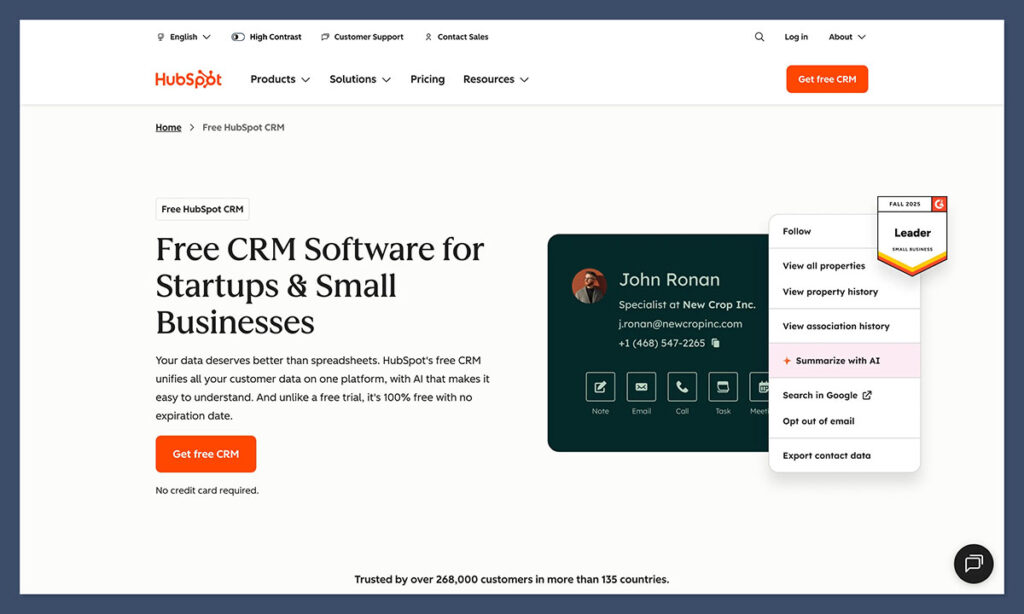
HubSpot offers a tiered approach. Many small businesses start with the free CRM and CMS tools, scaling their investment only as their revenue grows. The ROI typically manifests in the form of higher conversion rates and reduced churn, which often offsets the cost of the software.
3. Does HubSpot replace my existing tools?
Often, yes. By consolidating your email marketing, live chat, ticketing, and CRM into one platform, you not only reduce your tech stack complexity but also lower your overall software spend by eliminating redundant subscriptions.
4. How does AI fit into the picture?
HubSpot’s AI tools are focused on clearing the "noise" that prevents teams from performing. From drafting email copy to suggesting automation sequences, the AI is designed to act as a force multiplier for your existing staff, not a replacement for human strategy.
Conclusion: Starting Your Journey
HubSpot’s strength lies in its ability to reveal a deeper layer of your business as you grow. It starts as a simple contact record, but as you layer in the CMS, the commerce tools, and the automation, it becomes the central nervous system of your company.
For any ecommerce founder looking to shift from "selling products" to "building a customer base," the path forward is clear. By creating a free HubSpot account, you can begin to see the difference that total visibility makes. In the world of modern commerce, those who understand their customers best—and act on that understanding the fastest—will inevitably own the market.
 Dwi Wanna
  Lina Irawan
  Basiran