
 By Evan Lee Salim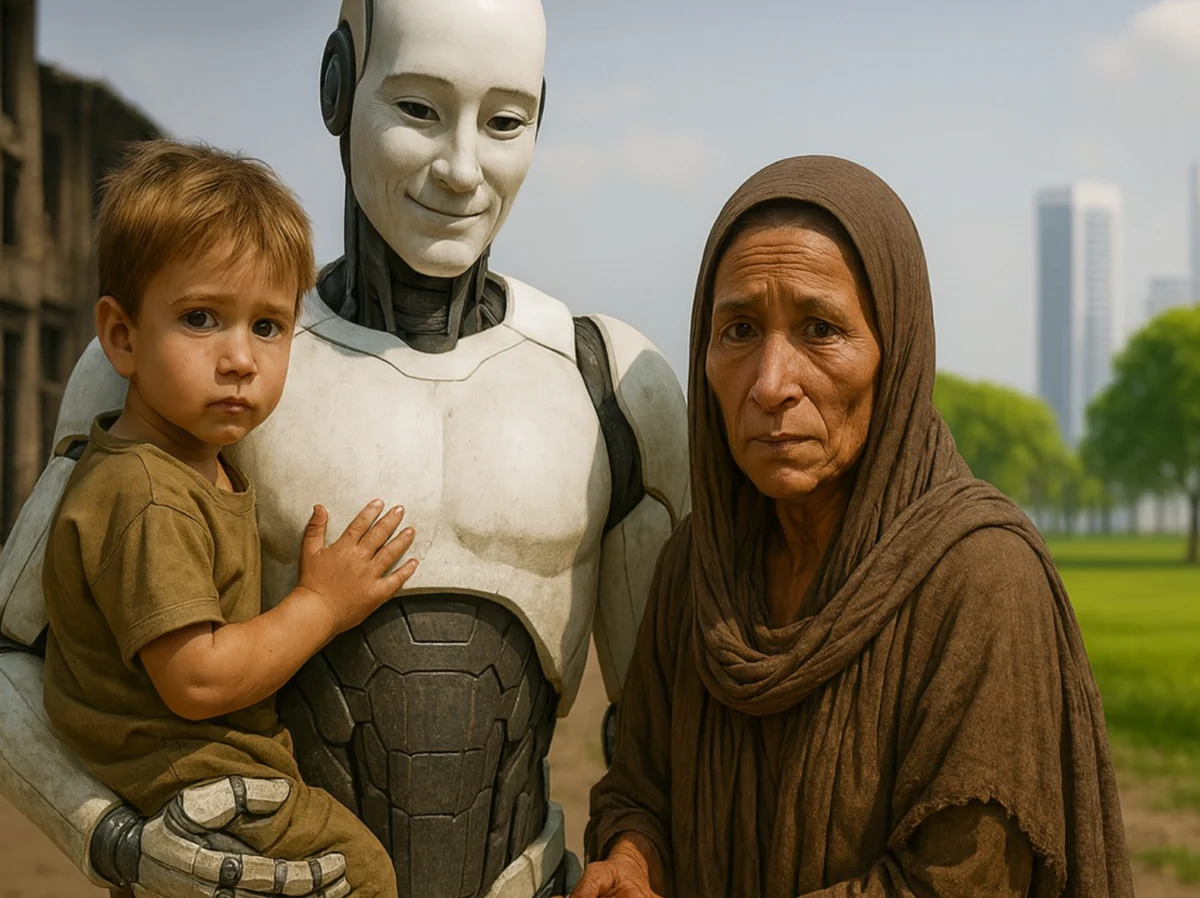
By The Editorial Desk
Published: Global Technology & Society Review
Quick Summary
We have officially moved past the era of humanoid robots as mere public relations stunts. As machines evolve from clumsy laboratory novelties into hyper-realistic entities powered by advanced artificial intelligence, society faces profound social, economic, psychological, and ethical challenges. When the physical and behavioral boundary between humans and machines dissolves, humanity must confront an unprecedented existential shift. This report explores the rapid technological chronology, current industrial applications, empirical data, official responses, and the sweeping implications of an android-integrated world.
Introduction: The Threshold of Fiction and Reality
For decades, science fiction cushioned our collective imagination with the notion that an "android revolution" was a distant, speculative fantasy. We read novels and watched cinematic epics featuring synthetic beings, secure in the knowledge that our biological uniqueness was safe. Today, that psychological buffer is rapidly eroding. The convergence of advanced electromechanical engineering, material science, and foundational artificial intelligence has accelerated the timeline of robotics beyond even the most aggressive historical predictions.
We are no longer looking at rudimentary metal frames executing rigid, pre-written lines of code. Modern humanoid robots walk with fluid biometrics, adjust to uneven terrain, and—most importantly—learn by observation. This technological sprint forces a startling question upon us: What happens when our world is populated by entities that mirror our physical form, yet possess none of our biological history, evolutionary struggles, or emotional mortality?
As these machines step out of controlled laboratory environments and onto factory floors, retail spaces, and eventually our living rooms, society is confronted with a looming identity crisis. The implications reach far beyond industrial efficiency, striking at the very core of human psychology, economic stability, and interpersonal trust.
Chronology of Humanoid Robotics: From Novelty to Neural Networks
To understand where we are heading, we must examine the rapid acceleration of the technology over the past quarter-century. The journey of humanoid robotics can be divided into four distinct epochs:

1. The Era of Stunts and Stability (2000–2010s)
At the turn of the millennium, humanoid robotics was defined by proof-of-concept hardware. In November 2000, Honda introduced ASIMO, a milestone robot celebrated primarily for its ability to walk forward, ascend stairs, and maintain balance. During this era, humanoids were largely public relations tools. They required millions of lines of hyper-specific, manual code for every minute movement. A single slip on a slightly uneven floor meant a catastrophic system failure.
2. The Mechanics Breakthrough (2015–2020)
Companies like Boston Dynamics and Hanson Robotics shifted the paradigm toward dynamic mobility and expressive design. In February 2016, Hanson Robotics activated Sophia, an international celebrity robot whose hyper-realistic facial expressions and conversational capabilities captured global media attention. Concurrently, hydraulic and electric actuators evolved, allowing robots to perform backflips, recover from heavy shoves, and navigate complex obstacle courses. However, these machines still lacked generalized intelligence; they were sophisticated remote-control marionettes or narrow-task operators.
3. The AI Convergence (2020–2024)
The true catalyst for the current revolution is the integration of generative AI and foundation models. Instead of hard-coding every joint movement, engineers began utilizing vision-language-action (VLA) models—such as NVIDIA’s GR00T and Figure AI’s Helix. Modern robots are now capable of observational learning. A human operator performs a task—such as sorting parts, folding laundry, or loading a dishwasher—while the robot records the visual and spatial data. The AI processes the context, mimics the action, and refines the execution autonomously through trial and error.

4. Commercial Deployment (2024–Present)
We have officially entered the deployment phase. Moving past laboratory demonstrations, humanoid platforms are now embedded in active commercial supply chains. Figure AI successfully completed a multi-month deployment of its Figure 02 model at BMW’s Spartanburg manufacturing plant, where it actively handled heavy sheet metal components contributing to the production of over 30,000 vehicles. Simultaneously, Tesla has integrated early iterations of its Optimus humanoids into its Gigafactories, stress-testing hardware and gathering continuous reinforcement learning data ahead of mass commercial scaling.
Supporting Data and Technical Realities
Despite remarkable leaps in digital "brains," physical engineering continues to impose severe limitations on humanoid deployment. Understanding the global market requires looking at the raw metrics driving research and development:
- Market Projections: According to recent market analysis by Research and Markets, the global humanoid robotics sector is transitioning rapidly from a pilot-project phase into a commercial manufacturing platform, backed by billions in venture capital and corporate investment.
- Power Constraints: Battery density remains a major operational bottleneck. Current commercial humanoids typically operate for only two to four hours under continuous load before requiring a mandatory recharge or battery swap.
- Bipedal Navigation Costs: While walking on flat factory floors has been mastered, dynamic pathfinding in unpredictable, unstructured human environments—such as a crowded sidewalk or a cluttered home—requires immense computational power and sensor arrays, keeping production costs high.
- Manufacturing Economics: Current high-end humanoids, such as Realbotix’s Aria (unveiled at CES 2025 with a $175,000 price tag), remain luxury assets. However, aggressive scaling by automotive and tech giants is projected to drive manufacturing costs down significantly over the next decade.
Official Responses and Regulatory Landscapes
Governments, labor unions, and international bodies are beginning to grapple with the systemic shocks posed by autonomous humanoids. The regulatory response, however, is lagging significantly behind the pace of venture capital innovation.

Labor Ministries and Economic Policy
In nations facing severe demographic contractions—most notably Japan, South Korea, and parts of Southern Europe—governments view humanoid robots not as job stealers, but as vital demographic crutches. With shrinking birth rates and rapidly aging populations, state-level initiatives in East Asia are actively subsidizing automation to maintain healthcare infrastructure and eldercare services.
Conversely, labor organizations in Western economies have sounded alarms. Following recent spikes in automated industrial integration, labor unions in North America and Europe have formally requested tripartite talks involving tech developers, economists, and legislators. Discussions center around preventative safety nets, including "robot taxes" levied on corporations that replace human workforces with synthetic labor, and preliminary frameworks for Universal Basic Income (UBI).
Ethical and Safety Standards Bodies
Global standards organizations, including the IEEE and ISO, are currently drafting ethical guidelines for human-robot interaction. Key areas of focus include:

- Transparency Mandates: Regulations requiring hyper-realistic humanoids to audibly or visually identify themselves as artificial entities to prevent deception.
- Data Privacy in Private Spaces: Establishing strict boundaries regarding what household robots can record, store, or transmit to cloud servers while operating inside domestic environments.
- Accountability Chains: Determining legal liability when a physical AI-driven machine causes property damage, injury, or operational failure in a shared public space.
Implications: The Positive Horizons and Dark Realities
When evaluating the trajectory of humanoid robotics, experts divide the future into two starkly contrasting outcomes: a golden age of abundance or a profound psychological and economic crisis.
The Positive Impact: Abundance and Relief
Proponents argue that the widespread adoption of humanoids will fundamentally elevate the human condition.
- The "3D" Jobs: Robots are uniquely suited to assume the "Dull, Dirty, and Dangerous" jobs. By dispatching humanoids into deep-sea mining sites, toxic waste facilities, high-voltage electrical grids, and disaster zones, industrial fatalities can be drastically reduced.
- Eldercare and Healthcare Support: In aging societies, lifelike humanoids can provide physical assistance—such as helping patients out of bed, monitoring vital signs, and offering social engagement to mitigate the devastating health impacts of senior isolation.
- Post-Scarcity Economics: If humanoid labor drives the marginal cost of manufacturing, agriculture, and construction down to near-zero, basic goods could become radically abundant and affordable, potentially eradicating extreme material poverty and freeing humanity from relentless survival labor.
The Negative Impact: Isolation, Deception, and Economic Disruption
Conversely, the dystopian undercurrents of this technological leap are severe.

- Deep Human Isolation: As humanoids become indistinguishable from real humans and are programmed to be infinitely patient, agreeable, and compliant, individuals may systematically abandon messy human relationships in favor of synthetic companionship. This withdrawal threatens to fracture community bonds and accelerate loneliness epidemics.
- Economic Displacement: The transition period carries immense societal risk. If millions of drivers, warehouse operators, retail clerks, and entry-level administrators are replaced within a compressed window, severe class stratification will occur unless robust economic restructuring takes place.
- Erosion of Epistemic Trust: When reality can be perfectly faked—where the person sitting next to you on public transit or interacting with you online might be an indistinguishable android—foundational trust collapses. Shared human experiences lose their intrinsic value when authenticity can no longer be verified.
Individual and State-Level Misuse
Beyond societal friction, hyper-realistic humanoids present unprecedented security threats. At an individual level, bad actors could deploy custom-skinned androids to impersonate corporate executives, political figures, or family members to breach high-security zones or commit sophisticated financial fraud. Furthermore, corporations could exploit "synthetic empathy"—programming household robots to simulate deep emotional bonds with children to subtly manipulate consumer behavior.
On a geopolitical scale, the weaponization of autonomous humanoids introduces terrifying scenarios: disposable, human-passing infiltration units capable of operating in foreign territories without traditional logistical footprints, effectively rendering espionage and asymmetrical warfare nearly impossible to track.
Conclusion: Preserving Humanity in the Age of the Machine
History demonstrates that technological progress cannot be halted by legislative bans or reactionary fear. The industrial, economic, and demographic pressures driving the humanoid revolution are simply too powerful. Therefore, the central challenge of our era is not whether humanoid robots will become a permanent fixture of civilization, but how we choose to integrate them.

The promise of ending extreme poverty, curing acute labor shortages, and eliminating dangerous workplace environments is too immense to discard blindly. Yet, charging into this future without rigorous global guardrails is an existential gamble. To survive the transition, society must implement mandatory identification standards for synthetic entities, establish robust economic safety nets for displaced workers, and enforce strict privacy frameworks for domestic robotics.
Ultimately, the mass arrival of lifelike humanoid robots serves as a mirror for humanity. For centuries, our species has defined its supremacy through the capacity to reason, communicate, create, and feel. As machines master those exact traits, they force us to look inward and redefine what makes us uniquely human. By delegating our most dangerous and monotonous burdens to synthetic hands, we are handed a rare, historic opportunity: to shift our collective focus toward art, philosophy, scientific discovery, and genuine human connection. The ultimate goal of the robot revolution must never be to replace humanity, but to give us our humanity back.
 Layla Zulfa
  Ali Ikhwan
  Asro
Asro 