
 By Suro Senen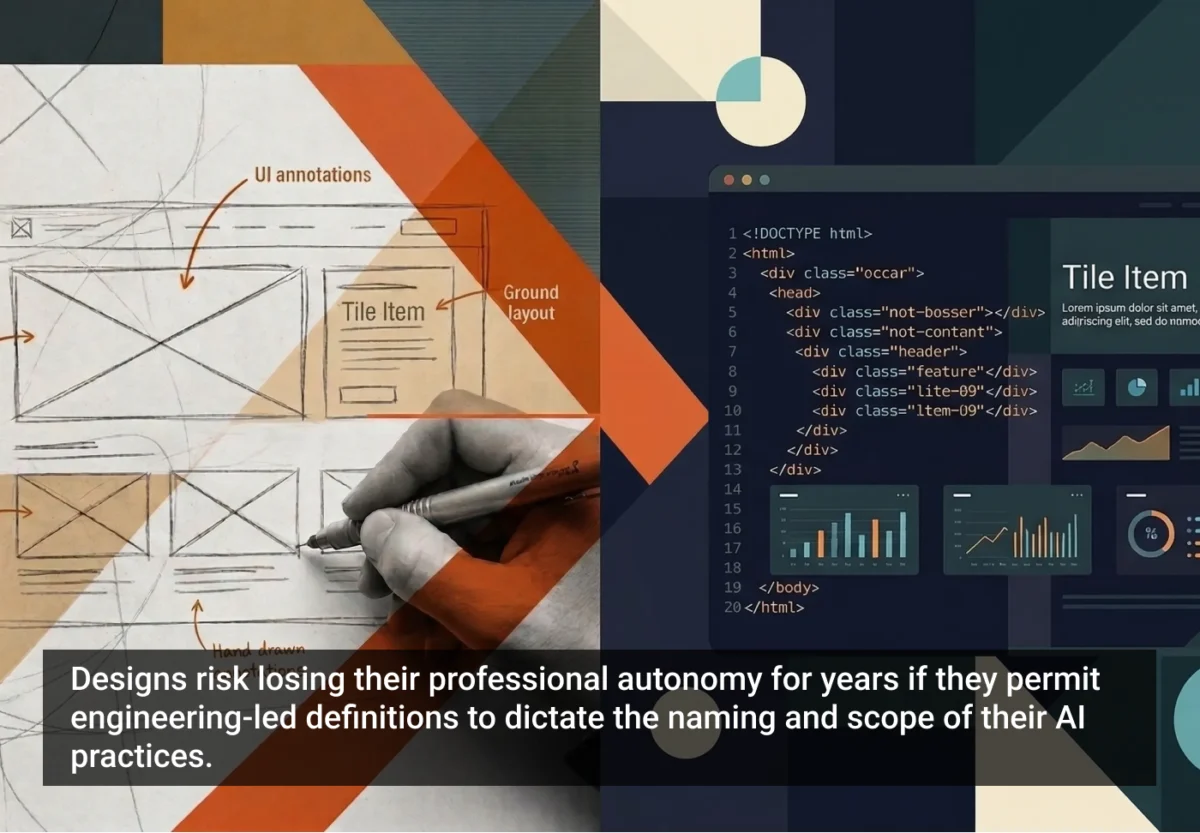
The terminology we use to describe our work is rarely neutral. It acts as a frame, shaping expectations, influencing professional value, and ultimately determining the boundaries of our agency. In the rapidly evolving landscape of AI-assisted design, a peculiar term has gained traction: "vibe coding." While initially intended to describe a specific, low-accountability approach to generation, the term has begun to colonize the broader design profession.
Designers who allow their practice to be categorized under this label risk surrendering their authorship. To be a "vibe coder" is to be a passenger in one’s own workflow—describing an intent loosely, accepting a model’s output, and eschewing the rigorous accountability that defines true design leadership. This article explores the growing rift between passive generative behavior and what is now emerging as "directed generation"—a high-fidelity, judgment-first approach to AI integration.
The Genesis of a Misnomer: Chronology of a Semantic Drift
The term "vibe coding" was popularized in early 2025, most notably by technologist Andrej Karpathy. In its original context, it was a precise, if somewhat irreverent, description of a specific software engineering behavior: prompting a model with a vague sense of direction and accepting the output without deep interrogation of the underlying logic. It described a low-accountability loop.
However, language is migratory. As the term seeped into the design community, it began to be applied to professional workflows that are fundamentally different from "vibe coding." Designers who are using AI to iterate on complex visual hierarchies, refine systemic constraints, and push the boundaries of design patterns are finding their work unfairly labeled with a term that implies lack of rigor.
This semantic drift is dangerous. As George Orwell once famously noted, the slovenliness of language makes it easier to have foolish thoughts. When an imprecise, engineering-centric term colonizes design, it doesn’t just misdescribe the work; it pre-shapes how the work is understood by stakeholders, hiring managers, and even the designers themselves. By failing to push back against this label, the design community is allowing external, often engineering-biased, perspectives to define the value and role of human intent in the creative process.
The Anatomy of the Divide: Judgment Over Generation
The current tension in the design industry is not about who has adopted AI—most practitioners have done so, at least nominally. The real divide lies in where the authority resides during the design process.
The Passive Model (Prompt-Accept-Ship)
In the passive model, generation drives decision-making. The designer provides a prompt, accepts the output, makes minor adjustments, and ships. The machine leads; the human supervises. This is the realm of "vibe coding," and while it has its place in rapid prototyping or brainstorming, it is not a sufficient methodology for high-stakes, systematic design work.
The Intentional Model (Directed Generation)
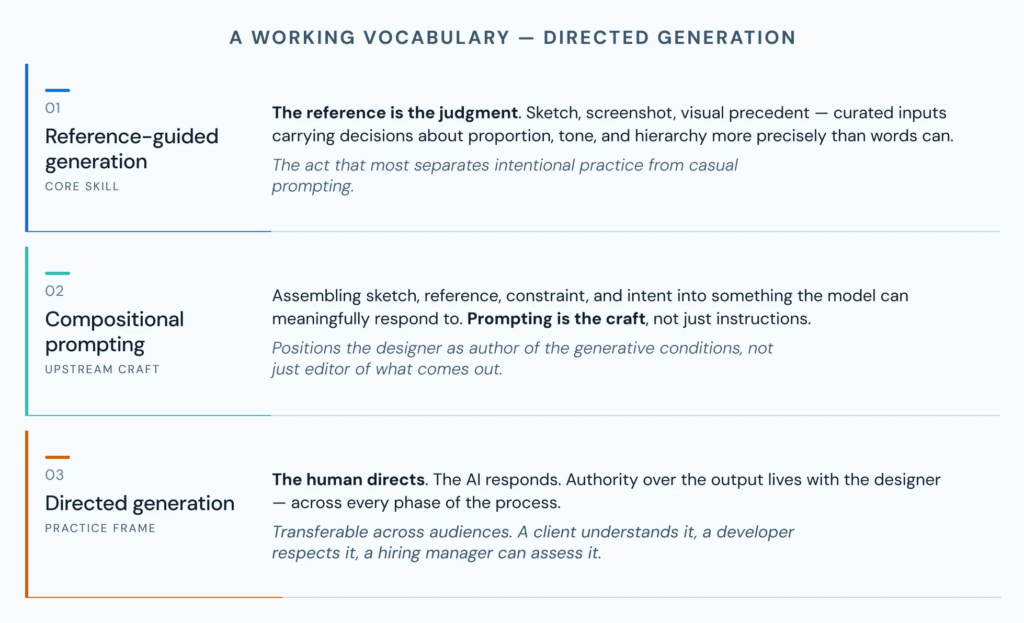
In the intentional model, judgment arrives first. The AI is treated as a high-fidelity tool that responds to the designer’s curated input. This approach utilizes "references"—sketches, visual precedents, or screenshots—that embody complex decisions about tone, proportion, and hierarchy.
These references serve as a form of "visual intent" that carries more precision than a paragraph of natural language ever could. The designer defines the conditions, and the AI works within the constraints provided. This is not passive; it is a rigorous, iterative dialogue where the designer’s judgment is the gatekeeper of every output.
Supporting Data: From Static Components to Non-Deterministic Systems
The transition from "pixel-pushing" to "pattern-defining" is the hallmark of this new design era. In traditional, deterministic design, patterns are treated as fixed artifacts. Consistency is achieved through replication, and flexibility is often sacrificed at the altar of rigid documentation.
Directed generation, however, shifts the paradigm. When a machine understands a design pattern abstractly enough to recompose it contextually, the pattern behaves less like a static component and more like a set of fluid relationships—spatial, typographic, and behavioral.
The Shift in Design Systems
- Traditional Methodology: Focuses on documentation, fixed components, and predictable handoffs. The goal is replication.
- Directed Generation: Focuses on the "grammar" of a system. The designer defines the conditions under which good instances emerge. The output is non-deterministic, meaning the system can generate coherent, on-brand designs across surfaces it has never encountered before.
This shift moves the designer’s craft upstream. The value is no longer in the manual creation of every instance, but in the quality of the primitives, the precision of the references, and the rigor of the constraints set by the designer. We are moving toward "agentic delivery"—systems that don’t just respond to prompts but carry forward the authoring intent of the designer with autonomy and fluency.
Official Responses and Industry Perspectives
Leading voices in the Design Systems Collective and other industry forums have begun to argue that the current vocabulary is insufficient for the sophistication of modern AI-assisted work. The prevailing view is that if designers do not define their own terminology, the market will define it for them—likely through the lens of efficiency and cost-cutting, rather than quality and intent.
Industry experts suggest that "Directed Generation" or "Reference-Guided Practice" are far more accurate descriptors for professional-grade AI work. These terms acknowledge the human-in-the-loop requirement and emphasize that the AI is a collaborator, not an author.
When asked why this distinction matters, practitioners emphasize the professional stakes. In a portfolio review or a client kickoff, the language a designer uses to describe their workflow directly influences their perceived value. If a designer presents their process as "vibe coding," they are signaling that they are a manager of AI outputs. If they present it as "directed generation," they are signaling that they are a director of design systems—a far more defensible and higher-value position.
Implications: The Professional Cost of Misnaming
The stakes of this debate extend far beyond semantics. History has shown that when a new discipline emerges, the practitioners who name their own work—who define the "what," the "why," and the "how"—set the trajectory for how the entire field is valued for a generation.
1. The Portfolio Review
When a junior designer or a veteran lead describes their work to a client or stakeholder, they are setting the terms of the engagement. Precise, confident language ("I used directed generation to ensure the design system scaled across mobile and web interfaces while maintaining strict typographic constraints") commands a higher rate than "I used AI to generate some vibes."
2. The Mentorship Gap
For the next generation of designers, the current nomenclature is a model for their own careers. If the industry teaches them that AI-assisted design is a passive act, we will lose the next generation of craft-focused, rigorous designers. We must teach them that AI is a tool for amplifying intent, not replacing it.
3. The Future of the Design System
The hybrid approach is the most realistic path forward. Production-ready components will always require deterministic precision, but the "exploratory" and "systemic" phases of design will increasingly benefit from non-deterministic, directed generation. Mature design practices must learn to navigate both, recognizing that different phases carry different risk tolerances.
Conclusion: Toward a New Vocabulary
The time has come to retire the "vibe coding" label for professional work. While it may accurately describe a low-accountability, casual mode of interaction, it is a poor descriptor for the rigorous, intentional practice of design leadership.
We propose a shift toward language that reflects the reality of the work:
- Directed Generation: The process of providing high-fidelity references to guide AI output.
- Compositional Prompting: The art of structuring inputs to ensure the AI adheres to complex design constraints.
- Reference-Guided Practice: An approach where visual intent serves as the primary driver for machine generation.
Ultimately, the goal is not to win a naming contest. The goal is to develop language that is precise enough to think with and robust enough to communicate the value of the designer’s role in an AI-augmented world. Designers who take ownership of their practice—and the language that describes it—will be the ones who lead the next era of creative work. Those who accept the shorthand of others will find their own agency diminished, their work misunderstood, and their professional value eroded. The definition of design is changing; it is time we defined it ourselves.
 Ammar Sabilarrohman
  Neng Nana
  Sagoh
Sagoh 