
 By Asro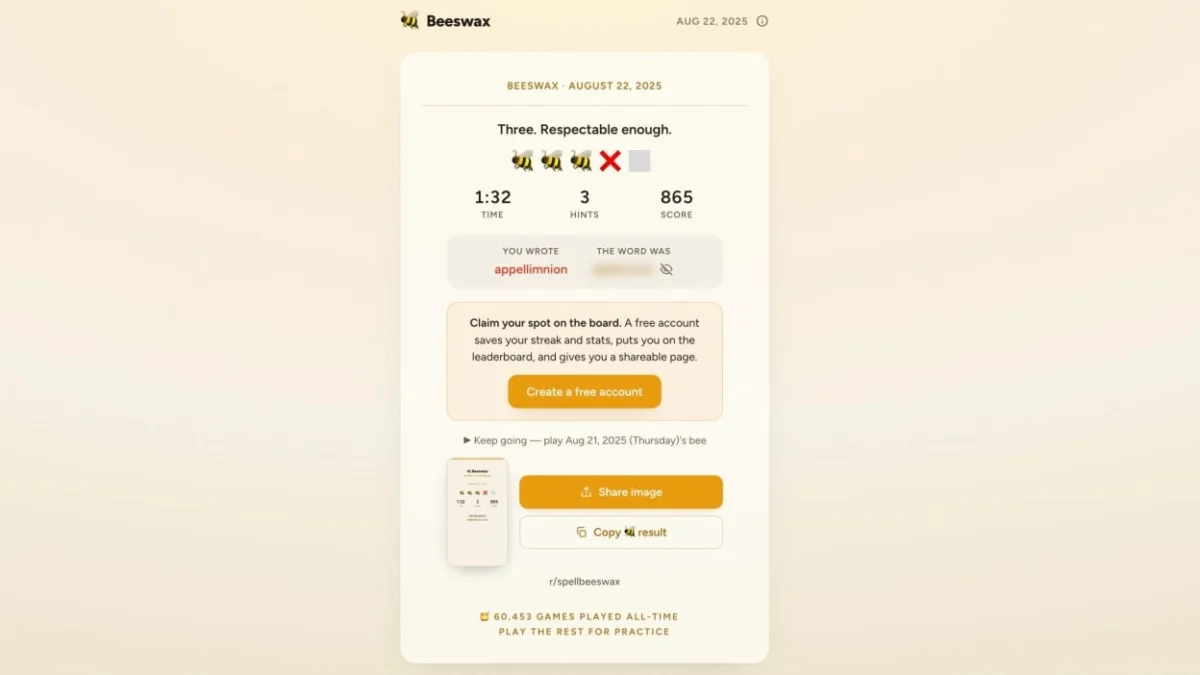
By Beth Skwarecki
Senior Health Editor
July 9, 2026
The landscape of the daily digital puzzle has evolved significantly since the meteoric rise of Wordle in 2022. While millions of players continue to start their mornings with five-letter guessing games, a new contender has emerged that shifts the focus from logic-based elimination to the refined art of orthography. Meet Beeswax, a browser-based game that brings the high-stakes intensity of a competitive spelling bee directly to your desktop or mobile device.
For those who find standard word games to be losing their luster, Beeswax offers a refreshing, albeit significantly more challenging, alternative. It is not merely a game of identifying letters; it is an auditory experience that demands precision, vocabulary mastery, and a deep appreciation for the etymological roots of the English language.
The Core Concept: A Digital Spelling Bee
To understand Beeswax, one must first distinguish it from the popular New York Times Spelling Bee. While the latter is a visual game of forming words from a cluster of letters, Beeswax is a literal recreation of the classic American spelling bee.
In this format, the player is presented with a button to trigger an audio file. A voice speaks a word, and the player is tasked with typing the correct spelling into an input field. There is no second guessing; there is no grid to help you narrow down the vowels. You have one attempt per word. If you spell it incorrectly, your game concludes for the day.
The game challenges you to correctly spell five words in total. This structure provides a concise, high-intensity experience that rewards those who have spent a lifetime reading and internalizing the complex, often counterintuitive rules of English spelling.
Chronology: From Classroom Tradition to Viral Browser Game
The history of the spelling bee in American culture dates back to the 18th century, but its digital transition has been surprisingly sparse. While we have seen an explosion in "daily" games—from Worldle to Heardle and various crossword variants—the actual act of spelling aloud has remained largely confined to academic settings or televised national competitions.
- Early 2026: Development began on Beeswax, with the goal of creating a "pure" spelling experience that eliminates visual crutches.
- Spring 2026: Beta testing began among niche word-game communities, where it gained traction for its punishing difficulty and "one-mistake-and-you’re-out" mechanic.
- July 2026: The game achieved wider public release, establishing a permanent archive that allows players to test their skills against historical daily challenges without needing to create an account.
The transition from a niche project to a recognized daily habit for word enthusiasts reflects a broader trend in gaming: the appetite for "short-form cognitive workouts." Like a morning run for the brain, Beeswax requires a specific type of mental focus that differs from the pattern recognition used in Wordle.
Supporting Data and Gameplay Mechanics
The gameplay mechanics of Beeswax are deceptively simple, yet the execution is bolstered by robust features that mimic professional competition environments.
The Role of Hints
Unlike competitive spelling bees where contestants are essentially on their own, Beeswax offers "lifelines" in the form of hints. Importantly, these hints do not dictate the outcome of the game, but they are tracked. When a player shares their final score on social media, the number of hints used is recorded—a feature that serves as a badge of honor for those who achieve a "perfect" score without assistance.

The hints provided are consistent with those allowed in official bees:
- Definitions: Essential for distinguishing homophones.
- Sentence Context: Provides the word used in a proper grammatical structure.
- Part of Speech: Clarifies whether a word is a noun, verb, or adjective, which often dictates spelling patterns.
- Language of Origin: Often considered the "pro-level" hint, this provides context on the linguistic roots of the word.
The Two-Minute Constraint
Each word is accompanied by a two-minute timer. This constraint serves a dual purpose: it maintains the momentum of the game and prevents the player from over-analyzing beyond the point of reason. Paradoxically, this timer serves as a natural deterrent against cheating. If a player spends two minutes frantically searching for a word in a dictionary, they lose the spirit of the game, rendering the "win" meaningless.
Linguistic Strategy: How to Master the Bee
Success in Beeswax is not found in a specific "cheat sheet," but rather in long-term linguistic development. For those looking to improve, the strategy is twofold:
1. The Etymological Approach
As the 2017 National Spelling Bee winner noted in discussions with Lifehacker, understanding the root of a word is the ultimate key to success. English is a "mongrel" language, borrowing heavily from Greek, Latin, French, German, and Arabic. By learning the rules of these source languages—such as the way French loanwords often retain specific vowel combinations or how Greek roots dictate "ph" versus "f"—players can make educated, accurate guesses even when encountering a word for the first time.
2. The "Read More" Mandate
There is no substitute for exposure. The more an individual reads high-level literature, the more they subconsciously absorb the "shape" of words. When you see a word frequently, you are less likely to stumble over double consonants or silent letters. Beeswax essentially tests the cumulative knowledge of your reading history.
Implications for Digital Gaming Culture
The success of Beeswax highlights a shift in user preferences regarding digital entertainment. In an era dominated by high-octane, dopamine-inducing games, there is a growing segment of the population that finds satisfaction in "slow games."
- The Archive Model: By keeping the entire archive available to non-registered users, the developers have prioritized accessibility over data mining. This builds immense goodwill within the gaming community.
- The Social Currency of Difficulty: In the age of social media, the "shareable result" is a key component of game growth. By making hint usage visible, the game creates a hierarchy of skill that encourages players to return and try to improve their performance without external aid.
- Educational Value: While primarily entertainment, Beeswax serves as a stealth educational tool. Players are actively incentivized to look up words they miss, thereby expanding their vocabulary and historical linguistic knowledge.
Conclusion: Is It Worth Your Time?
If you are someone who enjoys the morning ritual of a puzzle, Beeswax is a challenging, rewarding addition to your routine. It forces you to confront the limits of your own literacy in a way that feels both fair and exhilarating.
While the "game over" screen can be frustrating—especially when you realize you’ve been misspelling a common word for years—it is also a moment of genuine learning. By keeping the correct spelling hidden behind a spoiler tag, the game respects the user’s intelligence, allowing for a moment of reflection before revealing the answer.
Whether you are a seasoned spelling bee champion or someone who simply enjoys the structure of a daily challenge, Beeswax offers a sophisticated, minimalist experience that celebrates the English language in all its complex, irregular, and beautiful glory. You don’t need an account to start, and you don’t need a strategy guide to play—you just need to listen, think, and spell.
 Layla Zulfa
  Reynand Wu