
 By Ammar Sabilarrohman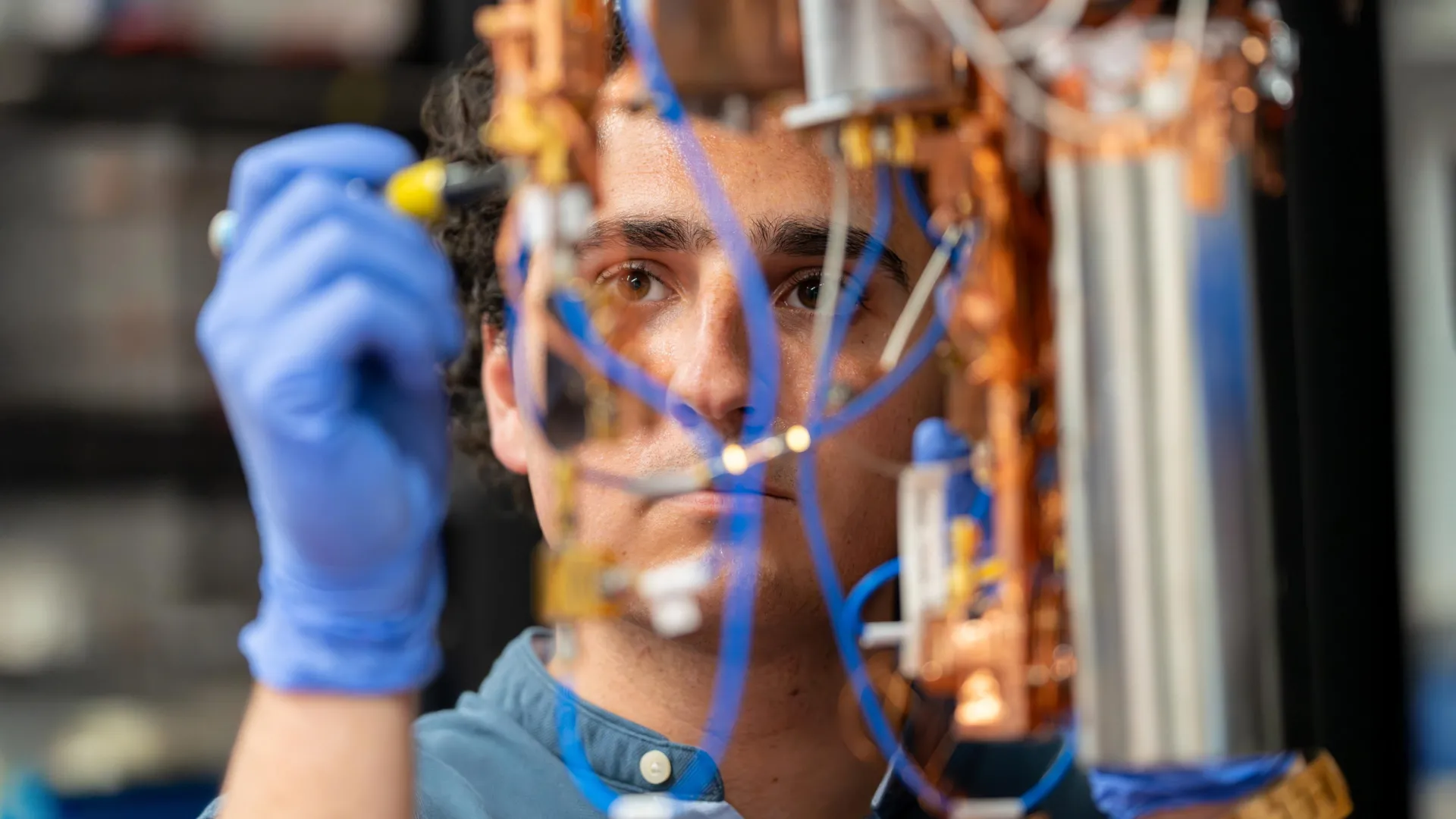
The race to build a functional, scalable quantum computer has long been hindered by a fundamental architectural challenge: how to connect widely separated quantum processing modules without losing the fragile state of entanglement that defines quantum information. Traditionally, this process has required active, high-precision control and the repeated measurement of individual photons—a hit-or-miss approach that is as computationally expensive as it is technically difficult.
However, a breakthrough from the Institute of Science and Technology Austria (ISTA) has fundamentally altered the landscape. Physicists led by Professor Johannes Fink and PhD student Alejandro Andrés-Juanes have demonstrated a fully autonomous method for entangling distant qubits using a "quantum bath" of correlated light. Published in Physical Review X, this experimental milestone validates a theoretical prediction that has remained dormant for over two decades, potentially laying the foundation for a new, self-stabilizing architecture for quantum networks.
The Core Challenge: Synchronization at a Distance
To understand the significance of the ISTA team’s work, one must first grasp the ephemeral nature of entanglement. Quantum entanglement is a phenomenon wherein particles share correlations that defy classical logic; a change in the state of one particle instantaneously influences its entangled partner, regardless of distance.
In the realm of quantum computing, entanglement is the "glue" that allows qubits to perform complex calculations in parallel. However, maintaining this connection between physically separated qubits is notoriously difficult. Historically, researchers have relied on two primary strategies:
- Direct Transmission: Sending a single, actively controlled photon from one qubit to another.
- Post-Selection Synchronization: Having each qubit emit a photon, then attempting to "match" them to generate entanglement.
The latter method, while sophisticated enough to contribute to the research recognized by the 2022 Nobel Prize in Physics, is inherently limited. It relies on repeated measurements and post-selection—a process that is not always successful. Because these methods require active intervention and high-speed feedback loops, they introduce "noise" and overhead, making them difficult to scale in a practical quantum processor.
A Chronology of Discovery: From Theory to Laboratory
The road to the ISTA experiment began over 20 years ago, when theoretical physicists first proposed that a "bath" of correlated particles could serve as an environmental stabilizer for distant quantum systems. Yet, for two decades, the concept remained purely academic. The conditions required to create such a bath were idealized, making them seemingly impossible to reproduce in a real-world laboratory setting.
The Path to Implementation
- Early 2000s: Theoretical foundations are laid for using correlated light to entangle remote quantum systems.
- Mid-2010s: The Fink Group at ISTA begins investigating the intersection of microwave photonics and superconducting qubits.
- 2021-2023: Alejandro Andrés-Juanes and Professor Johannes Fink begin the development of their prototype, focusing on overcoming the "mismatch" between continuous-variable entanglement (easily produced) and discrete-variable entanglement (needed for computing).
- 2024: The team successfully demonstrates the first fully autonomous, stabilized entanglement between two distant qubits using a shared microwave-photon bath.
The difficulty in reaching this point, according to Professor Fink, lay in the sheer sensitivity of the quantum environment. "Our experiments helped us reveal several factors that may have prevented scientists from designing a functional quantum bath using a single source of correlated photons," he noted. By accounting for the non-idealized realities of the lab—such as signal decay and environmental interference—the team successfully bridged the gap between theory and practice.
Technical Innovation: The Quantum Bath
The genius of the ISTA approach lies in its passive, autonomous nature. Instead of forcing qubits to entangle through human-directed control signals, the researchers created an environment—a "quantum bath"—that does the work for them.
Bridging Continuous and Discrete Variables
Quantum entanglement manifests in two primary flavors: continuous-variable (akin to the momentum and position of a pendulum) and discrete-variable (the "all-or-nothing" state required for logic gates). While continuous-variable states are relatively easy to generate, they are not directly useful for most quantum computing algorithms.
The ISTA team designed a system that uses a stream of correlated microwave photons to bridge this gap. "In our method, the quantum bath—the qubits’ environment—is the source of entanglement," explains Fink. "It creates a new ground state through a continuous stream of correlated photons. This way, the entangled qubit state is stabilized, even beyond the qubits’ own lifetime."
Because this state is continuously supported by the bath, it remains available as a resource for processing at any moment. This contrasts sharply with previous methods, where entanglement was a fleeting, temporary condition that required immediate utilization before the coherence collapsed.
Utilizing Microwave Photons
The choice of microwave photons was strategic. These low-energy particles are the workhorses of current superconducting-qubit technology. They are highly efficient at manipulating quantum information within the cryogenic environments required for quantum processors. While optical photons are better suited for long-distance communication (e.g., through fiber optics), the ISTA team’s mastery of microwave coupling provides a robust internal mechanism for modular quantum computers.
Supporting Data: Validating the Hidden State
To confirm that the qubits were indeed synchronized, the team employed quantum tomography. Since measuring a qubit forces it to collapse into a classical state (0 or 1), the researchers had to be clever. They used tomography to examine many different "slices" of the system’s behavior over extremely short intervals—specifically 20 to 80 nanoseconds.
By analyzing these rapid, high-resolution snapshots, the researchers were able to reconstruct the underlying quantum state without permanently destroying the entanglement they were trying to prove. The data confirmed that the qubits were not merely interacting, but were maintained in a stabilized entangled state, effectively proving that the "bath" was performing its intended function.
Implications for the Future of Quantum Computing
While the ISTA team admits that their method currently captures only about 10% of the bath’s available entanglement, the implications of this proof-of-concept are profound.
Moving Toward Fault-Tolerance
The most significant hurdle in quantum computing is error correction. Fault-tolerant operation requires systems that can maintain stability over long periods. By shifting the responsibility of entanglement from active control (which is error-prone) to an autonomous environment (the quantum bath), the ISTA team has provided a blueprint for more resilient architectures.
Scalability and Modular Networks
The ability to synchronize multiple distant qubits without active, per-module measurement suggests a path toward modular quantum processors. In this vision, instead of one massive, monolithic computer, we could have several smaller, specialized modules linked by these autonomous quantum baths. This would reduce the "cross-talk" and noise that currently plague larger superconducting systems.
Beyond the Lab
Looking ahead, the Fink Group is already exploring how these microwave-based systems might interface with optical photons. If the team can successfully bridge the "microwave-to-optical" transition, they could potentially link these autonomous modules over long distances via fiber-optic networks, effectively creating a distributed quantum internet.
"We present a relatively simple method that could be scaled up to synchronize multiple distant qubits," says Andrés-Juanes. While the technology is in its infancy, the transition from a 20-year-old theoretical prediction to a working laboratory prototype marks a critical turning point. The "quantum bath" is no longer just a mathematical curiosity; it is a viable, autonomous pathway toward the next generation of quantum hardware. As the field moves toward fault-tolerant operation, the ability to let nature, rather than manual intervention, handle the delicate task of entanglement may well prove to be the most practical solution yet.
 Sagoh
Sagoh  Asro
Asro  Siti Muinah