
 By Reynand Wu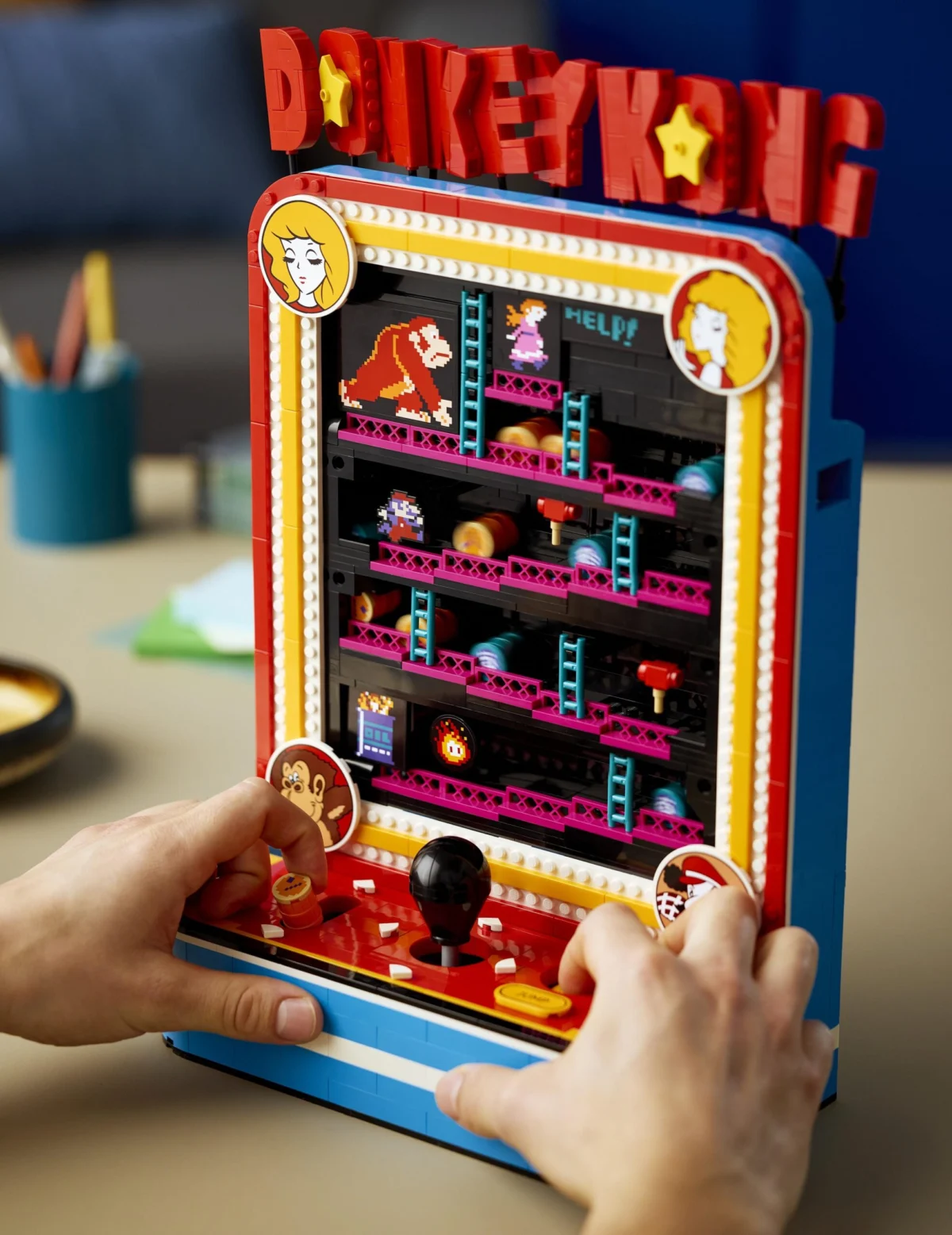
For fans of classic gaming and plastic brick construction, the intersection of LEGO and Nintendo has become a playground of high-end, nostalgia-driven design. The latest offering from the partnership—a meticulously engineered recreation of the original Donkey Kong arcade cabinet—promises to be more than just a display piece. It is a kinetic masterpiece, a testament to the dedication of designer Carl Merriam, and a love letter to the 8-bit era.
Merriam, a veteran LEGO designer, has built a reputation for crafting sets that capture the specific tactile joy of childhood favorites. His portfolio includes the stunning LEGO Nintendo Game Boy, the intricate Piranha Plant, and key contributions to monumental builds like the Lion Knights’ Castle and the beloved Pirates of Barracuda Bay. With the Donkey Kong arcade set, Merriam has moved from static display to mechanical marvel, creating a build that has reportedly earned the seal of approval from Nintendo legend Shigeru Miyamoto himself.
The Genesis of an Icon: Chronology of the Project
The journey to bring the 1981 arcade sensation to the LEGO world was not an overnight success. It began with the challenge of translating a digital, high-intensity platforming experience into a physical, gravity-fed mechanism.
For decades, the Donkey Kong arcade cabinet has occupied a hallowed space in pop culture. It was the game that introduced the world to "Jumpman"—later known as Mario—and the villainous ape who would eventually become a Nintendo icon in his own right. When the team at LEGO began conceptualizing the set, the primary goal was to capture the "feel" of the game rather than a direct, digital recreation.
Throughout the development process, Merriam and his team underwent dozens of iterations. The early prototypes focused on the arcade cabinet’s iconic silhouette, but the internal "gameplay" mechanism proved to be the project’s greatest hurdle. Over several months, the team refined the barrel-rolling physics, the lever-actuated character movement, and the integration of the classic, yet updated, Jumpman minifigure. By the time the final design was locked in, it had undergone rigorous testing—not just for structural integrity, but for the "fun factor" that defines the best LEGO Icons sets.

Engineering the Impossible: Mechanical Complexity
The set operates as a "pump" system. Despite the limitations of plastic bricks, Merriam succeeded in creating an infinite loop of gameplay. The mechanism relies on a vertical stack of 14 barrels lining the side of the model. When a user pulls the lever, a barrel is fed into the track, while another is released at the top.
"The system holds 20 barrels in total," Merriam explains. "This allows for up to six barrels to be in motion down the tracks simultaneously, perfectly mimicking the intensity of the original arcade screen."
The most impressive aspect of the build is its reliance on historical components. The barrels themselves are identical to those released in the 1989 LEGO pirate sets. The challenge was never the barrels themselves, but the track physics. Merriam spent weeks testing different slopes, studs, and beams to ensure the barrels moved at a consistent, challenging speed without jamming. He jokingly admits that he "rolled thousands of barrels down those tracks" until the friction was perfectly calibrated.
Supporting Data and Design Specifications
The Donkey Kong arcade set is a triumph of technical ingenuity. Its key features include:
- The Barrel Loop: A continuous, gravity-fed system that collects barrels at the bottom and recirculates them through the internal pump mechanism.
- Dynamic Movement: The joystick operates via a long, internal lever connected to a "dingler" mechanism, allowing the user to shift Jumpman left and right.
- Piano-Key Jumping: The jump button functions similarly to a piano key; pressing it triggers a see-saw lever that lifts the Jumpman rod, while gravity provides the return stroke.
- The "Poison" Barrels: In a nod to specific feedback from Nintendo, the "poison" barrels are weighted differently than the standard ones by housing LEGO minifigure heads inside, providing a distinct tactile difference.
- Interactivity: The Jumpman character is fully detachable, allowing for modular play, and the cabinet features sliding doors to clear any potential, though rare, barrel jams.
The set will be available for purchase starting August 1st, with a retail price point of £149.99 or €169.99. While North American pricing is pending, the global release is expected to mirror the premium status of other "Adults Welcome" LEGO Icons sets.

Official Perspectives: The Miyamoto Factor
The relationship between LEGO and Nintendo has grown significantly since their first collaborative sets. However, the involvement of Shigeru Miyamoto, the creative force behind Mario and Donkey Kong, adds a layer of prestige to this release.
When asked about Miyamoto’s involvement, Merriam was humble. "I haven’t met Miyamoto-san personally yet," he noted. "However, I did hear that he is very happy with the execution of this set." This endorsement is particularly telling, as Nintendo is famously protective of its intellectual property. The fact that the design team was able to address specific, granular requests—such as the weighting of the barrels—indicates a high level of trust and collaboration between the two companies.
The set also acknowledges the evolution of gaming history. While the original game featured a damsel in distress, the modern LEGO set exists in a world where Pauline has evolved into a character with significant agency and a major role in the broader Nintendo universe, a shift that the designers kept in mind while crafting the overall narrative of the set.
Implications for the Future of LEGO Gaming
The release of the Donkey Kong arcade set signals a shift in how LEGO approaches licensed properties. We are moving away from simple static display models and toward "functional kinetic art." This set, like the previously released $230 pinball machine, proves that LEGO can successfully bridge the gap between retro-tech and modern construction toys.
This trend has major implications for the market:

- Increased Complexity: As the target demographic for LEGO shifts toward adult collectors, we can expect more sets that require mechanical engineering rather than just aesthetic building.
- Cross-Generational Appeal: By tapping into the 8-bit arcade aesthetic, LEGO is effectively bridging the gap between parents who grew up with the arcade cabinet and children who know the characters through the Super Mario movies and modern Nintendo Switch titles.
- The "Infinite Play" Value: The move toward functional loops—like the infinite barrel run—increases the replayability of these sets. They are no longer just "build once and put on a shelf" items; they are desk toys that provide genuine tactile engagement.
As we look toward the future, the success of the Donkey Kong set likely sets the stage for further explorations into gaming history. If a simple, 8-bit platformer can be transformed into such a complex, satisfying machine, the potential for other arcade classics—like Pac-Man, Galaga, or Space Invaders—becomes a tantalizing possibility for the LEGO design team.
For now, Carl Merriam’s work stands as a high-water mark for the collaboration. It is a set that demands patience in its construction and rewards the builder with a mechanical performance that feels like magic. As Merriam put it, the process of finding the right mechanism was a struggle, but the final result is, by definition, "barrels of fun." Whether you are a lifelong Nintendo fan or a dedicated AFOL (Adult Fan of LEGO), this set offers a unique opportunity to own a piece of gaming history that, for once, you can actually play with.
 Raul Delapena Setiawan
  Siti Muinah
  Asro
Asro 