
 By Reynand Wu
The global economy is currently navigating its most significant technological transition since the advent of the internet. As Artificial Intelligence (AI) moves from experimental labs to the center of professional and personal productivity, the question is no longer whether AI will transform the world, but rather how it is reshaping the fundamental mechanics of labor, commerce, and daily life. To answer this, Google has officially launched the AI & Economy ATLAS (Activity, Task, Landscape, and Adoption Study), a landmark effort to quantify and analyze the human-AI interaction at an unprecedented scale.
The Core Mission: Why We Need an AI "Map"
The potential for AI to act as an engine for economic growth is widely accepted, yet the granular reality of its deployment remains largely obscured. For policymakers, economists, and business leaders, the transition is not "automatic or guaranteed." Success depends on empirical, evidence-based insights.
Google’s ATLAS project aims to fill this data void. By analyzing 15 million aggregated and de-identified human-AI interactions across its ecosystem—including the Gemini App, AI Mode, and the Gemini API—the company is providing the first comprehensive, large-scale look at how over one billion monthly users are actually leveraging these tools. The scope of the study is immense, spanning 150 countries, 140 languages, 800 distinct occupations, and 4,000 unique tasks.
Chronology: From Concept to Data-Driven Reality
The journey toward ATLAS began with the recognition that traditional economic indicators—such as GDP growth or unemployment rates—were too sluggish to capture the rapid, daily evolution of generative AI.
- The Foundation (Pre-2024): Google’s Chief Economist’s Office and the Technology & Society team identified a critical gap: the lack of a real-time, high-fidelity data source on AI utility.
- The Development Phase: Using Google DeepMind’s Observation Clustering and Taxonomy Organisation (OCTO), engineers developed a system to distill massive amounts of unstructured, conversational text data into actionable, categorized economic insights.
- Privacy-First Engineering: Because the data involves user interactions, Google implemented a rigorous, multi-layered privacy architecture. This includes scrubbing all personally identifiable information (PII), removing linkages between specific users and the summarized data, and grouping interactions into aggregated cohorts to ensure total anonymity.
- The Launch (Mid-2026): The publication of ATLAS v1.0 marks the transition from internal pilot to public research, providing a baseline for future longitudinal studies.
The Landscape: Insights from ATLAS v1.0
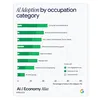
The initial findings from the ATLAS dataset offer a nuanced perspective on the "AI-augmented worker." Rather than a monolithic replacement of jobs, the data suggests a shift in task composition.
1. Shifts in Task Distribution
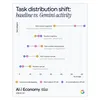
One of the most profound observations is how AI is altering the baseline of professional tasks. When users engage with Gemini, the nature of their work shifts. Tasks that are cognitively heavy, such as data synthesis, drafting, and complex problem-solving, are increasingly delegated to AI, allowing humans to focus on higher-level strategic output.
2. Global Adoption Patterns
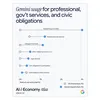
The data reveals a starkly global trend. Usage patterns are categorized by per-capita adoption, showing that while professional use is high in established tech-forward economies, there is significant "hidden" adoption in government and civic-facing tasks. Users are increasingly turning to AI to navigate bureaucratic systems, interpret complex regulations, and facilitate communication with civic institutions.
3. Non-Work Utility
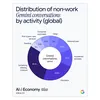
The study highlights that AI is not solely a professional tool. A significant portion of the traffic is dedicated to personal organization, educational support, and creative tasks. This "democratization of intelligence" suggests that the economic impact of AI will be felt as much in the household as it is in the boardroom.
Official Perspectives: The Experts Weigh In
The ATLAS report is not merely a corporate document; it has been shaped by some of the world’s leading economic minds. The project acknowledges the intellectual contributions of Dame Diane Coyle (University of Cambridge) and Dr. David Autor (MIT), both of whom have focused their careers on the intersection of technology and labor.
According to Google’s project leads, Zanna Iscenko and Scott Strand, the goal is to create a "living document." They emphasize that the current v1.0 report is just the starting point. By working in collaboration with academic institutions, Google intends to refine the taxonomy of AI tasks continuously, ensuring that as models become more "agentic"—capable of executing sequences of actions rather than just generating text—the ATLAS study will remain relevant.
The Broader Implications for the Global Economy
The release of ATLAS has profound implications for how we prepare for the future of work.
Policymaking and Regulation
Governments have long struggled to regulate a technology that is evolving faster than the legislative process. By providing empirical data on how AI is used in civic and governmental services, ATLAS allows policymakers to see exactly where the bottlenecks and opportunities lie. This could lead to more targeted digital literacy programs and infrastructure investment.
The Evolution of the Enterprise
For businesses, the ATLAS findings suggest that the competitive advantage will no longer reside in "adopting AI" in the abstract, but in optimizing the specific tasks that lead to human-AI synergy. Companies that understand how their specific industry segments are using AI can better pivot their talent management and training strategies.
Addressing the "Skills Gap"
The data points to a potential realignment of the labor market. As routine cognitive tasks are offloaded to AI, the premium on human soft skills—empathy, complex judgment, and ethical oversight—is likely to rise. ATLAS provides a window into this transition, helping educators and training providers understand which skills are becoming redundant and which are becoming essential.
Limitations and the Road Ahead
Google is transparent about what ATLAS does not cover. The v1.0 report is focused primarily on direct user interactions with Gemini and associated APIs. It does not yet capture the massive impact of AI embedded in enterprise platforms like Google Workspace, Google Translate, or the broader "world models" currently being pioneered in robotics and agentic coding.
Furthermore, the "AI Economy" is a moving target. As models transition from chatbots to active agents that can navigate software environments, the definition of a "task" will evolve. Google’s commitment to expanding the ATLAS scope suggests that future versions will likely integrate more complex data streams, eventually offering a comprehensive dashboard of the digital economy.
Conclusion: A Collaborative Effort
The AI & Economy ATLAS represents a shift in corporate responsibility. By opening its data—de-identified and structured—to the public, Google is inviting the global research community to help interpret the most significant economic shift of the century.
As we move forward, the success of the AI revolution will not be measured by the sophistication of the models themselves, but by the tangible, positive impact they have on human life. By providing a clear, empirical, and evolving map of this landscape, ATLAS serves as a vital tool for those tasked with guiding that transition. Whether you are a policymaker drafting new regulations, a business leader planning for the next decade, or a worker looking to upskill, the ATLAS project offers the evidence necessary to move from speculation to strategic action.
For those interested in diving deeper into the methodology or tracking future updates, the full ATLAS v1.0 report is available via the Google AI & Economy Research Program portal. As the project continues to scale, it promises to be the definitive lens through which we view the ongoing transformation of the global workforce.
 rifanmuazin
  Layla Zulfa
  Evan Lee Salim