
 By Raul Delapena Setiawan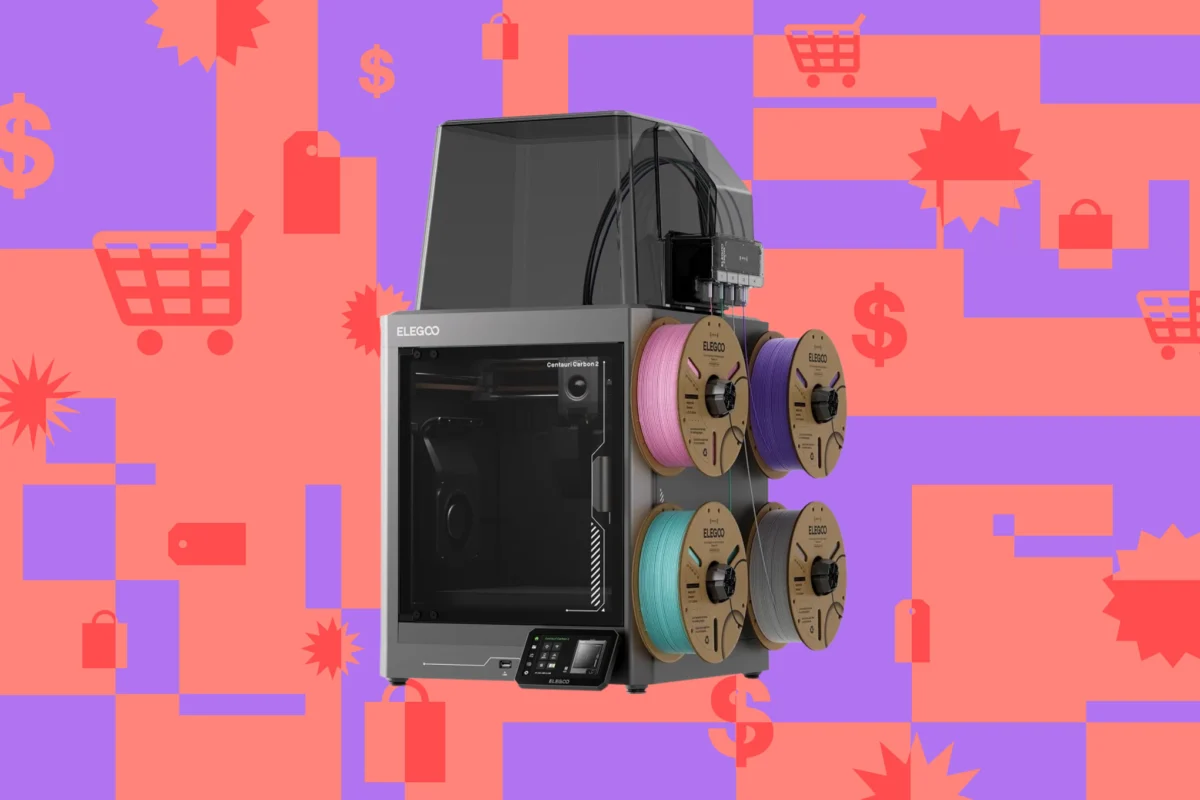
By Brad Bourque
Portland, Oregon
For years, the world of high-end 3D printing has remained an intimidating space for hobbyists and casual makers. Steep price tags, notoriously difficult calibrations, and the painstaking trial-and-error required to produce clean multi-color models have often acted as barriers to entry. However, a significant discount from prominent hardware manufacturer Elegoo aims to shift that narrative.
Elegoo has slashed the price of its feature-packed Centauri Carbon 2 Combo, bringing the cost down to $369—a nearly $100 markdown from its standard $449 retail price. For newcomers hesitant to invest heavily into a niche hobby, or for seasoned makers looking for a reliable machine that requires minimal tinkering, this deal presents one of the most compelling entry points in the current desktop manufacturing market.
Main Facts
The Elegoo Centauri Carbon 2 Combo is designed to bridge the gap between industrial-grade multi-material capabilities and consumer-friendly usability.
- Pricing & Discount: The printer is currently on sale directly through Elegoo’s official sales channels for $369, down from its regular MSRP of $449.
- Multi-Material Handling: The system is engineered to handle up to four separate filament rolls concurrently, enabling multi-color and multi-material prints without manual filament swaps mid-job.
- Enclosed Chamber & Auto-Bed Leveling: Unlike open-frame budget printers, the Centauri Carbon 2 features a fully enclosed printing environment that stabilizes internal temperatures—crucial for warping-prone filaments—alongside an automated bed-leveling system.
- User Interface: Project management, file transfers, and calibrations are streamlined via a large, responsive onboard touchscreen interface.
- Trade-Offs: While the machine is remarkably fast and capable out of the box, the initial assembly involves a slightly involved setup process—particularly regarding the alignment of the upper shield and the external filament hub. Furthermore, the external placement of the filament rolls means users in humid climates must store or manage moisture-sensitive materials carefully.
Chronology: The Evolution of Consumer 3D Printing and the Centauri Line
To understand why the price drop of the Centauri Carbon 2 Combo matters, it helps to examine how the consumer 3D printing market has evolved over the past decade.
Phase 1: The Era of Open-Source Tinkering (2010–2018)
In the early days of desktop 3D printing, machines were predominantly open-frame, belt-driven devices shipped in pieces. Users—often referred to as "makers"—spent hours assembling frames, soldering wires, manually leveling print beds with pieces of paper, and flashing firmware. While educational, this steep learning curve isolated mainstream consumers.
Phase 2: The Rise of Plug-and-Play Appliances (2019–2023)
As patents expired and manufacturing efficiencies improved, brands like Elegoo, Creality, and Bambu Lab entered the scene. Elegoo gained a massive following primarily through its high-resolution resin (SLA) 3D printers, eventually expanding heavily into fused deposition modeling (FDM) machines. Printers began arriving 90% pre-assembled, introducing features like auto-bed leveling and magnetic flexible build plates.
Phase 3: The Multi-Color Revolution and Enclosed Ecosystems (2024–Present)
The modern era is defined by speed, enclosure, and multi-color automation. The ability to print with four or more filaments simultaneously—once restricted to expensive, commercial-grade laboratory equipment—began trickling down to consumer desks. The introduction of the original Centauri series established Elegoo as a serious contender in the high-speed enclosed FDM space. The launch of the Centauri Carbon 2 Combo represents the maturation of this technology, shifting the focus from making the printer work to actually making things.
Supporting Data and Technical Overview
The specifications of the Centauri Carbon 2 Combo place it in direct competition with some of the industry’s heavy hitters, yet its promotional price point undercuts many rivals offering equivalent core features.
| Feature / Specification | Elegoo Centauri Carbon 2 Combo Details |
|---|---|
| Regular Price | $449 |
| Current Sale Price | $369 (approx. $80–$100 savings) |
| Filament Capacity | Up to 4 rolls simultaneously |
| Enclosure Type | Fully enclosed build chamber |
| Bed Leveling | Fully automated calibration |
| Control Interface | Large touchscreen panel |
| Target Audience | Beginners, casual makers, and efficiency-focused hobbyists |
Usability and Ergonomics
In practical testing, the printer proves remarkably fast right out of the box. However, first-time setup requires patience. Reviewers and early adopters have noted that aligning the upper shield and securing the filament hub can be finicky during initial unboxing.
Once operational, the fully enclosed build area provides immense utility. Enclosures significantly reduce ambient drafts, which is vital for maintaining consistent layer adhesion when printing advanced engineering filaments like ABS, ASA, or high-speed PLA. The automated bed-leveling mechanism ensures that the first layer—the foundation of any successful print—lays down accurately without requiring manual wrench adjustments.

Environmental Considerations
A notable design choice in the Centauri Carbon 2 Combo is the external storage of its four filament rolls. While this keeps the physical footprint of the printer relatively compact and accessible, it introduces an environmental variable. Thermoplastic filaments (such as PLA, PETG, and nylon) readily absorb moisture from ambient air, leading to print defects, bubbling, and weak layer bonding. For users operating in humid climates who do not print on a daily basis, manufacturers recommend detaching the filament rolls and storing them in dry boxes or vacuum-sealed bags between sessions.
Official Responses and Industry Context
While direct commentary from Elegoo’s executive leadership regarding this specific promotional window remains focused on retail outreach, company communications consistently emphasize a shift toward democratizing high-speed printing.
Industry analysts point out that hardware price compression is a natural result of fierce competition among manufacturers based in Shenzhen and global distribution networks. Brands are increasingly utilizing bundle discounts—such as the "Combo" designation that pairs the core printer with multi-filament management hardware—to lock consumers into cohesive material ecosystems.
"The race to the bottom in 3D printer pricing is largely over; the new race is for value-add integration," notes a consumer hardware analyst based in Seattle. "Consumers no longer just want a printer that moves an extruder back and forth. They want multi-color capabilities, automated safety features, and enclosure safety straight out of the box without paying upwards of six hundred dollars. Elegoo’s pricing strategy with the Centauri Carbon 2 directly pressures competitors to reevaluate their mid-tier margins."
Implications for the Consumer Market
The drop of the Centauri Carbon 2 Combo to $369 carries several downstream implications for hobbyists, educators, and the broader DIY manufacturing landscape:
1. Lowering the Psychological Barrier to Entry
For many prospective hobbyists, spending upwards of $400 to $500 on a device they may only use occasionally is a tough financial pill to swallow. By dipping well below the $400 threshold, Elegoo removes much of the financial risk associated with taking up 3D printing as a new pastime.
2. Streamlining the Maker Experience
Because features like auto-leveling and multi-color handling are baked directly into the hardware and software experience, users spend less time troubleshooting failed prints, recalibrating axes, and tweaking slicing parameters. This shifts 3D printing from a technical engineering hobby closer to an appliance-like experience—akin to a traditional 2D paper printer.
3. Increased Mainstream Adoption of Multi-Color Models
Single-color prints have historically dominated home manufacturing due to the sheer complexity of manual filament changes. Systems that manage four rolls concurrently change the design paradigm, allowing users to print detailed, colorful miniatures, functional household organizers, complex mechanical assemblies, and toys with minimal human intervention.
4. Pressure on Competing Brands
As Elegoo normalizes sub-$400 pricing for fully enclosed, multi-material systems, rival manufacturers will likely be forced to respond with their own seasonal promotions, hardware revisions, or bundled accessory packages. Ultimately, this hyper-competition benefits the consumer, driving innovation forward while making advanced fabrication tools cheaper and more reliable than ever before.
For those looking to take advantage of the sale, the Centauri Carbon 2 Combo is currently available directly through Elegoo’s official online store.
 Nana Wu
  Nana Muazin
  Suro Senen